BEOBACHTUNGSWAGEN
artillery observation vehicles
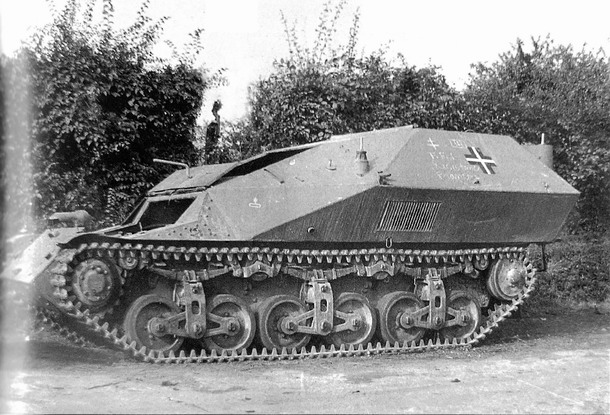
Beobachtungspanzer auf Lorraine Schlepper (f), source: Flickr.com, Public domain, edited
Beobachten is the German word for "to observe," which perfectly captures the purpose of the vehicles that carried this term in their name. These were mobile, armoured observation posts designed to serve the needs of the artillery. Their role was to locate enemy positions, relay their coordinates to friendly artillery units, and then assist in adjusting fire onto the target.
The Germans built observation vehicles on the chassis of their own tanks, but also on a variety of captured ones — including, for example, the French artillery tractor Lorraine. The vehicle known as the Beobachtungspanzer auf Lorraine Schlepper (f) was a product of the so-called Baukommando Becker. On the original chassis, a simple, low, and boxy superstructure was erected. Its sharply angled walls were intended to provide better protection against incoming fire.
The vehicle carried no integral armament apart from a machine gun mounted in front of the roof hatch. In its place, it was equipped with an expanded radio suite and an array of optical observation and rangefinding instruments. A total of 30 units were produced. These vehicles served primarily on the Western Front, attached to self-propelled gun units that shared the same chassis.
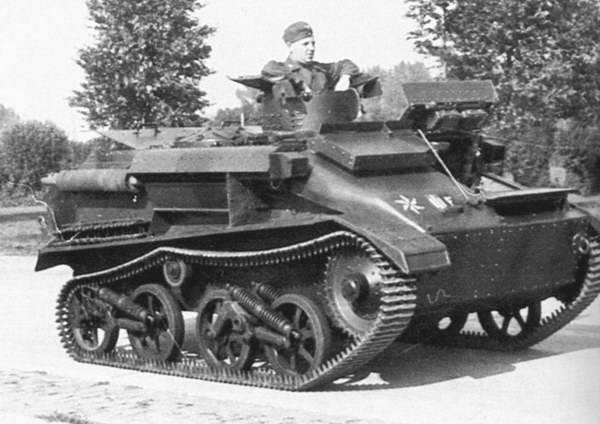
Beobachtungspanzern auf Fahrgestell Mk VI (e), source: Flickr.com, courtesy of the publishing user, edited
Another French vehicle whose chassis the Germans pressed into service for an observation variant was the Hotchkiss 38H tank. Once again, a straightforward superstructure was welded together from flat steel plates. The front wall was steeply angled to improve resistance to hits, though given the overall armour thickness, the hull could realistically only withstand small arms fire and light shell fragments.
The vehicle's sole armament was an MG 34 machine gun chambered in 7.92 mm. The gunner was protected by a small shield, but only from the front. The vehicle naturally carried a powerful radio set and an artillery rangefinder. A total of 24 units were built, and they served within units equipped with self-propelled howitzers on the same chassis.
Yet another captured vehicle — and certainly not the last — to serve as the basis for an observation variant was the Renault UE. The Germans made extensive use of this originally French cargo carrier. On its chassis they built an improvised tank destroyer, a rocket launcher, and a machine gun carrier. Forty units were also converted into armoured artillery observation vehicles.
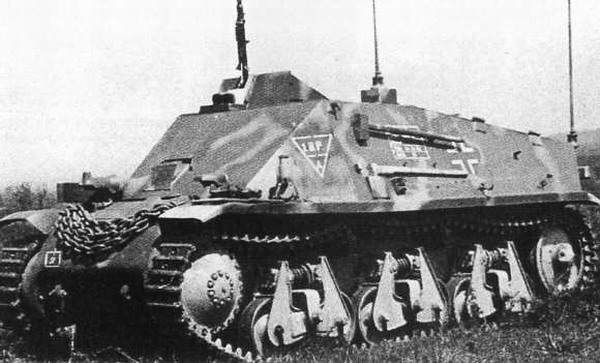
Panzerbeobachtungswagen 38H (f), source: Flickr.com, courtesy of the publishing user, edited
Above the original cargo bay, a compact boxy superstructure was fitted. Inside it sat the radio equipment, while a binocular artillery rangefinder could be extended through the roof. These vehicles again served alongside units equipped with self-propelled guns built on captured French chassis.
The light British Carden Loyd Mk VI tank was also used by the Germans as the basis for an armoured observation vehicle. Only four examples are said to have been built, and all of them served within the 227th Artillery Regiment, which was among other things equipped with self-propelled howitzers on the same captured chassis. The general practice of assigning Beobachtungspanzer vehicles to units operating self-propelled guns on identical chassis had sound logic behind it — it simplified maintenance, repairs, and the ordering of spare parts.

Reproducing text from the Panzernet website without the written consent of the operator is prohibited.