MINENRÄUMER ALKETT
project for a heavy engineer vehicle
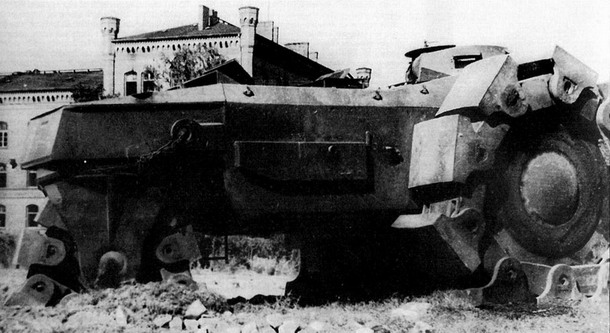
Prototype of the Minenräumer Alkett heavy mine-clearing vehicle. Source: Flickr.com, with permission of the publishing user, edited
At the request of the Weapons Office, Alkett began development in 1942 of a vehicle intended to clear lanes through minefields through which infantry, tanks, and other vehicles could then safely advance. The machine had to be capable of withstanding both the blasts of mines it drove over and potential enemy fire, which meant very heavy armour was essential.
No precedent existed for the design of such a vehicle, so Alkett had to work from scratch. The Minenräumer Alkett rode on three wheels. The two large-diameter front wheels were driven; at the rear a single smaller swivelling wheel carried the back of the vehicle. Power for this monster came from a twelve-cylinder Maybach HL 120 petrol engine producing 300 horsepower. Maximum speed is generally given as 15 km/h. The vehicle's weight is disputed in the sources, with figures ranging from 38 to 55 tonnes.
The hull structure was very straightforward, consisting of flat welded steel plates of varying thickness. Precise armour thickness figures are not known; according to some sources the most exposed areas — the hull front and floor — may have been 40 mm thick. On the front portion of the hull roof sat a rotating turret taken from the Panzer I tank, carrying the vehicle's sole organic armament: two 7.92 mm MG 34 machine guns.
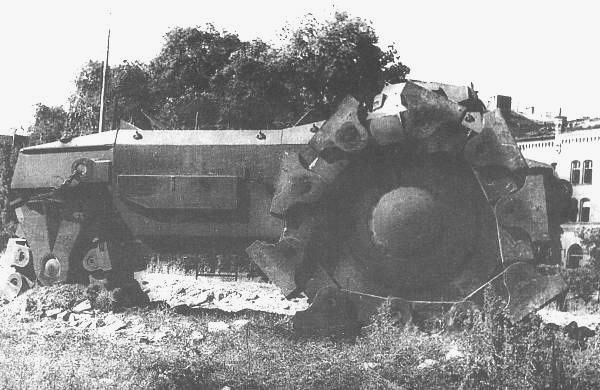
Prototype of the Minenräumer Alkett heavy mine-clearing vehicle. Source: Aviarmor.net, edited
All three wheels were fitted around their circumference with massive cast metal blocks. These blocks made contact with the ground as the vehicle moved and were designed to withstand mine blasts beneath them. The number of crew members is not known with certainty. At minimum the crew consisted of a driver and a gunner; a third member serving as radio operator or commander is also theoretically possible.
Only a single complete prototype was finished before the end of the war. As far as is known, the planned live mine-field driving trials were never carried out. After the German surrender, this remarkable machine fell into the hands of the Red Army, which transported it to the Soviet Union, where it has survived to the present day at the Kubinka tank museum.

Reproducing text from the Panzernet website without the written consent of the operator is prohibited.