VIELFACHWERFER SOMUA
rocket launcher on a French tractor chassis
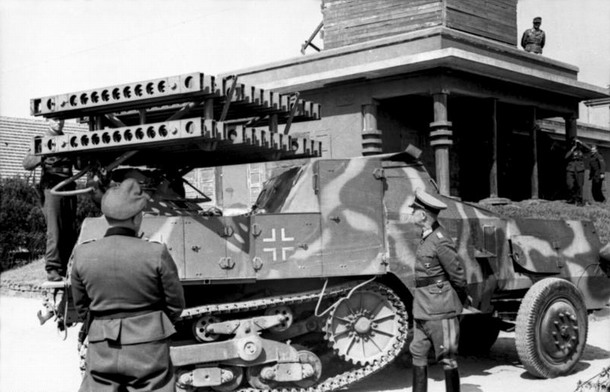
8cm Vielfachwerfer auf Fahrgestell Somua MCL, source: Bundesarchiv_Bild_101I-300-1863-30, Wikimedia, Creative Commons, edited
Alongside the MCG series of tractors, the French Somua concern had been producing the heavier MCL series of half-tracks since 1933. The Somua MCL vehicles were of a sturdier overall construction than the MCG model, powered by a stronger 85 horsepower engine and featuring a somewhat more complex track assembly.
These vehicles too naturally became part of the German war booty after the conquest of France, and they likewise served as the basis for some interesting conversions. One such conversion was a self-propelled rocket launcher carrying the official designation 8cm Vielfachwerfer auf Fahrgestell Somua MCL.
On the French chassis, a simply designed superstructure was built, welded together from flat steel plates. The engine bonnet was level with the rear platform, with only the crew cab rising higher from the hull at the midpoint of the vehicle's length. Entry and exit were through large single-piece doors set into each side wall. Behind the cab, on the platform already mentioned, the rocket launcher rail assembly was mounted on a rotating base. "Barrel" is not quite the right term here, as the launchers were simply open guide rails 186 cm in length. The strong influence of the Russian Katyusha was immediately apparent.
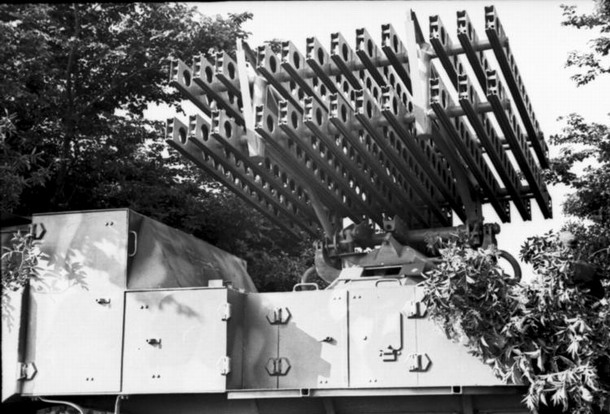
8cm Vielfachwerfer auf Fahrgestell Somua MCL, source: Bundesarchiv_Bild_101I-300-1863-18, Wikimedia, Creative Commons, edited
The launch rails were arranged in two rows of twelve, one above the other. Two rockets were clipped to each rail — one on top and one underneath — giving the launcher the ability to fire 48 rockets in a single salvo. The rockets were 80 mm in calibre and came in either high-explosive or smoke variants. The total on-board ammunition supply was 288 rockets, equivalent to six complete salvoes. The maximum range of the launcher was approximately 5,300 metres.
The workshops of Baukommando Becker produced just six examples of this weapon in total, and series production was never approved. All vehicles built were subsequently assigned to Schnelle Brigade West. No details of their actual combat deployment are known.
Reproducing text from the Panzernet website without the written consent of the operator is prohibited.