3,7 cm SELBSTFAHRLAFETTE
a half-track tank destroyer project

prototype of the half-track tank destroyer 3.7 cm Selbstfahrlafette L/70; note the machine gun on the turret, which could also be used for engaging low-flying aircraft; source: flickr.com, used with permission of the publishing user, edited
Half-track Tank Destroyers
Tanks became the undisputed symbol of the German Army's resurgence during the 1930s. The Germans understood very clearly what potential this relatively new type of weapon held for modern offensive warfare — and precisely for that reason they also began thinking very seriously about defence against tanks. In the mid-1930s Germany still found itself in the position of the weaker party, still working on developing its own tanks while potential adversaries already had hundreds in their arsenals. The ability to defend effectively against enemy armour was therefore critically important. And since tanks — in the German conception — were above all to be fast, the means of destroying them had to be fast as well, or rather faster still than their intended prey. They also had to be capable of cross-country movement and, ideally, relatively inexpensive.
In formulating these requirements, the German Waffenamt drew on analogies from its own air force and navy, reasoning roughly as follows: if you want to attack an enemy bomber, you do not send your own bomber against it, but a faster, more agile and cheaper fighter. If you want to sink an enemy ship, you can, among other options, dispatch a small, fast and inexpensive torpedo boat. Why not apply the same logic to a specialised machine for destroying tanks? And so the concept of the tank hunter — or tank destroyer, in German Panzerjäger — was born.
Within the technical means available to the Germans at the turn of 1934–35, the decision was made that the ideal candidate for a Panzerjäger meeting the stated requirements would be a lightly armoured vehicle on a half-track chassis. Three half-track tank destroyer projects were launched in response: a lighter one armed with a 37 mm cannon, and two heavier vehicles carrying a 75 mm gun. Development of the first was entrusted to Hansa-Lloyd and Rheinmetall Borsig. Hansa-Lloyd was to supply the chassis and armoured hull, using as its basis the half-track tractor it was then developing under the designation HL kl 3, specifically in the (H) variant — that is, with the engine mounted at the rear. Rheinmetall was to prepare the fighting turret and a modified 37 mm anti-tank cannon to go in it.
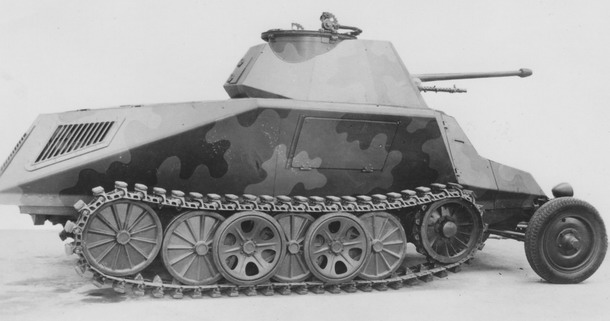
prototype 3.7 cm Selbstfahrlafette L/70; note the emergency access hatch in the side wall above the tracks; source: flickr.com, used with permission of the publishing user, edited
The Hansa-Lloyd Design
Hansa-Lloyd (a subsidiary of Borgward) had been working since 1933 on developing a half-track artillery tractor with a 3-tonne towing capacity — the vehicle that would eventually materialise as the series-production Sd.Kfz. 11. In 1934 the first chassis prototype for this tractor appeared under the factory designation HL kl 2, followed a year later by the improved HL kl 3. For the tank destroyer project, however, a modified chassis variant was prepared under the designation HL kl 3 (H), where the letter H in parentheses most likely stood for Heck — meaning stern or rear — referring to the relocated engine, which on this prototype was mounted at the rear rather than at the front as on the later production tractors.
The sources do not explicitly explain why the designers chose to move the engine from the front to the rear, but their reasoning can be deduced. The artillery tractor for which the chassis was originally being developed was not intended to carry any armour or weapons. The new tank destroyer was to be both armoured and armed — and therefore inevitably heavier. The weakest point of any half-track chassis is its front wheeled section, and the engine relocation was most likely intended to relieve the front axle of weight that would otherwise risk overloading it, particularly when going downhill or climbing over uneven terrain. The main element of the chassis was of course the track unit, consisting of a front drive sprocket, a rear idler wheel, and five road wheels. Each road wheel was made up of two discs mounted at unequal spacing on their axle: the discs of the odd-numbered wheels were close together and nestled into the gaps between the discs of the even-numbered wheels. The wheels were sprung by torsion bars. The tracks were fitted with rubber pads to reduce vibration when travelling at speed on hard surfaces.
Among the other modifications to the chassis was the repositioning of the driver's station to the centre of the hull. On the original tractor chassis the driver sat on the left, with a seat beside him for another soldier. The planned tank destroyer, however, was to have no co-driver, and it therefore made sense to seat the driver not to the left but in the centre. This naturally also required relocating all the controls, including the steering wheel, which additionally had to be tilted so that it would fit beneath the armour plate.
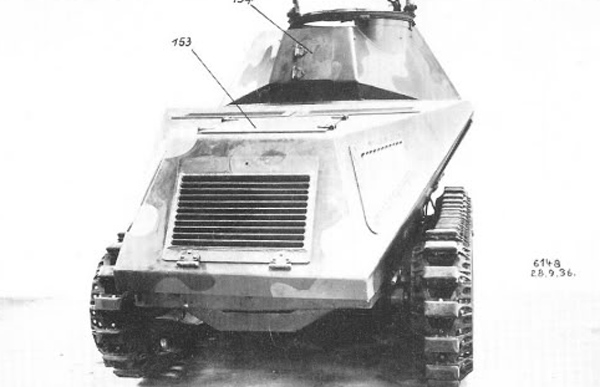
prototype 3.7 cm Selbstfahrlafette L/70; the engine was housed in the rear section of the hull; source: forosegundaguerra.com, edited
Armament
Just behind the driver's seat, the chassis frame housed the gearbox, and above it a platform for the rotating gun mounting. This substantial mounting carried not only the cannon itself but also seats for the two-man gun crew. To the left of the cannon the gunner's seat was fixed to the mounting; to the right and behind the cannon sat the loader. Also attached to the mounting were a canvas bag for catching spent cartridge cases and a box holding an immediate-use ammunition supply for the cannon. Behind the gunner's back, a heavy arm extended from the mounting and connected it to the rotating turret.
The mounting carried the 3.7 cm PaK L/70 cannon. Sources are unfortunately rather sparse on detailed information about this weapon. It appears to have been developed by Rheinmetall through modification of the standard PaK 35/36 anti-tank gun, with a significantly lengthened barrel — instead of the original 45 calibres, the new barrel was 70 calibres long, hence the L/70 designation. The Panzer Tracts series states that the armour-piercing round for this cannon weighed 710 g and left the muzzle at 900 m/s. If the projectile weight given is correct, this was not the standard ammunition used with the PaK 35/36 but a special round developed specifically for the new modified cannon. The mounting allowed vertical elevation from -7 to +20 degrees and a full 360-degree traverse.
Further back in the chassis frame, behind the gun mounting platform, sat the fuel tank and battery, followed by the engine compartment. This housed a Hansa-Lloyd 3500L petrol six-cylinder engine of 3.485 litres displacement, developing 70 hp at 2,600 rpm. The radiator was positioned ahead of the engine, with a bulkhead separating the engine section from the main fighting compartment. Connected to the engine was a Hansa-Lloyd Goliath gearbox with four forward speeds and one reverse. Some sources indicate that a two-speed reduction gearbox was also fitted.
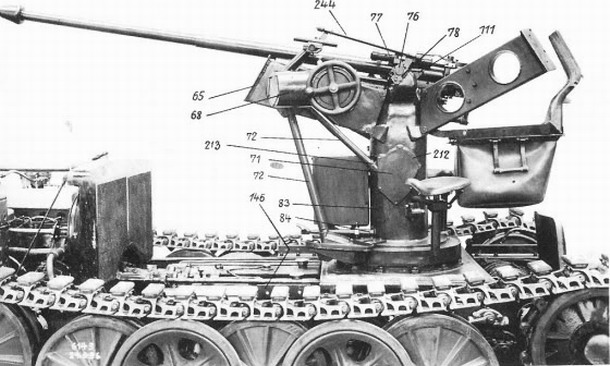
factory photograph of the gun mounting for the 3.7 cm Selbstfahrlafette L/70; note the gunner's seat and the cartridge-case bag; the large arm with two circular openings connected the gun mounting to the rotating turret; source: forosegundaguerra.com, edited
The chassis carried a hull welded from flat armour plates. Thanks to the repositioning of the driver's station described above, and especially to the relocation of the engine to the rear, the front section of the armoured hull could be kept very compact. The driver's armoured compartment accordingly had only a low, narrow nose, behind which rose the front wall with its main vision port. Additional vision ports were provided in both side walls of the driver's cab. Apparently in the interests of weight saving, the front wheels were not fitted with any mudguards, and the front suspension was left entirely exposed and unprotected.
Behind the driver's compartment came the main hull section, whose walls flared outward significantly as they rose from the chassis, providing a sufficiently wide surface on the roof to accommodate the fighting turret. The extended rear section of the hull enclosed the engine compartment and was therefore fitted with louvred ventilation grilles and service access hatches. On the roof of the hull sat the rotating fighting turret, through whose front wall the cannon barrel protruded. To the right of the cannon was a machine gun port; to the left was the aperture for the cannon's gun sight. Despite appearances, the fighting turret had an open roof — only in its right rear section was there a ring mount for the machine gun, which could also be used for engaging low-flying aircraft. In the rear wall of the turret was a closeable opening, apparently intended to facilitate ammunition loading.
The half-track tank destroyer received the official designation 3,7 cm Selbstfahrlafette L/70 — literally "self-propelled mounting for the 3.7 cm L/70 cannon." The crew numbered three men. The driver had, in effect, his own small compartment at the front of the vehicle, separated from the main fighting compartment only by the back of his seat. He entered and exited through fairly large doors in the side walls of his station. The other two crew members were the gunner and loader already mentioned; the gunner most likely also served as vehicle commander. These two could enter and exit either through the open turret roof or through rectangular hatches in the side walls above the tracks. At the rear wall of the fighting compartment — the bulkhead separating it from the engine section — was a large ammunition box for the cannon.
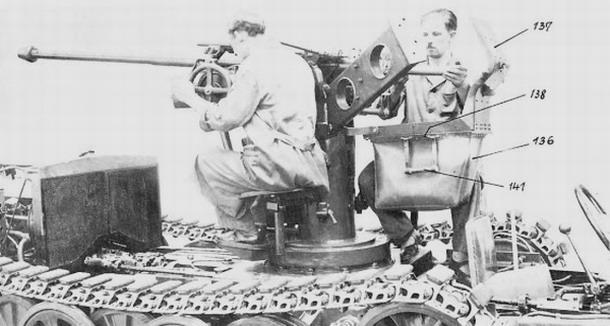
this factory photograph shows the positions of the gunner and loader inside the 3.7 cm Selbstfahrlafette L/70; the large arm between the two men connected the gun mounting to the rotating turret; source: flickr.com, used with permission of the publishing user, edited
First and Last
The prototype of the 3,7 cm Selbstfahrlafette L/70 was completed apparently in September 1936 — at least, that is the date on the factory photographs. The vehicle measured 5.1 metres in length and 2 metres in width, and was capable of 50 km/h on roads. Information on its weight, armour thickness, fuel consumption and other such details is unfortunately not available in the literature, nor are any specifics about the results of its testing. One thing, however, is certain: the first prototype built was also the last, and the project was cancelled. It is generally stated that the half-track vehicle failed to meet the Army's expectations. In the end it proved not appreciably faster than conventional tanks, and reportedly not even significantly cheaper — though of course unit cost at the prototype stage is not an entirely fair measure.
ARTICLE
CONTENTS:
Reproducing text from the Panzernet website without the written consent of the operator is prohibited.