REIHENWERFER SOMUA
heavy mortar on French half-track chassis
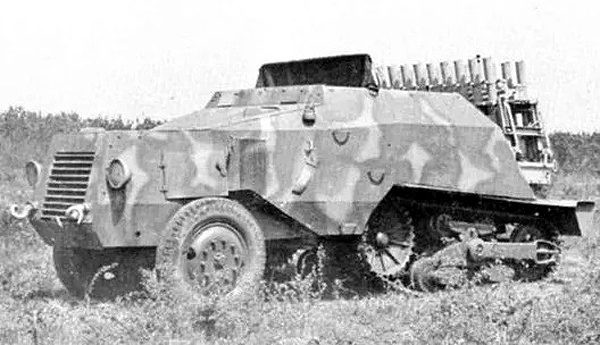
8 cm Reihenwerfer auf SPW S303 (f), a self-propelled mortar on the chassis of the French SOMUA MCL half-track, source: Flickr.com with permission of the publishing user, edited
Introduction
In the summer of 1942, the so-called Baukommando Becker (sometimes also referred to as Baustab Becker) began operating in France. Its mission was to breathe new life into the various vehicles captured from the French army in 1940. By this means, the Germans sought to obtain reasonably serviceable combat equipment at minimal production cost — and above all without making further demands on the already overstretched German armaments industry. While the main effort of the Baukommando was directed at fully tracked vehicles, wheeled and half-tracked vehicles also received a degree of attention. One of Becker's creations was a multi-barrel self-propelled mortar designated the Reihenwerfer, built on the half-track chassis of the French firm SOMUA.
The SOMUA Half-Tracks
SOMUA (Société d'outillage mécanique et d'usinage d'artillerie) was one of the companies that, in the early 1930s, fell under the spell of the half-track designs of engineer Adolphe Kégresse. This Frenchman had spent many years at the court of Tsar Nicholas II of Russia, serving as the monarch's personal driver and manager of the imperial motor pool. It was precisely the natural conditions of Russia and the state of its so-called roads that led Kégresse to the idea of replacing the rear wheels of a standard passenger car with a short track unit. A vehicle modified in this way handled not only soft terrain far better, but excelled above all in deep snow. And to keep the track unit from adding too much weight to the vehicle, Kégresse used rubber tracks rather than metal ones. Once he had refined the whole concept, he went so far as to patent it in 1913.
After returning to his native France — driven home by the Bolshevik Revolution of 1917 — Kégresse began collaborating with Citroën and played a central role in launching its half-track vehicle programme, aimed at both the commercial market and the military. On these heavier vehicles, the rubber tracks were fitted with metal cleats to improve traction and durability. The Citroën–Kégresse half-tracks became widely known to the public through the adventurous expeditions across Africa and Asia that Citroën organised during the 1920s and 1930s. In the wake of this success, a number of other companies purchased licences to manufacture half-tracks based on Kégresse's design — among them the British firms Burford and Crossley, Belgian FN Herstal, Italian Alfa Romeo, and the French manufacturers Renault, Schneider, UNIC, and SOMUA.
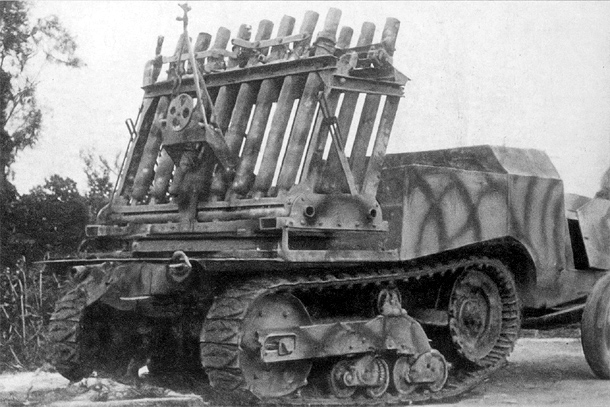
the lighter version of the Reihenwerfer, based on the SOMUA MCG chassis, carried a bank of 16 mortars; its armour plate was somewhat lower than that of the variant on the SOMUA MCL chassis, source: Flickr.com with permission of the publishing user, edited
SOMUA, the last of the companies mentioned, built several types of vehicles on the Kégresse chassis for the French army. This article concerns itself with two of them: the SOMUA MCG and the SOMUA MCL. Somewhat surprisingly, it is rather difficult to find a reliable explanation of what the designations actually stand for. According to some sources, the letters MCG were an abbreviation of Mise en Caisson de Grosses Pieces, which could be very loosely translated as a carrier of heavy loads. Other sources suggest it stood for Moyen Chenillé de Guerre, meaning something along the lines of medium war half-track. The abbreviation MCL is interpreted by some authors as Modèle de Chenillette de Liaison, which would translate as something like a light liaison tracked vehicle. Frankly, none of these explanations sounds entirely convincing.
In any case, the SOMUA MCG entered production in 1932 and was intended to serve as a personnel and cargo carrier, an artillery tractor for 155 mm howitzers, and also as a service and recovery vehicle. The 6.8-tonne half-track was powered by a four-cylinder petrol engine of 4.7 litres displacement, producing a maximum of 60 horsepower. The vehicle could carry a payload of up to 1,500 kg directly and tow a load of up to 3,500 kg. Maximum road speed was around 31 km/h. The half-track was entirely unarmoured — the engine bonnet, driver's cab, and rear cargo area (in those variants that had one) all looked much like those of an ordinary civilian truck of the era. The total number produced is unfortunately rather unclear: some authors put it at just over three hundred, others at under eight hundred, and figures as high as 1,500 occasionally appear — though the latter seems almost certainly an exaggeration.
The second of the two types, the SOMUA MCL, entered production in 1935. It was a considerably more robust and powerful machine than its predecessor. The vehicle weighed 10.9 tonnes and its 6.558-litre engine produced 90 horsepower — a full fifty per cent more than the MCG. Like the MCG, it was intended to tow 155 mm howitzers, but the French army relied on it far more heavily as a recovery vehicle. In total, only 148 examples were built. Whereas the lighter SOMUA MCG managed well enough with rubber tracks fitted with metal cleats, the heavier MCL required a switch to a track made of metal links, which were in turn fitted with rubber pads for a smoother ride. The use of this heavier track necessitated the addition of a second return roller. So while the upper run of the rubber track on the MCG was supported by a single roller, the metal track of the MCL required two. The MCL also received a more robust drive sprocket with characteristic spokes.
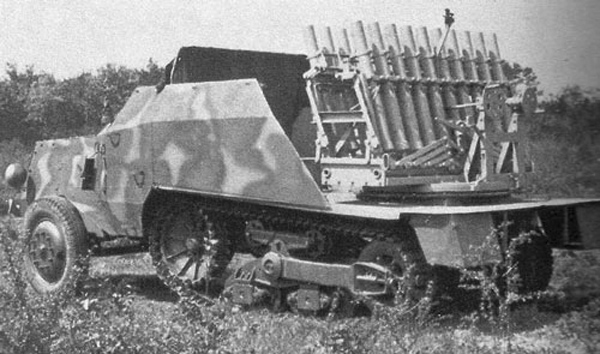
the Reihenwerfer on the SOMUA MCL chassis had 20 mortar barrels; this photograph gives a clear view of the two cranks used to traverse and elevate the barrels, source: Flickr.com with permission of the publishing user, edited
After the French capitulation, a significant number of serviceable (or repairable) SOMUA MCG and MCL half-tracks fell into Wehrmacht hands. The Germans pressed these vehicles into service in their original form, designating them the Leichter Zugkraftwagen S307 (f) for the MCG type and the Mittlerer Zugkraftwagen S303 (f) for the MCL. Beyond towing various artillery pieces, both half-tracks also served their new owners as the basis for several conversion projects. A portion of the MCG vehicles was rebuilt as tank destroyers armed with a 75 mm gun, some were converted into ammunition carriers, others into armoured personnel carriers, and some into the self-propelled Reihenwerfer mortar already mentioned. An equivalent self-propelled mortar was also developed on the MCL chassis.
Self-Propelled Mortars
The full official designations of the self-propelled mortars were 8 cm Reihenwerfer auf SPW S307 (f) for the variant based on the MCG half-track, and 8 cm Reihenwerfer auf SPW S303 (f) for the variant based on the MCL. Other sources, however, give the designations Leichter Reihenwerfer (16 Rohre) auf Fahrgestell Somua MCG and Schwerer Reihenwerfer (20 Rohre) auf Fahrgestell Somua MCL respectively. In general terms the two variants were very similar, but they differed in a number of specific details. The front engine section and the crew cab received armour welded from flat plates 12 mm thick. The driver's and co-driver's (i.e. the vehicle commander's) cab was left open at the top. Early vehicles on the MCG chassis had somewhat lower cab armour, so that the heads of both men protruded above the open roof (photo HERE). On later MCG-based vehicles, somewhat taller armour was used, which also protected the heads of the driver and commander. The MCL-based variant apparently had the taller armour from the outset. Behind the rear wall of the cab was a bench for the remaining three crew members, protected on both sides by armour plate.
Further to the rear was the fully open fighting compartment, which housed the vehicle's armament. On the Reihenwerfer based on the SOMUA MCG, this consisted of an assembly of 16 linked mortars on a rotating mount, designated the Reihenwerfer Schießgerät RG-16. On the heavier vehicle, the assembly comprised a full 20 mortar barrels, and its designation was most likely Reihenwerfer Schießgerät RG-20 (though this is our own inference). Like the half-track chassis themselves, the mortars were war booty — specifically the French Brandt mle 27/31, calibre 81 mm. The French army had held several thousand of these mortars before the war. The Germans redesignated the captured weapon as the 8 cm Granatwerfer 278(f). The mortar fired 3.25 kg projectiles to an effective range of up to 2.8 km.
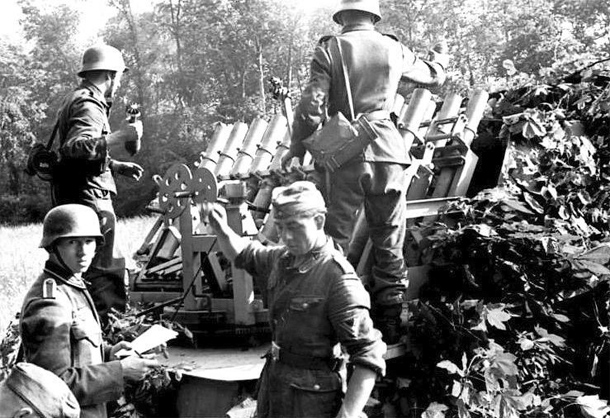
a Reihenwerfer on the SOMUA MCL chassis during mortar loading, source: Bundesarchiv Bild 101I-300-1863-15, Wikimedia, Creative Commons, edited
Description of the Weapon
In the Reihenwerfer Schießgerät assembly, the mortar barrels were joined together into a large frame, which was mounted on a rotating base with gear teeth running around its entire circumference. The assembly also incorporated the elements used to aim and fire the weapons. First among these was a bracket for a periscopic sight, and alongside it a pair of cranks for controlling the traverse of the base and the elevation of the entire barrel frame. On the left side of the frame there was a firing handle by which the whole salvo was discharged. The rotating base allowed an unlimited 360° traverse, while barrel elevation ranged from +35° to +90°. There was also a system of linkages by which the barrels could be tilted slightly sideways, causing them to spread out in a fan pattern rather than standing parallel to one another — though only by a few degrees. The further a barrel was from the centre of the row, the greater the angle it was given. In this way the dispersion of the fire — and therefore the width of the area covered by the falling bombs — could be adjusted.
A conventional mortar works by simply dropping a bomb down the barrel: when it slides to the bottom, it strikes a firing pin which ignites the propellant charge at the base of the bomb, and the bomb is fired out of the barrel. This means that the moment a soldier drops the bomb in, it is fired almost instantly. A multi-barrel mortar obviously cannot function in this way. The barrels of the Reihenwerfer Schießgerät were therefore fitted with retaining catches which held each bomb at the muzzle after loading. The crew would first load bombs into all the barrels of the assembly — with their noses protruding from the muzzles — and only when the firing handle was pulled would all the catches release simultaneously, allowing the bombs to fall to the bottom of their barrels and be fired in a single collective discharge.
Some authors maintain that pulling the handle did not fire all the bombs at once, but rather in rapid succession one after another. Other sources say the entire salvo was discharged at the same instant. Frankly, it is difficult to imagine what mechanism the designers could have used, given the fairly primitive construction of the whole device, to achieve a delay between individual shots. In theory one could envisage the firing handle releasing one bomb at a time — the catch on the first barrel would release, rotate or shift in some way, and thereby mechanically connect the handle to the catch on the adjacent barrel, and so on down the line. In that case, however, the firer would have had to pull the handle again and again until all 16 or 20 bombs had been fired. Our own view is that the handle simply released the bombs in all barrels simultaneously and the entire salvo was therefore fired at a single moment. The Reihenwerfer thus served as a shock weapon. The vehicle would simply fire a full salvo of 16 or 20 bombs and then disappear — change position. The bombs therefore did not fall on the target area progressively, but all at once, giving the enemy no time to take cover.
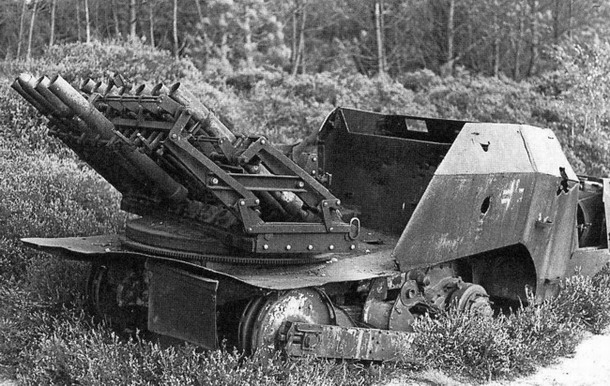
a wrecked self-propelled mortar on the SOMUA MCG chassis somewhere in France, source: Flickr.com, Public domain, edited
Both variants of the Reihenwerfer had a crew of five, most likely comprising the driver, the vehicle commander, the gunner, and two loaders. Unlike the lighter version, the heavier Reihenwerfer was equipped with a radio set, which means the commander probably also doubled as the radio operator. As for ammunition supply, figures are given only for the MCG-based vehicle: 90 mortar bombs.
As already noted, the self-propelled mortars were built in the workshops of Baukommando Becker in France itself. During 1943, it appears that 36 of the lighter Reihenwerfers on the MCG chassis were completed, along with 16 of the heavier variants on the MCL. All vehicles thus produced were apparently handed over to the 21st Panzer Division, which had been re-formed in France after its destruction in North Africa. Within the division, the Reihenwerfers were distributed among three subordinate units: Sturmgeschütz Abteilung 200 and two Panzergrenadier regiments — the 192nd and 125th.
The self-propelled mortars described here saw actual combat against the Allies following the landings in June 1944. How they fared in practice, however, is not recorded in any available source. Their limited range forced crews to advance to within relatively close distance of the target. Loading the mortar assembly was certainly a time-consuming process, but on the other hand the discharge of the entire salvo took only seconds, and if the vehicle then managed to disappear, it stood a reasonable chance of success. If the commander was able to select a suitable target — advancing enemy infantry, for instance — and a good firing position, such as under cover at the edge of a wood, a Reihenwerfer attack could come as a genuine shock to the enemy. Four vehicles operating together could put 80 mortar bombs into a single location in one go, which was already a very considerable weight of fire.
ARTICLE
CONTENTS:
Reproducing text from the Panzernet website without the written consent of the operator is prohibited.