FLAKWAGEN MB L 4500 R
Flak 36 on a Mercedes-Benz chassis
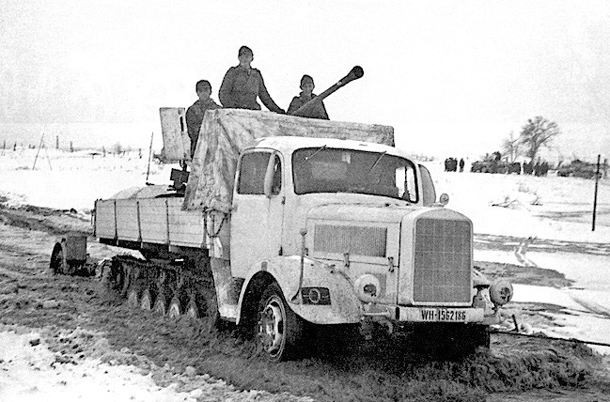
Mercedes-Benz L 4500 R converted into a self-propelled anti-aircraft gun; the pictogram on the right front mudguard bears a certain resemblance to the insignia of the Ski-Jäger Division 1; source: Flickr.com, used with permission of the publishing user, edited
The Half-track "Mules"
The very first autumn on the Eastern Front made it abundantly clear that German trucks and Soviet roads were not going to get along. Persistent rain and heavy traffic turned the unpaved "roads" into muddy traps, from which only fully tracked or at least half-track vehicles could escape with any reliability — at the cost of enormous amounts of time and even more fuel. For supply trucks specifically, the solution was to convert them from wheeled to half-track configuration, simply replacing the rear wheels with a track unit. To keep costs down, lighter types were to use existing components from Panzer I tanks, while heavier types would use components from Panzer II tanks. This was the origin of the whole family of half-track trucks known collectively as the Maultier — German for mule.
The most famous member of the Maultier family was undoubtedly the converted Opel Blitz, but the family also included various trucks from Alfa Romeo, Ford and Mercedes-Benz. The vehicle that concerns us here is the product of Daimler-Benz — the company was called Daimler-Benz, the vehicle itself Mercedes-Benz — specifically the L 4500 type. This truck entered production in 1939 and for the next five years was assembled at the factory in Gaggenau in south-western Germany. During September and October 1944 the factory was targeted by Allied air raids that caused such damage that production had to be relocated to the Sauer factory in Vienna, where it continued until 1945.
The Mercedes-Benz L 4500 was produced in two wheeled versions: the L 4500 S with rear-wheel drive and the L 4500 A with all-wheel drive. And then there was the half-track version, which received the type designation L 4500 R. The vehicle was powered by a Mercedes-Benz OM 67/4 diesel six-cylinder engine with a displacement of 7.274 litres and an output of 111 hp. The gearbox was a manual unit with five forward speeds and one reverse. The maximum speed of the wheeled versions is generally quoted at 66 km/h, though the literature does not give a figure for the half-track variant. A total of 1,486 Mercedes-Benz L 4500 R vehicles were produced.
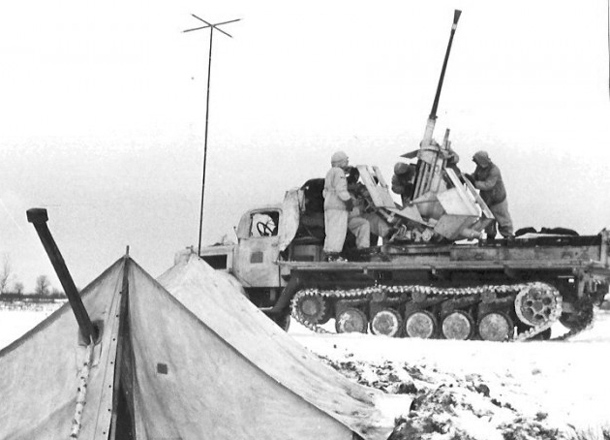
Flakwagen Mercedes-Benz L 4500 R ready for action; the winter setting suggests deployment on the Eastern Front; source: Flickr.com, used with permission of the publishing user, edited
Anti-aircraft Gun Carrier
The Mercedes-Benz L 4500, in all its variants, offered a very solid payload capacity of over 4.5 tonnes — making it not only an excellent supply vehicle but also a suitable candidate for conversion into a weapons carrier, specifically a Flakwagen (anti-aircraft gun carrier). An unspecified number of wheeled Mercedes trucks were therefore converted (most likely in 1943 and 1944) into air defence vehicles, in three variants carrying different armament. You can read more about these in the Flakpanzers section.
These official factory conversions involved not only the installation of the weapon but also armour for the cab, ammunition boxes, new fighting compartment side panels, and in some cases lateral stabilising outriggers. In all cases, however, the conversions were based on wheeled Mercedes trucks — the L 4500 A or L 4500 S. The half-track Mercedes-Benz L 4500 R was not included in the official conversion programme, but it too eventually got its chance — apparently through an unofficial field modification. As surviving photographs demonstrate, a 37 mm Flak 36 anti-aircraft cannon was installed on its chassis.
The Flak 36 Cannon
The weapon was mounted on a rotating pedestal in the centre of what had been the cargo area, complete with its gun shield. The Flak 36 boasted a theoretical rate of fire of up to 160 rounds per minute and the ability to send 635-gram shells to an altitude of 4.8 kilometres (though significantly different figures can also be found in the literature). The weapon itself in combat configuration weighed 1,544 kg, which represented no excessive burden for a truck chassis. Unlike its officially converted wheeled counterparts, the half-track Mercedes Flakwagen received none of the additional refinements such as cab armour, stabilising outriggers, or new wire-mesh fighting compartment side panels. The driver and co-driver were left with the standard pressed-steel cab, and the gun's fighting compartment was enclosed by nothing more than a simple wooden plank surround.
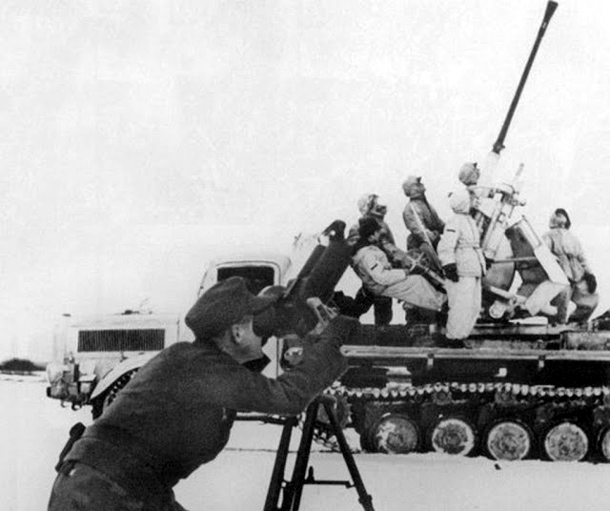
all eyes scanning the sky for a target for the 37 mm Flak 36 cannon; source: Flickr.com, used with permission of the publishing user, edited
One rather poor-quality photograph suggests that the vehicle described was built in at least two examples. Which unit carried out the conversion, and exactly when, the literature unfortunately does not say. As for where the vehicles were deployed, the surviving photographs point to the Eastern Front. Some sources suggest the vehicle belonged to Ski-Jäger Division 1, led to this conclusion by a certain resemblance between that division's insignia (an oval through which a ski passes) and the marking painted on the right front mudguard of the vehicle in question. This marking is, however, only dimly visible in the photograph, and it may well have been an entirely different pictogram altogether.

ARTICLE
CONTENTS:
Reproducing text from the Panzernet website without the written consent of the operator is prohibited.