HKp 6.03
successor to the legendary half-track personnel carrier
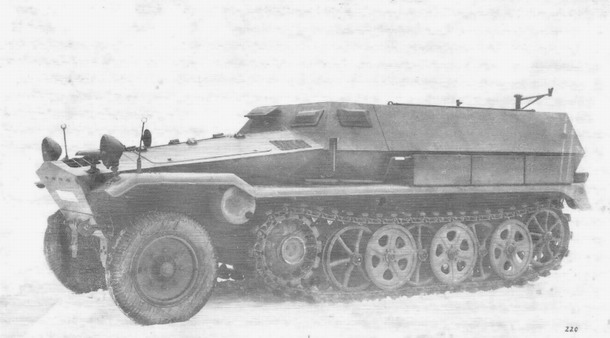
the HKp 6.03 project was intended to produce a successor to the Sd.Kfz. 251 armoured personnel carrier; source: Flickr.com, used with permission of the publishing user, edited
Successor to the Sd.Kfz. 251
Among the universally recognised symbols of the Wehrmacht were undoubtedly the half-track armoured personnel carriers, known in German service by their ordnance code Sd.Kfz. 251, and their full official designation mittlerer Gepanzerter Mannschaftstransportwagen. Although this legendary vehicle did not enter service with the German Army until 1939, its development can in fact be traced all the way back to 1933 — when work began on the light artillery tractor Sd.Kfz. 11, which later served as the foundation for the personnel carrier. This heritage gave the Sd.Kfz. 251 certain shortcomings: the chassis on which it stood had originally been designed for an entirely different purpose — towing guns — and by 1939 it was hardly at the cutting edge of modern engineering.
As a result, the Army actually began exploring possibilities for a fundamental modernisation even in the same year the carrier entered service. In July 1939 the HK 6 programme was launched (HK = Halbketten), under which Hanomag was to develop a series of half-track vehicles to replace the older — and all structurally related — types Sd.Kfz. 11, Sd.Kfz. 250 and Sd.Kfz. 251. The planned successor to the "251" was designated within this series as HKp 6.03. Hanomag was responsible for developing the chassis and drivetrain, while the armoured hull was to be designed by Büssing-NAG.
Evaluation Prototypes
Two evaluation prototypes were built during 1941 and subsequently tested through to 1942. At first glance the new vehicle was surprisingly similar to the original Sd.Kfz. 251, yet a great deal had actually changed — in fact almost everything. Instead of a conventional frame chassis, the vehicle used a self-supporting armoured hull tub, which offered better protection against mine strikes and was also watertight, allowing the carrier to ford deep water. It was specifically because of this deep-wading capability that the engine air intakes were relocated to the top of the engine bonnet. Beneath the new bonnet sat a new engine — a Maybach HL 45 six-cylinder unit with a maximum output of 150 hp. The gearbox was also new: an eight-speed Maybach Variorex.
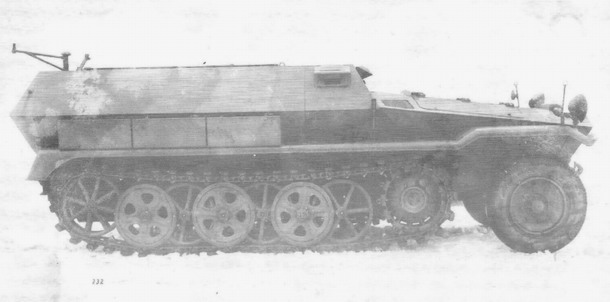
the HKp 6.03 bore a strong resemblance to the older Sd.Kfz. 251, but was an entirely new vehicle — one that ultimately never reached production; source: Flickr.com, used with permission of the publishing user, edited
Also new were the front wheel suspension, the brakes and final drives for the tracks, the road wheels and drive sprockets, the mudguards, the exhaust silencer, and numerous other components. The HKp 6.03 had 40 mm more ground clearance than its predecessor and could carry 30 litres more fuel. Despite all these changes, however, the overall layout remained essentially the same as that of the older Sd.Kfz. 251: conventional pneumatic-tyred wheels at the front, a torsion bar-sprung track unit at the rear; engine at the front, driver and commander's cab behind it, and at the rear a compartment for an infantry section of 10 men. The troop compartment had entry doors in the rear wall and an open top.
The new vehicle's weight was around 9 tonnes, the front armour was a solid 30 mm thick, and the maximum road speed was reportedly as high as 65 km/h. Although the HKp 6.03 undoubtedly represented a step forward, it was ultimately not accepted for series production. At the end of 1941 the Kätzchen project had been launched, promising to deliver a fully tracked armoured personnel carrier of completely new design. The HKp 6.03 programme was therefore cancelled before the end of 1942. It is worth adding that the Kätzchen project also never reached series production, and so German forces had to rely on the Sd.Kfz. 251 — with all its qualities and shortcomings — right to the end of the war.

ARTICLE
CONTENTS:
Reproducing text from the Panzernet website without the written consent of the operator is prohibited.