10,5 cm leFH auf HKl 6p
light howitzer on a half-track chassis
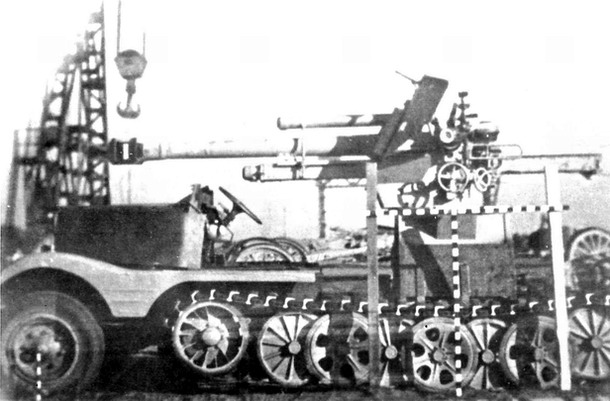
the first evaluation installation of the 105 mm howitzer used the older HL Kl 5 chassis; source: Flickr.com, used with permission of the publishing user, edited
An Affordable Self-propelled Gun
The first conceptual sketch of a 105 mm light howitzer mounted on the H Kl 6p half-track chassis was drawn up at the end of September 1943. The Germans were pursuing this avenue in an effort to obtain a relatively inexpensive self-propelled gun for motorised infantry units. Conventional towed artillery was too slow for these formations, while self-propelled guns on fully tracked tank chassis were both unnecessarily expensive and in short supply overall. Making use of an already-produced half-track chassis therefore seemed a sensible solution, and the H Kl 6p chassis from Hanomag (Hannoversche Maschinenbau AG) was identified as the most suitable candidate for the purpose.
Evaluation Prototype
The first test installation of the 105 mm howitzer took place apparently at the turn of 1943–44, though at that stage on the older chassis designated HL Kl 5. The HL Kl 5 type was in fact the previous generation of the target chassis, of which only 40 examples had been built in 1936 and 1937 (at the time still in the Hansa-Lloyd factories). This redundant, retired chassis was deliberately chosen as a cost-saving measure, since the sole purpose of the vehicle being built was presumably to verify whether the chassis could support the howitzer at all. The weapon was installed on an otherwise almost completely stripped chassis — only the engine bonnet was retained. The vehicle was most likely subjected to basic driving and firing trials, and on 22 January 1944 it was demonstrated to Hitler himself by Army representatives. He approved the concept and ordered a transition to mass production as quickly as possible.
The series-production self-propelled gun was of course to be based on the target H Kl 6p chassis. These chassis were produced at the factories of the aforementioned Hanomag company and were used for the assembly of the Sd.Kfz. 251 armoured personnel carrier. The chassis had a front steered wheel axle and a rear track section, consisting on each side of six road wheels, a drive sprocket and an idler wheel. The road wheels were arranged in inner and outer rows so that they partially overlapped one another. This arrangement allowed more road wheels to be fitted within a relatively short track unit — and more wheels naturally meant better weight distribution and less stress on the running gear. The road wheels were mounted on swing arms, whose travel (and thus the wheel suspension) was controlled by torsion bars running transversely across the chassis frame.
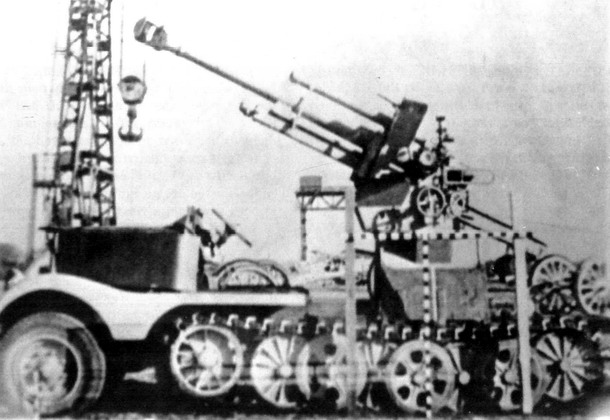
another photograph of the evaluation vehicle on the HL Kl 5 chassis; the rods with scale markings were used to measure the movement of the weapon on firing; source: Flickr.com, used with permission of the publishing user, edited
The use of torsion bars meant that the road wheels on opposite sides of the chassis could not be positioned at exactly the same longitudinal point, as their torsion bars would have met in the middle of the chassis. The wheels on the right side were therefore shifted slightly rearward, resulting in a larger gap between the first road wheel and the front drive sprocket, and conversely a greater overlap between the last road wheel and the rear idler. The torsion bars of the opposing road wheels could thus be housed side by side within the chassis — the bar for the right-side wheel running just behind the bar for the left-side wheel. As a consequence of this arrangement, the entire track unit on the right side was slightly longer than the one on the left, which is why the right track required 56 links while the left needed only 55.
The front-mounted drive sprocket did not use conventional teeth but instead had lugs that engaged with holes in the track links. The rear idler wheel was of the same construction as the road wheels in the inner row, but was mounted somewhat higher and its suspension bracket allowed it to be moved forwards and backwards to achieve the correct track tension. The 280 mm wide tracks were fitted with rubber pads for smoother running on hard roads. Motive power was provided by a Maybach HL42 TUKRM petrol six-cylinder engine delivering a maximum of 100 hp at 2,800 rpm. The engine was housed at the front, above the conventional wheels, and connected to a four-speed Hanomag gearbox followed by a second two-speed reduction gearbox. The reduction gearbox allowed switching between road and cross-country modes, giving the driver a total of eight forward gears and two in reverse. The fuel tank held 110 litres, sufficient for approximately 250 km on roads.
Armament
A fully traversable mounting for the leFH 18/40 light field howitzer (leFH = leichte Feldhaubitze) was installed in the rear section of the half-track chassis. According to the literature, the mounting was designed so that a standard towed howitzer could be attached to it directly after being lifted from its conventional wheeled carriage. It is therefore interesting that the howitzer fitted to the half-track chassis carried the extended designation leFH 18/40/1 — a type of designation with an additional number after a slash that was generally used to identify a specific modification of a weapon distinct from the standard version.
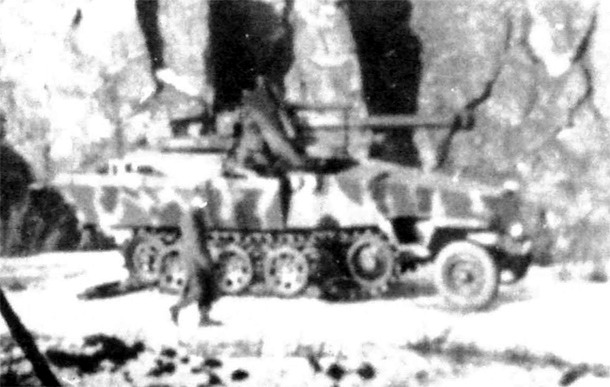
sometime before November 1944, Hanomag completed four pre-series vehicles in the definitive configuration, which subsequently underwent troop trials; source: Flickr.com, used with permission of the publishing user, edited
In any case, one of the key attractions of the half-track self-propelled gun was precisely the ability to remove the howitzer easily from the chassis and reinstall it on a conventional wheeled carriage — at which point the leFH 18/40/1 would presumably revert to being a standard leFH 18/40. There were even plans for the self-propelled gun to tow the empty wheeled carriage behind it as a trailer. This would indeed have fitted the historical pattern — the artillery branch of the German Waffenamt had requested something very similar for the self-propelled guns being developed on tank chassis in the preceding two years (see the article on the Grille / Heuschrecke programme). The towed wheeled carriage was also to carry the lifting equipment needed to remove and replace the howitzer on the chassis.
Let us return briefly to the leFH 18/40 (or leFH 18/40/1, as one prefers) itself. The howitzer with the numeral 40 in its designation was developed in 1942 as a lightened and more easily manufactured variant of the standard leFH 18. The weapon used separate-loading ammunition, meaning that the shell (weighing 14.81 kg) was loaded first, followed by the propellant cartridge. The range of the weapon could be adjusted by varying the propellant charge — that is, by selecting the number and size of powder increments inserted into the cartridge. For the standard towed howitzer, six charge sizes were available, the largest of which allowed a maximum range of 10,675 metres. There was also a special charge for long-range "FH Gr. fern." shells, which could reach out to 12,325 metres. It is likely, however, that the use of this special long-range ammunition was prohibited in the self-propelled variant — and it would be no surprise if the use of standard charge No. 6 was also restricted in some way — since the heavy propellant loads would have placed considerable strain on the chassis.
Following the approval of the half-track self-propelled gun in January 1944, the Waffenamt signed a contract with Hanomag for delivery of an initial evaluation batch of four vehicles by June 1944. After troop trials of these vehicles, production of a further 50 was to follow, with deliveries beginning in August of the same year. Unlike the first prototype, the series vehicles were to receive armour protection for the engine compartment and driver's cab, and where possible some degree of protection for the fighting compartment as well. The total vehicle weight was not to exceed 8.5 tonnes. The required deadlines appear not to have been met, but the four evaluation vehicles were nonetheless completed, and a report dated 22 November 1944 states that their troop trials were already underway.
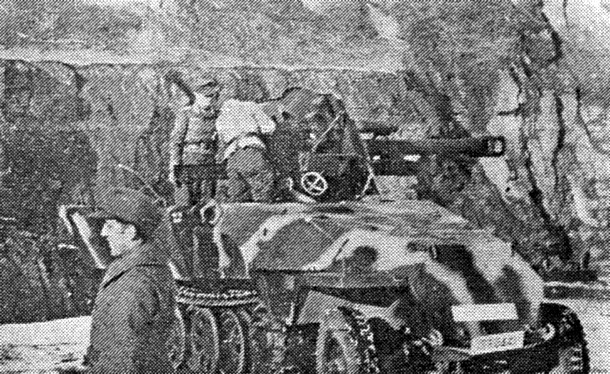
the mounting allowed the howitzer to traverse a full 360 degrees, though when firing to the side the vehicle rocked very severely; source: Flickr.com, used with permission of the publishing user, edited
These four pre-series vehicles received the required armour for the engine compartment and driver's cab. The armour arrangement was very similar to that of the Sd.Kfz. 251 Ausf. D armoured personnel carrier, but lacked the front cab wall with vision ports and also the roof — so the driver and co-driver's compartment was only partially protected. The fighting compartment at the rear was enclosed on the sides and at the back by low foldable walls; it is not clear from the sources or photographs whether these were metal or merely wooden boarding. Equally, the sources do not state how much ammunition the vehicle carried on board.
Trials and Production
Testing of the first four self-propelled guns was conducted at the Artillerieschule II artillery school, then based in the town of Groß Born (today Borne Sulinowo in Poland). The trials revealed among other things that when the howitzer was traversed to fire to the side, the entire vehicle rocked violently, and the crew in the open fighting compartment had to hold on very firmly to avoid being thrown to the ground. Overall, however, the trials appear to have been satisfactory. The production of the first batch of 50 vehicles proved more problematic. The Hanomag factories in Hanover, like many others, were hit by Allied air raids, and on 11 December 1944 the company reported to the Waffenamt that production of the ordered vehicles was seriously threatened. The first four series-production vehicles were eventually delivered in January 1945. A further 12 were planned for February, then 15 in March, 14 in April and a final 5 in May 1945. None of these, however, appear to have been completed.
ARTICLE
CONTENTS:
Reproducing text from the Panzernet website without the written consent of the operator is prohibited.