PANZER HELFEN DIR
handbook for the German Panzergrenadier
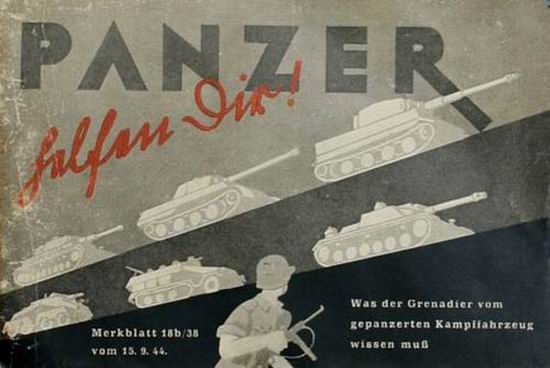
The tank helps you – you help it too! That was the message of the Panzer helfen Dir booklet, also known as Merkblatt 18b/38, published in 1944 with the subtitle "What the grenadier must know about armoured fighting vehicles".
The publication provided information about the types of armoured equipment a soldier might encounter on the battlefield and fight alongside. Tanks and other fighting vehicles were entirely dependent on infantry support. For that cooperation to be effective, soldiers had to understand the characteristics of individual weapon types, know their combat tactics, their strengths and weaknesses, and their demands on support from other army branches. That is precisely what this booklet was intended to teach them.
Following the proven formula of tank manuals and similar documents, this little booklet too was packed with rhymes and amusing cartoon illustrations.
I should point out to readers that the summaries of individual pages below are in no way literal translations – they are brief summaries of the content only.
SELECTION OF CONTENTS:
Page 2
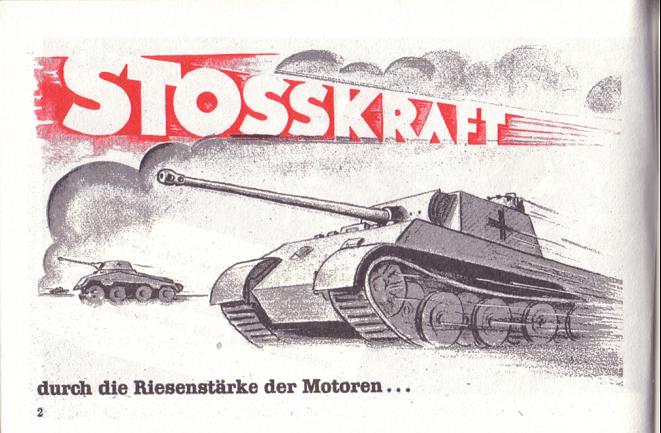
Striking power... thanks to the force of engines!
Page 3
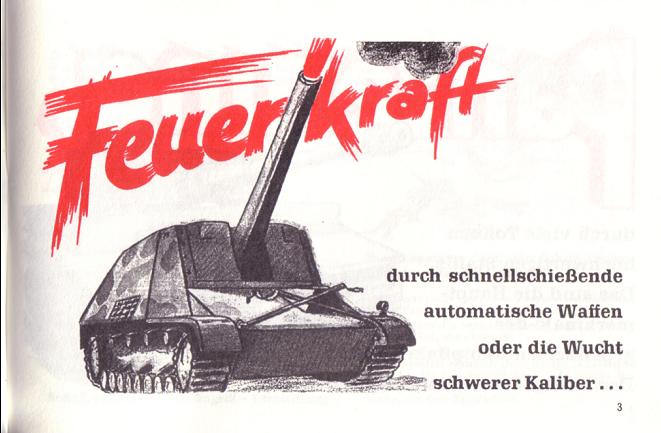
Firepower... thanks to the high rate of fire of automatic weapons and the effect of large-calibre arms!
Page 4
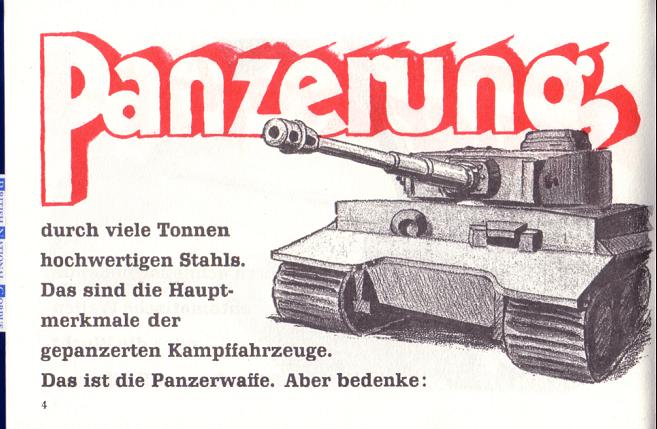
Armour protection... thanks to many tonnes of quality steel! That is what armoured fighting vehicles are. That is the Panzerwaffe.
Page 5
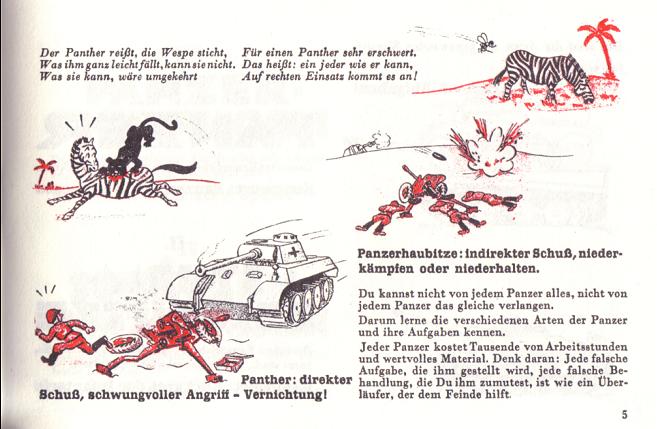
The Panther tears, the Wespe (wasp) stings – in other words, every vehicle has its own particular purpose. You must learn to tell the different types of armoured equipment apart and understand what each is for. Every machine represents thousands of hours of labour and vast quantities of material, and every wrong decision about its use is like a deserter helping the enemy.
Page 6
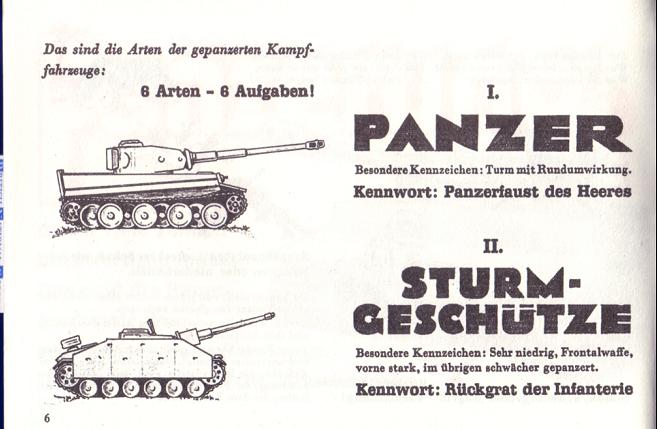
Six types of armoured vehicle – six types of task. First come tanks, whose distinguishing feature is the rotating turret. Tanks are the army's fist. Next are assault guns – low-profile, heavily armoured at the front but less so on the other faces. Assault guns are the backbone of the infantry.
Page 7
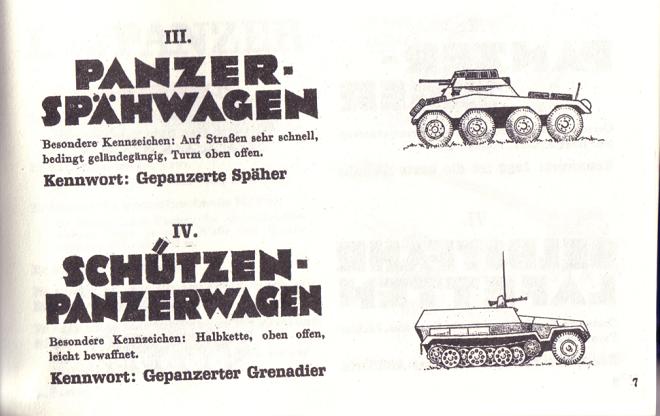
The third type is the armoured reconnaissance car, whose distinguishing features are high road speed and dependence on favourable terrain. They are the armoured scouts. Then come armoured personnel carriers – half-tracked and usually only lightly armed.
Page 8
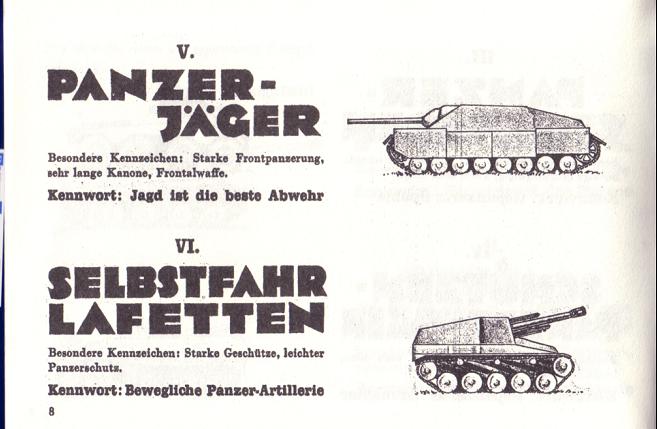
Tank destroyers are type number five. They have heavy frontal armour and a very long gun barrel. Their motto is "the best defence is attack". Self-propelled guns, the sixth type, are distinguished by their heavy weapon and only light armour protection.
Page 9
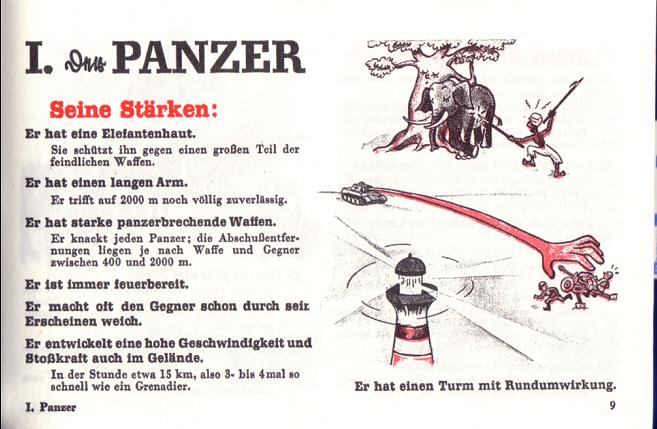
The tank is the first of the types described. Its strengths include its "elephant skin" and an "arm" that can reach 2,000 metres and punch through the armour of an enemy tank. The tank is combat-ready at all times and moves three times faster than a foot soldier.
Page 10
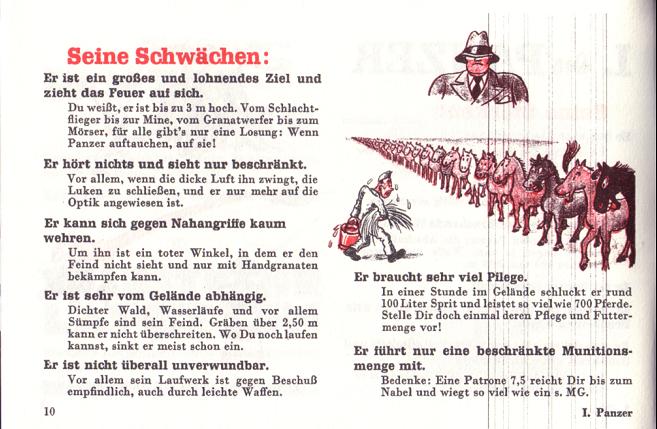
But the tank has its weaknesses too. It is a large and tempting target that draws fire from the enemy's weapons. It cannot hear and sees poorly, struggles to defend itself against close-range attack, needs a great deal of maintenance, is not invulnerable despite its heavy armour, and carries only a limited supply of ammunition.
Page 11
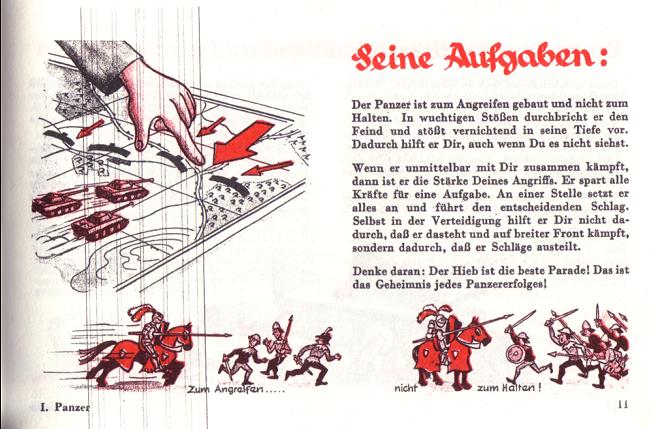
Tanks are built for attacking, not for standing around. Their task is to cut deep into enemy lines. When you fight alongside one, you will see what force it can add to an attack. Even in defence, a tank must not stand still but sally out to strike.
Page 13
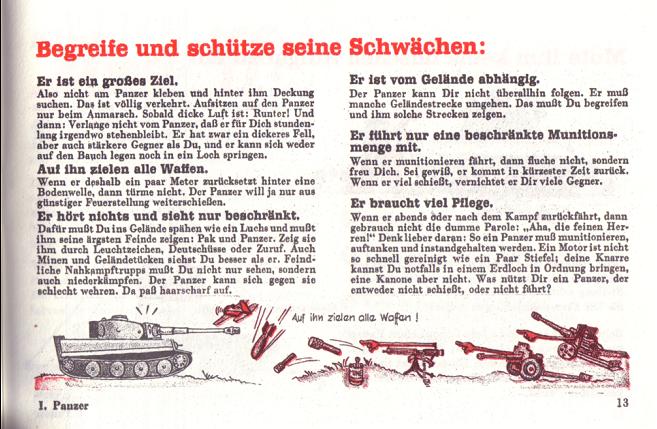
A tank has weaknesses you must help to protect. It is a large target and draws every enemy weapon towards it. It sees and hears poorly, so you must look out for it and warn it of the enemy. On top of that, the tank is dependent on terrain conditions and carries only a limited supply of ammunition.
Page 16
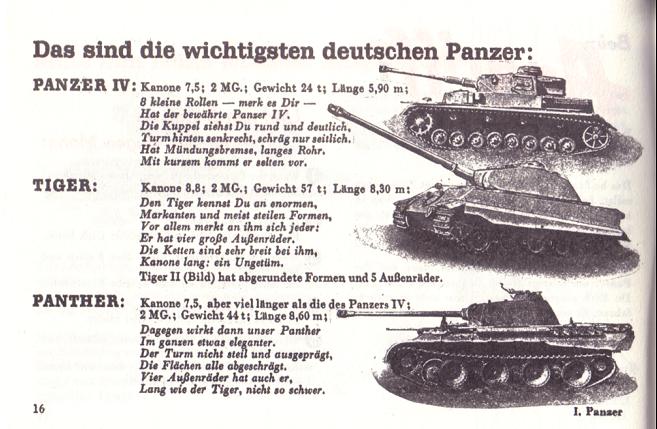
These are the real German tanks: the 24-tonne Panzer IV with a 75 mm gun, the 57-tonne Tiger with an 88 mm gun, and finally the Panther with a 75 mm gun and a weight of 44 tonnes.
Page 17
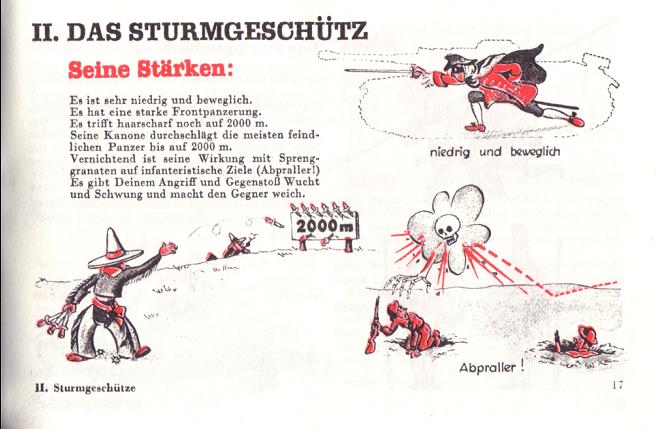
The next type of vehicle is the assault gun. Its advantages are a low silhouette, high mobility, strong frontal armour and accuracy at ranges of up to 2,000 metres. Its gun can readily punch through an opponent's armour or decimate enemy infantry.
Page 18
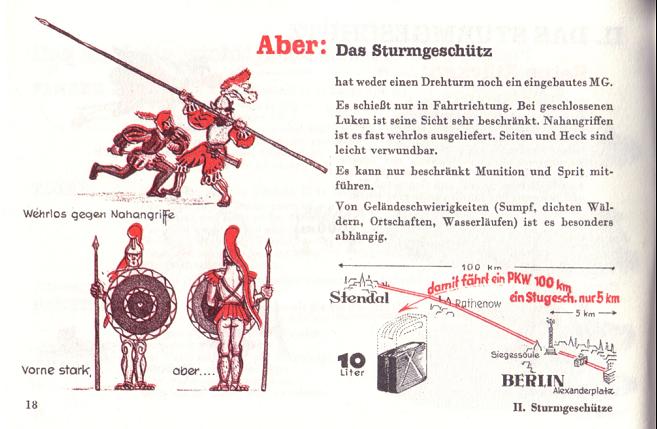
The Sturmgeschütz has no rotating turret and no integral machine gun armament. It can therefore only fire in the direction of travel and is defenceless against close infantry attack. The side and rear armour is relatively thin, and the supply of ammunition and fuel is limited.
Page 19
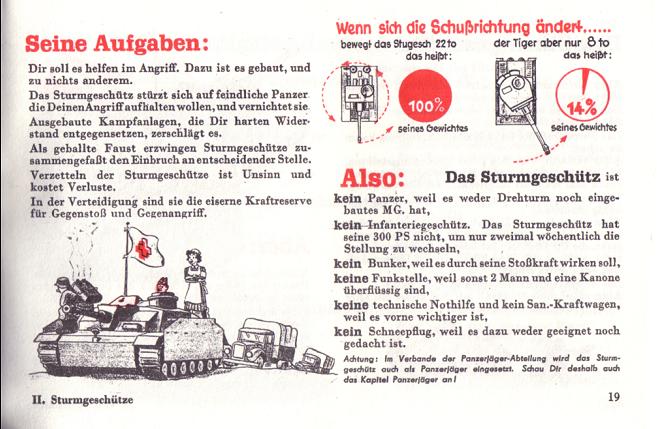
The StuG's task is to help you in the attack – that is what it was made for. A StuG is not a tank, not a field gun, not a bunker, not a radio station, not an ambulance. It is a clenched fist that helps you break through enemy lines. The StuG's disadvantage is that, unlike a tank, it has no rotating turret and must therefore move 100% of its own weight in order to aim.
Page 21
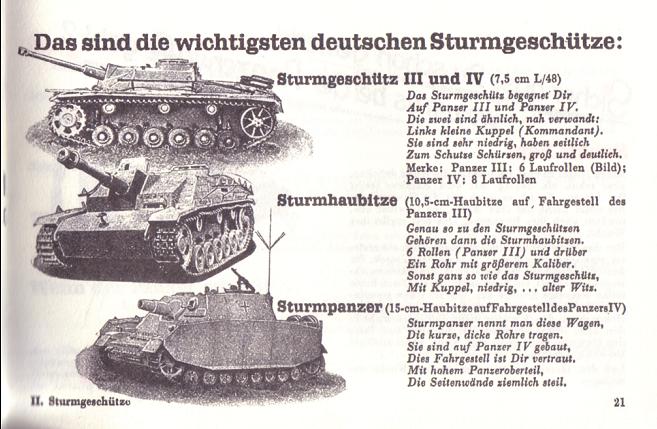
And these are the German assault guns: the Sturmgeschütz III and Sturmgeschütz IV, both with 75 mm guns; the Sturmhaubitze with a 105 mm howitzer; and finally the Sturmpanzer IV – also known as the Brummbär – with a 150 mm gun.
Page 26
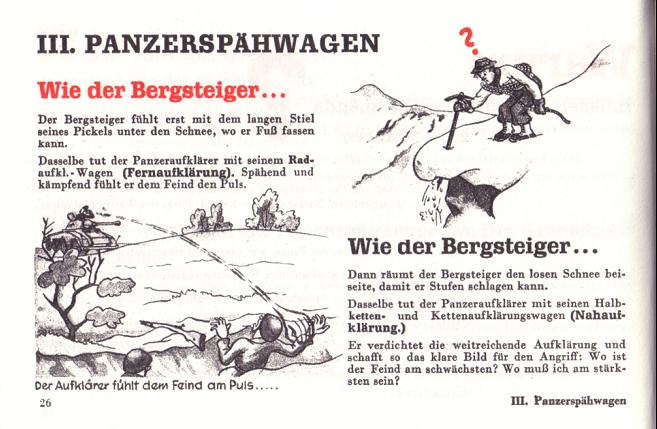
Reconnaissance works like the pick handle a mountaineer uses to test where he can safely step. Reconnaissance troops take the pulse of the enemy. They must find out where he is weakest – and where the attack must therefore strike hardest.
Page 27
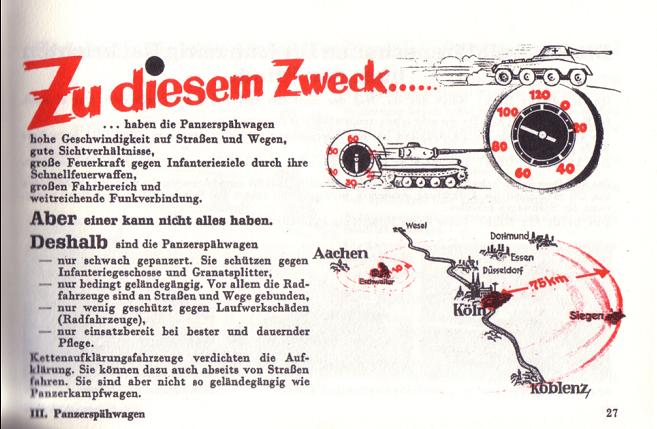
Armoured reconnaissance cars are tailored to their purpose. They are fast, carry observation equipment, have a long operational range and relatively effective anti-infantry armament. On the other hand they have only light armour and are road-dependent. Half-tracked reconnaissance vehicles offer perhaps slightly better cross-country capability.
Page 28
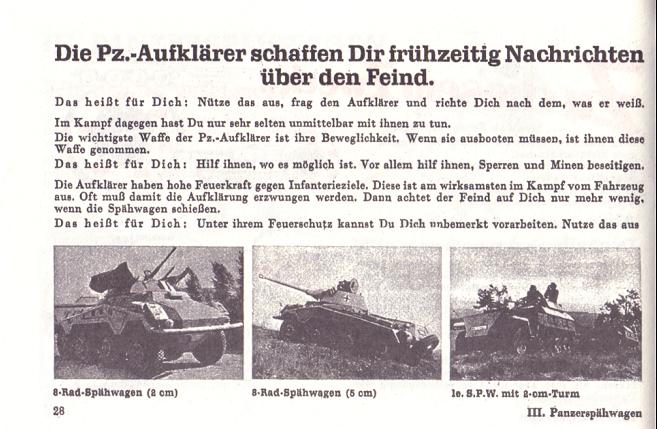
The greatest weapon the reconnaissance troops have is their speed. When they have to dismount from their vehicles, they lose this weapon. So help them by clearing obstacles and mines. An armoured car can also assist you with its firepower, especially during engagements against enemy infantry.
Page 29
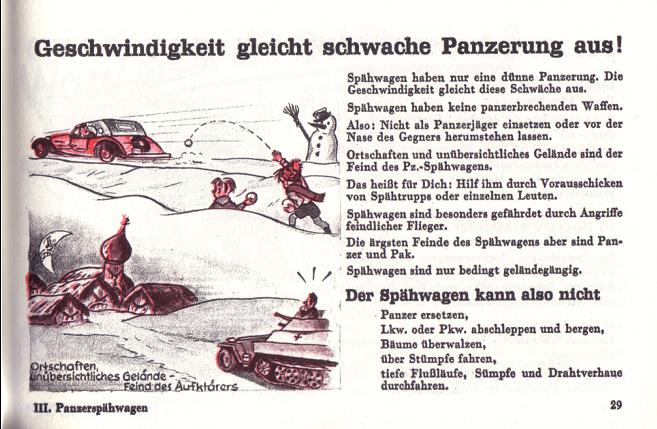
The speed of armoured cars is offset by their thin armour, and for this reason they must not approach enemy tanks or anti-tank guns. Aircraft are also a serious threat to them, as are built-up areas and terrain with restricted visibility.
Page 30
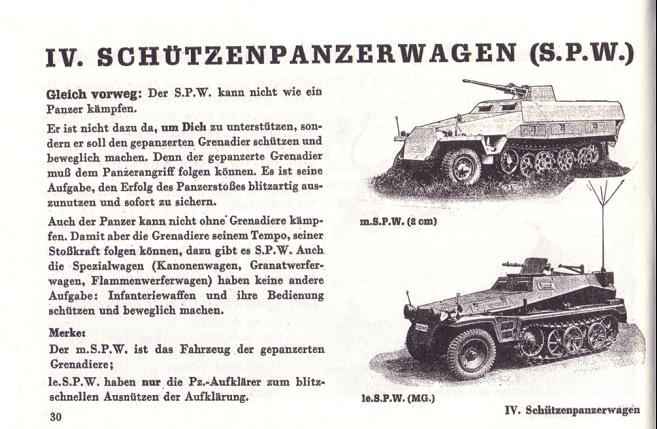
Armoured personnel carriers cannot support you in the same way tanks do, as they are intended primarily for transporting grenadiers. Their purpose is to allow grenadiers to keep pace with a lightning tank attack. At the same time they can also carry out reconnaissance tasks.
Page 31
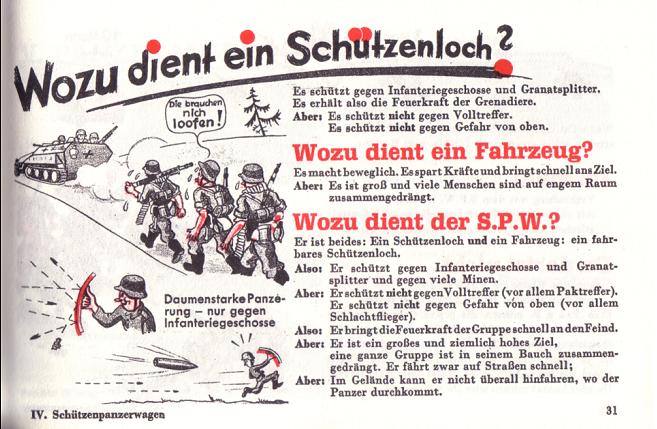
Armoured personnel carriers combine the qualities of a vehicle and a trench. They protect against small-arms fire and shell splinters, but not against heavier weapons or threats from above. They deliver soldiers to the objective faster, but at the same time force them to be crowded into a small space – which is dangerous if the vehicle takes a hit.
Page 32
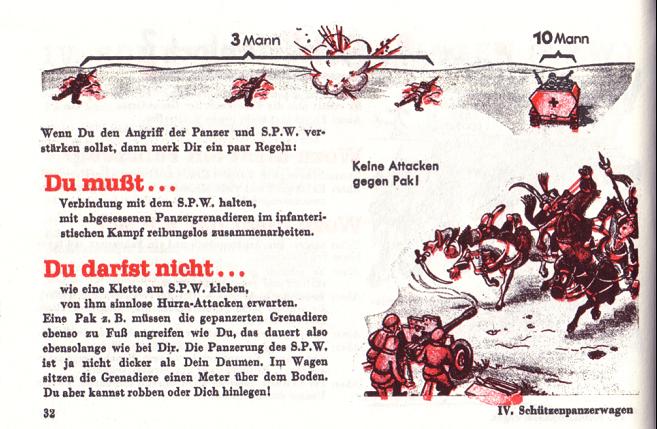
Armoured infantry don't always have it as easy as you might think, riding in their armoured carrier. They sit a metre above the ground and, unlike you, cannot quickly go to ground and crawl. And when they attack against an anti-tank gun they have to go on foot, just like you.
Page 33
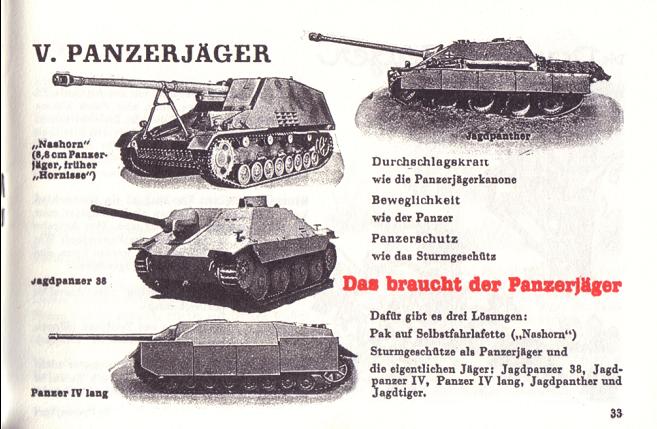
And what tank destroyers does the German army have? The Nashorn – an anti-tank gun on a self-propelled mount; assault guns serving in the tank-hunting role; and finally the purpose-built tank hunters: the Jagdpanzer 38, Jagdpanzer IV, Jagdpanther and Jagdtiger.
Page 34
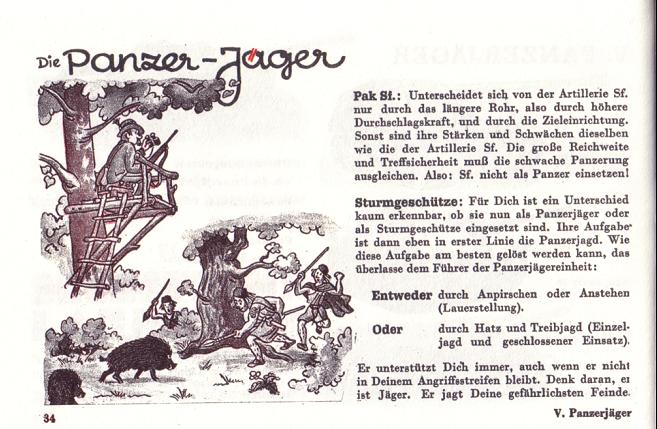
You can tell tank destroyers from self-propelled guns by their long barrel. Long range and accuracy are typical for them. These advantages are however offset by relatively thin armour. Assault guns can also perform the tank-destroyer role when called upon.
Page 36
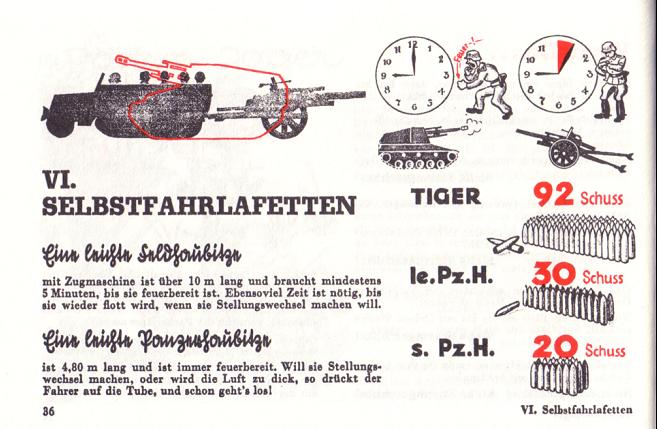
A towed gun together with its tractor measures more than 10 metres in length and takes roughly five minutes to be ready to fire. It then needs another five minutes to be limbered up and ready to move again. A self-propelled gun is less than five metres long and is ready to fire or move at any moment.
Page 37
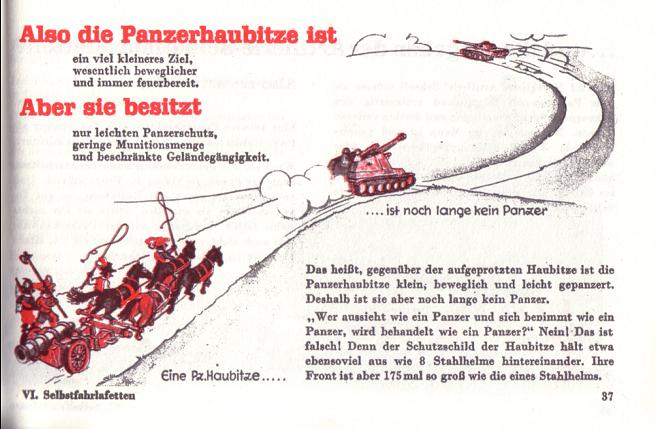
A self-propelled gun thus presents a smaller target, is more mobile and is always ready to fire – but it is not a tank! It is dependent on passable terrain, carries a limited supply of ammunition and has only thin armour. The frontal armour of a self-propelled gun is only 8 times thicker than your helmet, yet its surface area is 175 times greater than that of a helmet.
Page 38
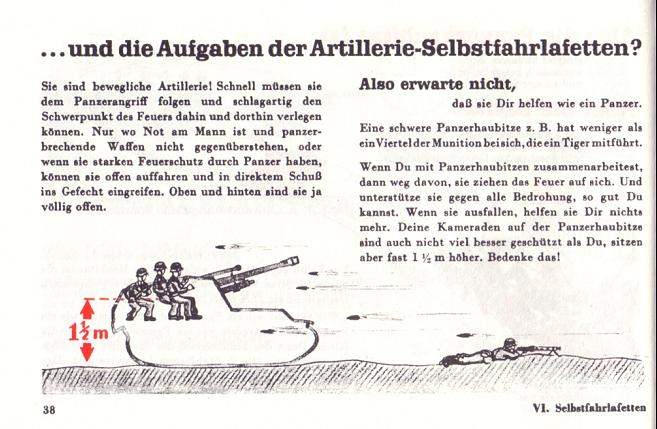
The task of self-propelled guns and howitzers is to follow tanks rapidly in the attack and shift their fire support swiftly to wherever it is needed. Self-propelled guns should engage in direct combat only in an emergency.

Reproducing text from the Panzernet website without the written consent of the operator is prohibited.