LAFFLY W 15 T
armoured personnel carrier on a French chassis
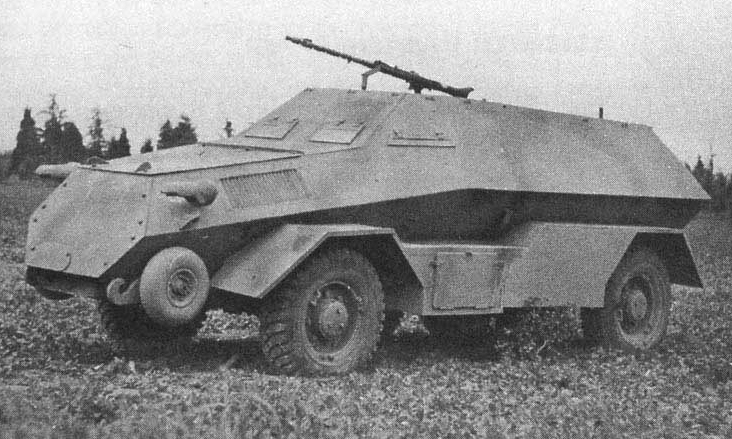
Laffly W 15 T, four-wheel version; source: topwar.ru, edited
When France was conquered in 1940, large numbers of Laffly W 15 T light trucks fell into German hands along with other equipment. The Germans used these vehicles primarily for their original purpose – as cargo trucks – but a smaller number were converted into armoured infantry carriers.
The vehicles received a new armoured superstructure similar to that of the Sd.Kfz. 251 half-track. Behind the engine compartment, the driver and vehicle commander sat side by side. Their position led directly into the troop compartment without any dividing wall. The top of the troop compartment was left open, which on one hand meant reduced protection against enemy fire and the elements, but on the other allowed the infantry to bail out quickly over the sides and to fire their personal weapons just as easily.
The hull side walls were angled, breaking at mid-height so that the upper and lower halves met at a relatively sharp angle. This sloping increased their resistance to enemy projectiles. The vehicle's only organic weapon was an MG 34 machine gun, 7.92 mm calibre, mounted on the forward edge of the troop compartment.
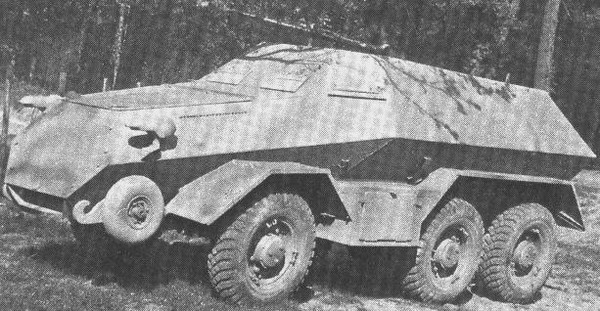
Laffly W 15 T, six-wheel version; source: topwar.ru, edited
The original French trucks were six-wheelers, and the first German armoured carriers built on their basis were likewise six-wheeled. A four-wheel version appeared later, however, in which the middle axle was removed and the space it had occupied on the chassis was blanked off with sheet metal, as can be seen in the first photograph.
An interesting feature was a pair of small wheels mounted at the very front of the vehicle, beneath the front mask. These wheels prevented the nose of the vehicle from digging into the ground, making it easier to negotiate uneven terrain. The Germans retained this design feature on the converted armoured carriers.
The exact number of carriers produced is not known, but it was most likely only a handful of vehicles. These were then in all probability deployed on the Western Front as part of the so-called Schnelle Brigade West, a formation composed almost entirely of converted French equipment.
Reproducing text from the Panzernet website without the written consent of the operator is prohibited.