WILTON FIJENOORD/KRUPP
an armoured car with a tangled fate
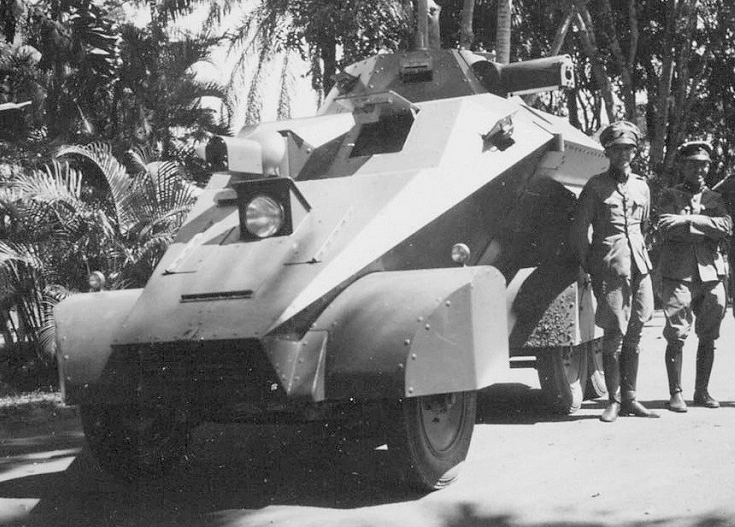
Wilton Fijenoord armoured car in colonial service on the island of Java, source: militarymodels.co.nz with the permission of the site operator, edited
A Vehicle for the Dutch Colonies
The Krupp light truck in the L2H 43 variant was manufactured by Krupp between 1933 and 1936 (later succeeded by the L2H 143 version). The vehicle served in a number of roles — transporting cargo and infantry, and towing lighter weapons. Given how widely it was used, it was also the basis for several field conversions into self-propelled guns. Beyond these, at least one official armoured car was also built on its chassis. This was not, however, for the German Army, but for the Kingdom of the Netherlands. Nevertheless, this vehicle can be counted among the German World War II armoured cars — the reason for which will be explained below.
In August 1933, the Dutch Ministry of Colonies was looking for an armoured car to serve in its East Indies territories. The company Wilton Fijenoord of Rotterdam responded to this requirement by building an armoured body for installation on the chassis of the aforementioned German vehicle, the Krupp L2H 43. Originally the car was planned with just a single machine gun in a rotating turret. The final version, however, carried three machine guns in total: one in the front hull wall, one in the rear hull wall, and a third in the turret. Thanks to this arrangement, the machine guns could cover virtually the entire area around the vehicle with their fire. The weapons were housed in a kind of jacket or sleeve that protected — and apparently also cooled — their barrels. Because of the thickness of these sleeves, the guns gave the immediate impression of cannons rather than machine guns. The on-board ammunition supply was 6,000 rounds.
Vehicle Description
The chassis was a three-axle layout with single wheels at both front and rear. The wheels were protected by large armoured mudguards, with the two rear wheels sharing a single common mudguard. Above this, on both sides of the vehicle, was a closable storage box for carrying various equipment. The hull was riveted together from flat steel plates — 3 mm thick on the floor and roof and 10 mm on all other walls. The front of the hull followed the sharply raked line of the original engine bonnet, which increased the effective armour protection. The lower portion of the nose served as the air intake for the powerplant and was fitted with steel louvres. An interesting feature of the front wall was a headlight mounted in the centre, which could apparently be folded flush into the armour. The side and rear walls were also steeply angled.
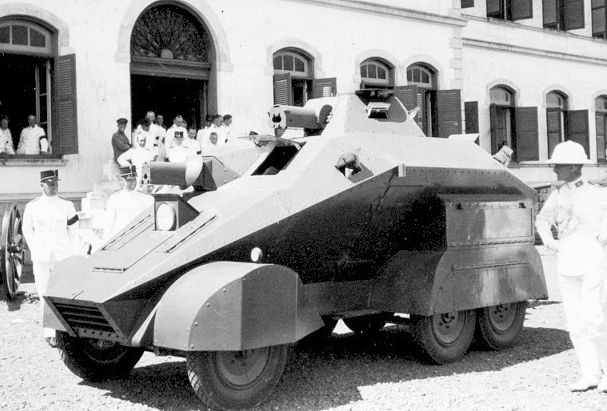
Wilton Fijenoord armoured car in colonial service on the island of Java, source: militarymodels.co.nz with the permission of the site operator, edited
The vehicle had two driver's stations to make reversing easier. Reversing an armoured car was by no means a straightforward task: from the front station, the driver had no view whatsoever behind the vehicle, and turning the whole car around was sometimes simply impossible in combat conditions — for instance when stuck in a narrow street or among rubble. The installation of a second driver's station was therefore fairly standard practice for this type of vehicle.
The armoured car inherited its powerplant from the original truck: a Krupp M304 four-cylinder petrol engine with a displacement of 3.3 litres, producing a maximum output of 60 horsepower at 2,500 rpm. The gearbox was a four-speed Aphon unit. So equipped, the 4.5-tonne vehicle could reach a top road speed of up to 70 km/h. The fuel tank capacity is usually given as 65 litres — if correct, this represents a reduction from the original Krupp Protze truck's 110-litre tank. Even so, the fuel supply was reportedly sufficient for a range of up to 250 kilometres on road. The crew comprised three men. The commander had his station in the turret and also operated the turret machine gun. The front and rear drivers each additionally manned one of the hull machine guns. Entry and exit for the hull crew was via large doors in the lower portion of the side wall, in the space between the front and the two rear axles. The commander had his own hatch in the turret roof.
A Great Disappointment
The Dutch factory completed a total of three examples of this vehicle. Initial trials in the Netherlands produced promising results, and in April 1934 two of the vehicles were shipped to the Far Eastern colonies and put into service on the island of Java. The results in actual operational use proved more disappointing than successful, however. The vehicles turned out to be too heavy for the local unpaved roads and bridges. The air-cooled engine had a tendency to overheat, and — even more problematic — it was unable to run properly on the lower-quality petrol produced by the local refinery. The soldiers were therefore forced to use the only higher-grade fuel available to them, namely aviation petrol, which naturally created logistical complications. Both vehicles were consequently returned to the manufacturer as unsuitable for local conditions, and the entire programme was cancelled.
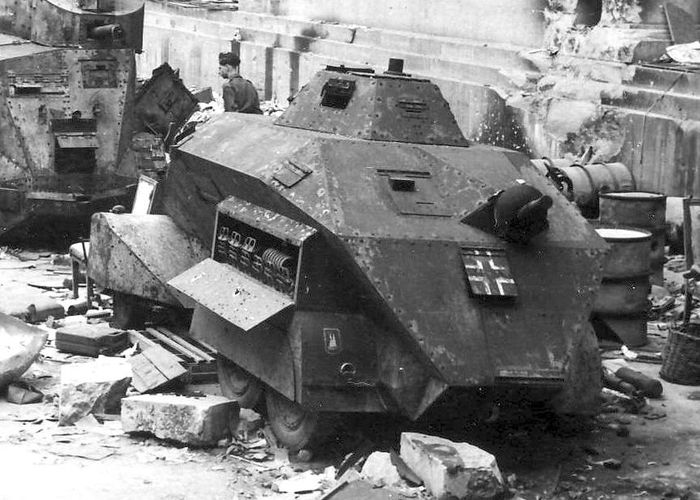
wreck of the Dutch armoured car in the courtyard of the Reich Chancellery in captured Berlin, source: militarymodels.co.nz with the permission of the site operator, edited
From Java to Berlin
Wilton Fijenoord managed to sell the two returned vehicles to Brazil the following year, where, after a number of modifications, they were assigned to police units in São Paulo. As a curiosity, among those modifications was the replacement of the machine guns with tear-gas projectors, as the vehicles were intended primarily for dispersing demonstrations. The factory, however, did not know what to do with the third example until it finally managed, in 1936, to agree a sale to the Dutch government for use by the army. After all, the vehicle had performed well during trials under "continental" conditions. Payment for the vehicle was reportedly settled by means of a tax concession.
In 1938 the vehicle was assigned to an artillery unit. When the Netherlands was overrun in May 1940, this vehicle fell undamaged into the hands of the German Army. As for its subsequent fate, two entirely different accounts can be found. According to the first, the vehicle remained in the Netherlands, where it was used by German occupation forces, who then took it with them when they withdrew. According to the second version, Wehrmacht representatives reasonably concluded that attempting to put such a one-of-a-kind vehicle to combat use would be wholly impractical, and so it ended up as an exhibit in a Berlin technical museum.
Either way, with some latitude we can count this vehicle among the German World War II armoured cars, because the Germans pressed it into service out of sheer desperation during the literal last days of the war — against the Soviet forces storming Berlin. Whether it actually saw combat or not will probably remain an unanswered question. What is certain is that the damaged wreck of this vehicle was found in the very heart of captured Berlin, in one of the courtyards of the Reich Chancellery. After the war ended it was most likely stripped and scrapped.
ARTICLE
CONTENTS:
Reproducing text from the Panzernet website without the written consent of the operator is prohibited.