ADKZ
an Austrian project the Germans never adopted
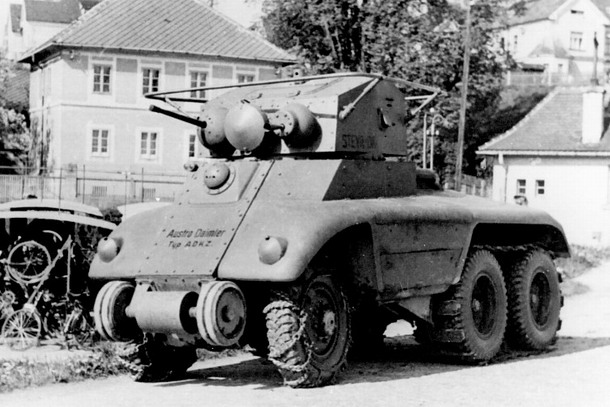
the final ADKZ prototype, note the chains on the front wheels and the improvised tracks on the rear wheels, source: warwheels.net with the permission of the site operator, edited
Origins of the Vehicle
The armoured car ADKZ cannot in any sense be described as a representative of German combat equipment in World War II, yet it certainly deserves a mention in this section. The ADKZ was developed by Steyr-Daimler-Puch on an order from the Austrian Army. Development ran from 1935 to 1937, when a fully representative prototype in production-ready form was completed. In addition to this final example, two earlier evaluation vehicles were most likely also built, which differed from the final prototype — and apparently from each other — in various details.
Vehicle Description
The designation ADKZ was an abbreviation of Austro Daimler Kraft Zugwagen. The vehicle had a three-axle chassis with all-wheel drive. The front axle was steerable and fitted with single wheels; the rear axles had doubled wheels, giving the vehicle ten wheels and tyres in total. The rear axles were suspended on each side by a single shared leaf spring. To improve handling — especially on soft ground — chains could be fitted to the front wheels and improvised tracks pulled over the wheels of both rear axles. The hull was of simple, angular construction, built from flat plates joined by welding and riveting. Armour thickness ranged from 8 to 14.5 mm. The nose of the front wall was formed by the junction of the upper and lower plates, from which the upper plate rose to the flat hull roof, on which the rotating turret was mounted.
In the upper portion of the front wall was a relatively large rectangular driver's visor. Behind the turret platform the hull roof stepped down and gave way to a horizontal engine compartment roof panel fitted with several service and ventilation openings. Further back, this panel kinked and angled down towards the rear. The vehicle's turret was angular in shape and carried all of the integral armament: a 20 mm anti-tank cannon and an 8 mm machine gun. The cannon was mounted on the right-hand side of the turret's front wall and the machine gun on the left, each in its own spherical ball mount. Between the two weapons, the early prototypes had a vision port, while the final version of the vehicle had a large headlight housed in a closable round metal cover. The on-board ammunition supply comprised 150 rounds for the cannon and 3,000 rounds for the machine gun.
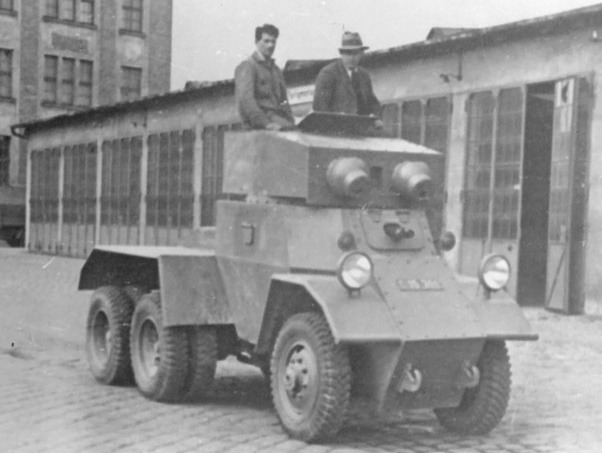
the first ADKZ prototype, note the angular mudguards and the original headlights, source: warwheels.net with the permission of the site operator, edited
The turret roof was angled: its front section was sloped, the rear section flat. In the front portion was the main crew hatch, closed by a two-piece lid. The side walls and rear wall all had closable observation ports that could also be used for firing personal weapons. The vehicle's powerplant was a water-cooled, petrol-powered Austro Daimler M 650 six-cylinder engine with a displacement of 4,994 cc, producing a maximum output of 108 horsepower at 2,500 rpm. The Voith JDR 2.54/3.3M 2 gearbox offered three ratios for travel in both forward and reverse directions. The ADKZ weighed 8 tonnes and had a top speed of 75 km/h. It measured 4,765 mm in length, 2,416 mm in height and 2,400 mm in width. Cross-country range was approximately 300 km; on roads it was around 400 km. The crew comprised three or four men.
The early prototypes had very simply designed angular mudguards — one individual guard for the front wheel and a longer shared guard for both rear wheels. The space between the front and rear mudguards was left open on the early prototypes. Two tow hooks for attaching tow ropes were fixed to the lower portion of the hull's front wall. Large conventional automobile-style headlights were mounted on the front mudguards. A pair of horns was also originally fitted to the front wall. Two further headlights on the rear mudguards faced rearward and were used when reversing.
In its final form, however, the vehicle had mudguards with rounded edges. On at least the left-hand side, the space between the front and rear mudguard was enclosed to create a storage compartment for tools and equipment, so the front mudguard effectively flowed continuously into the rear one. The original automobile-style headlights were replaced on the last prototype by smaller lights recessed directly into the mudguards, which could be covered by a metal shield. On the lower portion of the hull's front wall, where the tow hooks had previously been, a small additional axle with two solid wheels now appeared. These served purely as an aid to prevent the vehicle from becoming high-centred when crossing large obstacles. A sizeable frame antenna was also fitted around the turret, mounted on four struts. The antenna can be seen in photographs of the earlier prototypes too, however, so it was not exclusive to the final example.
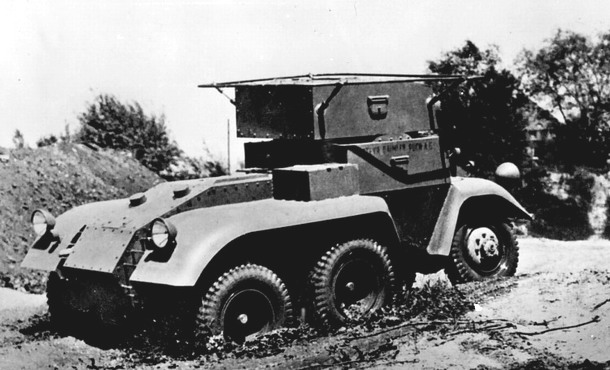
apparently the second ADKZ prototype, which already has rounded mudguards but still retains the original headlights, source: warwheels.net with the permission of the site operator, edited
End of the Project
The completion of prototype testing and the placing of a series production order were cut short in March 1938 by Austria's annexation into the Nazi Third Reich. The Germans had no interest in proceeding with production of this vehicle, and the entire project was cancelled. The prototypes that had been built most likely never saw any combat deployment during World War II.

ARTICLE
CONTENTS:
Reproducing text from the Panzernet website without the written consent of the operator is prohibited.