PANZERSPÄHWAGEN AB41
an Italian armoured car produced for the Wehrmacht as well
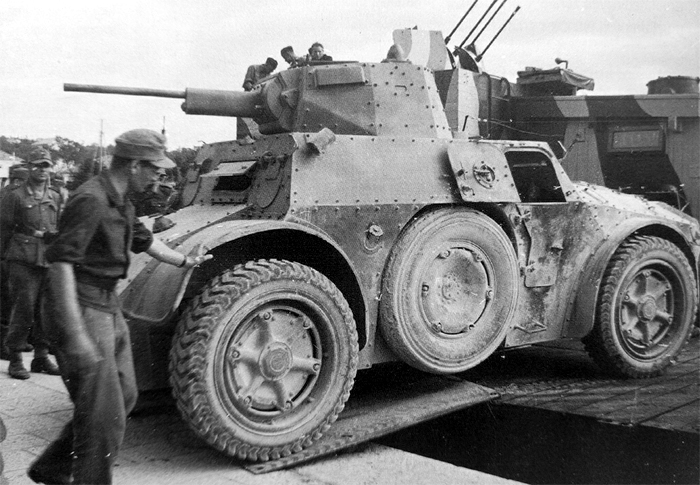
Panzerspähwagen AB41 201(i) deployed by the German army, most likely somewhere in Yugoslavia, source: flickr.com with the permission of the publishing user, edited
Italian Booty
It took just a few months of 1943 to shake the Italian alliance with Nazi Germany to its core and bring it crashing down like a house of cards. In May of that year, the last remnants of the German-Italian forces in Tunisia surrendered, ending Italy's presence on the African continent for good. In July, Allied forces landed in the south of Sicily, and it was plain for all to see that the next step would be an invasion of the Italian mainland. The country's political leadership began to consider how best to face the inevitable, and concluded that a swift change of sides was the most advantageous option. After Allied aircraft bombed Rome itself on 19 July, events moved quickly. On 25 July 1943, Mussolini was voted out as Prime Minister by the Grand Council of Fascism and, for good measure, promptly arrested.
The Germans were, of course, watching all of this closely and had little difficulty working out what was likely to come next. Italy's newly appointed Prime Minister, Pietro Badoglio, assured the Germans that Italy would remain on their side, but the Wehrmacht had already begun preparing for swift action in the event of Italian treachery. And treachery duly arrived on 3 September 1943. On the same day that British forces landed on the Italian mainland, the Italians signed an armistice with them. By the time this was made public — which did not happen until 8 September — German units were already on alert and launched an operation codenamed Achse (Axis). Among the primary objectives of this operation were the occupation of as much Italian territory as possible and the rapid disarmament of the Italian Army. In the course of this disarmament, the Germans seized enormous quantities of weapons from their now former ally, including nearly a thousand armoured fighting vehicles of all types — among them approximately two hundred armoured cars of the type Autoblinda 41, or AB41 for short.
Origins of the Vehicle
But rather than beginning in the middle of the story, let us go back to the beginning and look at what happened before the Italian Autoblinda 41 became the captured German Panzerspähwagen AB41 201(i). The story of this armoured car began in 1937, when the Italian Army drew up a requirement for the development and production of a modern wheeled armoured vehicle to replace outdated and inadequate types such as the Lancia 1ZM and the FIAT 611. At virtually the same time, the Italian colonial police (Polizia dell'Africa Italiana, or PAI), responsible for maintaining order in Italy's African colonies, was calling for exactly the same thing. These police units also had to rely on the ancient Lancia 1ZM and the only marginally younger Terni Tripoli, and were pressing hard for modern equipment.
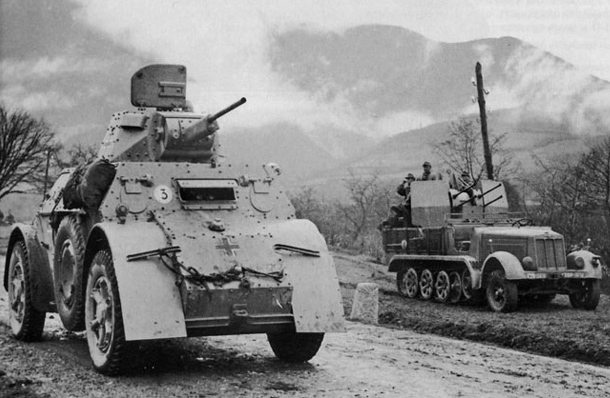
Panzerspähwagen AB41 201(i) and an Sd.Kfz. 7/1 fighting against partisans in the Yugoslav mountains; the vehicle has been fitted with extended front mudguards to protect the tyres from being shot out, source: flickr.com with the permission of the publishing user, edited
The army wanted a vehicle designed primarily for reconnaissance within armoured formations — fast, agile, long-ranged, and capable of handling difficult terrain. The colonial police needed something with which they could suppress local unrest and insurgent activity across the vast and remote expanses of Italy's colonial territories, which at the time comprised Libya, Eritrea, Ethiopia and Somalia, their combined area roughly ten times that of Italy itself. The police therefore needed a vehicle that was fast, agile, long-ranged, capable of handling rough terrain and extreme climatic conditions. The representatives of the two firms approached — FIAT-SPA of Turin and Ansaldo of Genoa — presumably had little trouble recognising that the army's and the police's requirements were, in essence, almost identical. And from that realisation it was only a short step to the idea of joining forces and satisfying both customers at once: building a single armoured car that could be lightly adapted to meet the specific wishes of either organisation.
The two firms therefore embarked on the development of such a vehicle as a consortium. It is worth noting that while SPA was a separate company in its own right (its full name being Società Piemontese Automobili), it was a subsidiary of FIAT, which is why it is usually referred to as FIAT-SPA. The designers at FIAT-SPA happened at the time to be working on a new artillery tractor, the Trattore Medio Modello 1940 (TM40), and decided to use certain elements of its chassis for the new armoured car as well. A full-size wooden mockup of the vehicle was built in April 1938. Once representatives of the army and the colonial police had approved the proposed design, work began on two prototypes — one for the army and one (with a few minor differences) for the police.
First Prototypes
The completed prototypes were demonstrated to representatives of both armed services on 15 May 1939 under the designation AutoBlindoMitragliatrice, or ABM (literally "armoured machine-gun car"). While the army prototype was tested in Italy, the police prototype travelled to Italian East Africa — the territory of present-day Eritrea, Ethiopia and Somalia — for trials under the conditions of its intended operating environment. Between 3 June and 12 September 1939 the vehicle completed a gruelling 13,000-kilometre journey without major difficulty. Both the army and the police were very satisfied with the new type. After the trials, both organisations submitted a few requests for changes, but these amounted to no more than minor details. The only significant requirement came from the army and concerned the firepower: instead of two machine guns in the fighting turret, the military now wanted a combination of one machine gun and a 20 mm cannon.
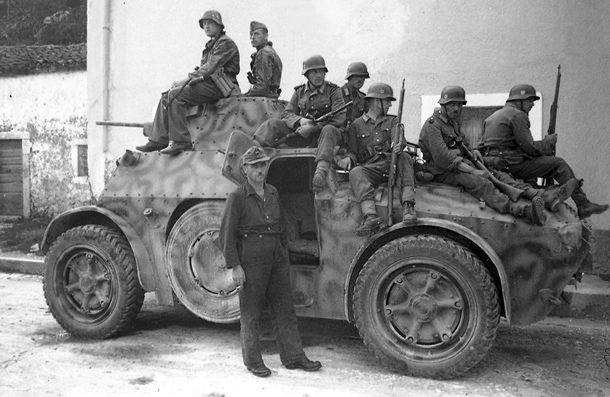
Panzerspähwagen AB41 201(i) loaded with infantry, preparing to set out on patrol somewhere in the vicinity of the Yugoslav town of Opatija, source: flickr.com with the permission of the publishing user, edited
AB40 and AB41
By this point it was already March 1940, Europe was at war, and the Italians could not afford to delay production of the new armoured car. It was therefore decided to proceed with series production of the machine-gun-armed version, while the manufacturer would simultaneously continue developing a cannon-armed variant. The vehicle received the official designation Autoblinda Modello 1940, or AB40 for short, and the FIAT-SPA and Ansaldo consortium received an order for 176 units for the army and 9 for the police. In the event, getting production of the new vehicle up and running took considerably longer than the military and political authorities had probably anticipated. Series production did not effectively begin until January 1941, and the first five complete vehicles were not finished until March of that year. The slow start to first-generation production at least gave the designers enough time to work on the second generation, which received a new fighting turret with the requested 20 mm cannon and the designation AB41. And so it came about that when the first five production AB40s rolled out of the factory in March 1941, production of the newer AB41 was already getting under way. As a result, only 24 examples of the purely machine-gun-armed AB40 were ever built. We will leave the AB40 at this point and focus from here on exclusively on the AB41.
Vehicle Description
The AB41 rode on a chassis with four independently suspended large-diameter wheels, all of which were both driven (4×4) and steerable — meaning the rear wheels also turned when cornering, which considerably improved the vehicle's manoeuvrability. The armoured hull had a load-bearing frame to which the individual steel plates were riveted. Virtually all walls of the hull used plates 9 mm thick (8.5 mm according to some sources), with the exception of the floor and roof, which were only 6 mm. At the front of the hull was the main driver's station, followed by the fighting compartment, which ended at the rear driver's station, beyond which lay the engine compartment housing a water-cooled petrol six-cylinder FIAT-SPA ABM 1 developing 78 horsepower.
When the designers at FIAT-SPA and Ansaldo were developing the AB41, they had planned to fit it with a more powerful 88-horsepower engine. That unit was not available in sufficient numbers in March 1941, however, so the improvement had to be deferred, and the AB41 retained the original weaker engine from the AB40 — at least until the more powerful unit could be procured "in quantity." Fuel for the engine was stored in three interconnected tanks with capacities of 118, 57 and 20 litres, giving a total of 195 litres of petrol. At the very rear of the hull, behind the engine, were two large radiators. Cooling air was drawn into the engine compartment through louvres in the upper bonnet and expelled through a grilled vent in the rear hull wall. Sources give the vehicle's total weight as either 7.5 or 7.8 tonnes. The stated operational range varies between 320 and 400 km, depending on which author you choose to believe. As for top speed, we will return to that shortly.
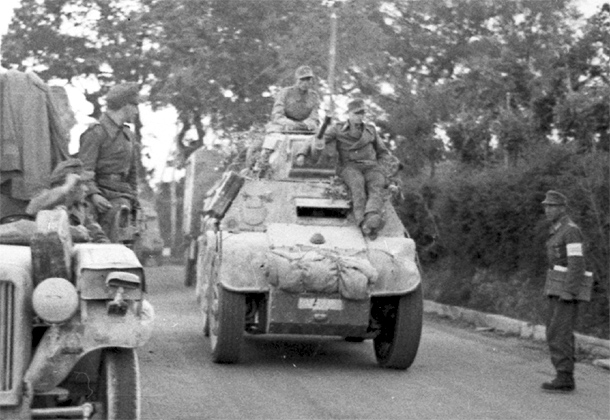
Panzerspähwagen AB41 201(i) passing an Sd.Kfz. 10/4 half-track, source: Bundesarchiv Bild 101I-315-1111-02, Wikimedia, Creative commons, edited
In the front wall of the fighting compartment was a rectangular closable driver's visor, flanked on either side by circular covers concealing the headlights. On both sides of the hull, spare wheels were mounted in recesses in such a way that they could rotate freely, helping the vehicle to negotiate undulating terrain. Immediately behind the spare wheels, the side walls featured entry doors, the upper and lower halves of which opened independently. The rear wall of the fighting compartment had a visor for the rear driver, with the rear machine-gun port mounted beside it. A rear driver's station was nothing unusual on larger armoured cars. If a vehicle found itself in danger and needed to withdraw quickly, turning around to face the enemy could be a serious problem — a large vehicle turning in the face of the enemy made an easy target, and in some situations, such as a narrow road or an urban street, turning around might not even be possible. Reversing was not straightforward either: from his position at the front of the vehicle, the front driver typically had almost no rearward visibility and could easily strike an obstacle. It was precisely for this reason that larger armoured cars were often fitted with a rear driver's station, from which the vehicle could be controlled when travelling backwards — though this was not mere reversing in the ordinary sense. The design of such vehicles typically allowed for more or less full-capability travel in either direction.
And the AB41 was no exception. The vehicle's engine was directly connected to a six-speed main gearbox, behind which was installed a separate reverse gearbox that could invert the direction of rotation at the output of the main transmission. This meant that all six gear ratios could theoretically be used in either direction of travel. In practice, however, only the front driver could access all six gears, while the gear lever at the rear driver's station permitted — for safety reasons — only the first four. The reduced number of ratios available in reverse limited the maximum achievable speed when travelling backwards to around 37 km/h. Going forward, the car could reach approximately 78 km/h (this figure applies to the AB41 fitted with the later, more powerful 88-horsepower engine). The rear driver changed the direction of rotation, and thus the direction of travel, using a changeover lever.
Italian crews reportedly made frequent use of the vehicle's rapid-reverse capability and would attack enemy positions "backwards." With the fighting turret also rotated to the rear, all weapons could be brought to bear simultaneously — those in the turret and the rear hull machine gun. At the same time, the engine was between the crew and the enemy, providing considerably more protection than the relatively thin frontal armour.
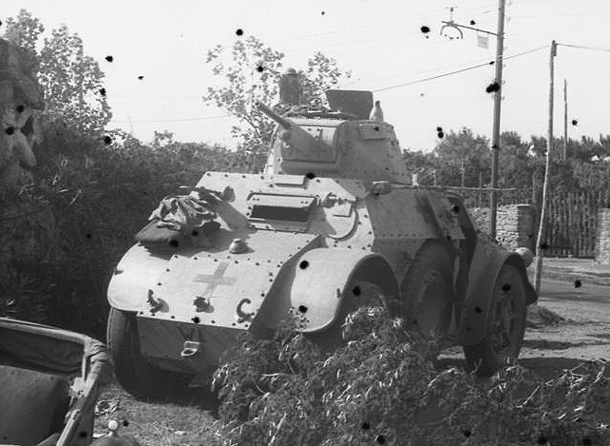
Panzerspähwagen AB41 201(i), apparently in Luftwaffe service, source: Bundesarchiv Bild 101I-304-0608-21A, Wikimedia, Creative commons, edited
The rotating turret, adapted with certain modifications from the light tank L6/40, was mounted on the roof of the fighting compartment. The turret had an octagonal footprint and slightly angled walls, and was again constructed using the technique of riveting armour plates to an angle-iron frame. The bulk of the turret's front wall was taken up by the movable cylindrical gun mantlet housing the cannon and machine gun. The cannon was a Breda 20/65 Modello 1935 of 20 mm calibre, with a barrel length of 65 calibres. It was an automatic weapon with a theoretical rate of fire of 220 to 240 rounds per minute, capable of penetrating somewhere between 27 and 30 mm of vertical homogeneous armour at a range of 500 metres (depending on the source you consult). The cannon was fed from the left side using eight-round magazines — the standard version of this cannon used twelve-round magazines, but the confined interior of the turret required the use of shorter ones. As for the vehicle's on-board ammunition supply, at least two different figures appear in the sources: some state a total of 57 magazines holding 456 rounds, while others give only 43 magazines with 344 rounds.
Secondary armament consisted of two Breda Modello 1938 machine guns in 8 mm calibre. One was mounted to the left of the cannon in a shared mantlet; the other was located in the rear wall of the fighting compartment. The machine guns were fed by 24-round magazines. And as usual, sources cannot quite agree on the size of the machine-gun ammunition supply — some give 1,992 rounds in 83 magazines, others 2,040 rounds in 85 magazines. In any case, the magazines for both the cannon and the machine guns were stored in wooden boxes on either side of the fighting compartment. The hull machine gun could be removed from its mounting and attached to a pintle on the turret roof, allowing it to be used in an anti-aircraft role against low-flying enemy aircraft. The turret roof also featured a crew hatch with a single-piece lid and a rotating observation periscope. The rear turret wall had an ammunition loading port, which was also used when removing the cannon for maintenance.
Virtually all sources agree that the fighting turret for the AB41 was taken from the light tank L6/40. However, they say almost nothing about the modifications the turret had to undergo in the process of being fitted to the armoured car. The most obvious new feature was ventilation louvres in the side walls, protected on the outside by riveted covers (photo HERE). There are, however, certain indications that other, less obvious but arguably more significant structural changes were also made. The first clue is the stated range of vertical weapon movement in the turret's front wall. While the L6/40 tank is typically credited with elevation limits of −12° to +20°, the AB41 is said to have had only −9° to +18°. Was this a consequence of structural modifications to the turret, or simply a minor error in the figures cited? Then there is another matter entirely. The fighting turret of the L6/40 tank had walls 30 mm thick at the front and 15 mm on the sides and rear. How, then, to explain the findings of a British report on the examination of a captured AB41, issued in May 1943 at Chobham, which states that the front wall of the fighting turret has armour 18 mm thick while the remaining turret walls are only 9 mm (figures that some publications also cite)? And photographs, too, reveal a visible difference in the thickness of the front wall between the L6/40's turret and that fitted to the AB41.
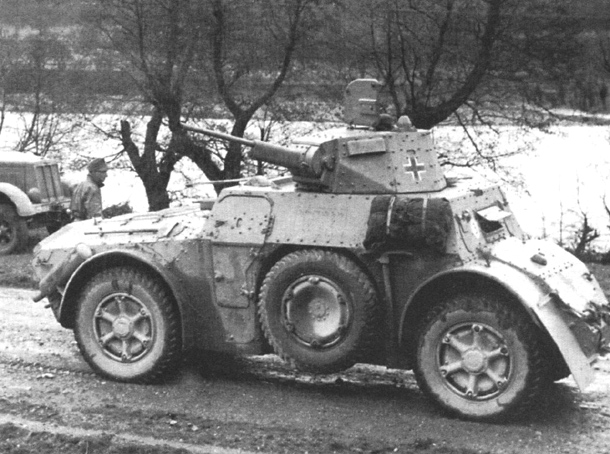
Panzerspähwagen AB41 201(i) deployed against partisans in the Yugoslav mountains, source: flickr.com with the permission of the publishing user, edited
The armoured car's crew comprised four men: a front driver, a rear driver, a radio operator who was also responsible for the rear hull machine gun, and a commander, who operated both weapons in the rotating turret. On the subject of radio equipment, the standard fit was the Magneti Marelli RF 3M, a combined receiver-transmitter. Both units were housed on the left side wall of the fighting compartment and connected to a folding antenna on the left front corner of the hull. Command vehicles, however, carried the RF 2CA set, with its antenna positioned on the left rear corner of the hull instead.
As already mentioned above, the designers at FIAT-SPA and Ansaldo had planned a more powerful engine for the AB41 to compensate for the increased overall weight of the vehicle compared to the AB40. The intended FIAT SPA ABM 2 engine, rated at 88 horsepower, was not available in the required numbers when series production of the AB41 began in March 1941. It was therefore decided that the new AB41 would initially be produced with the same engine as the older AB40 — the FIAT SPA ABM 1, rated at 78 horsepower. As so often happens, this "temporary" arrangement dragged on considerably longer than planned, and the more powerful engine did not begin to be fitted to production vehicles until well into 1942. The majority of AB41s thus left the production line with the original, weaker engine. To be precise: the weaker FIAT SPA ABM 1 (78 hp) was fitted to the first 435 vehicles produced in 1941 and 1942, while the more powerful FIAT SPA ABM 2 (88 hp) was used in the 232 vehicles produced between 1942 and 1944. Which brings us neatly to the total production figure for the AB41: a respectable 667 units.
Some authors go so far as to suggest that AB41 vehicles fitted with the cannon turret but the original engine continued to be designated AB40, and that the AB41 designation was only adopted once the more powerful engine was introduced. This would be consistent with the text of the already-mentioned British examination report, which states that the vehicle examined was an Autoblinda 40 with chassis number 40788, manufactured in 1941 — yet the description unambiguously refers to an Autoblinda 41, as it mentions a 20 mm cannon.
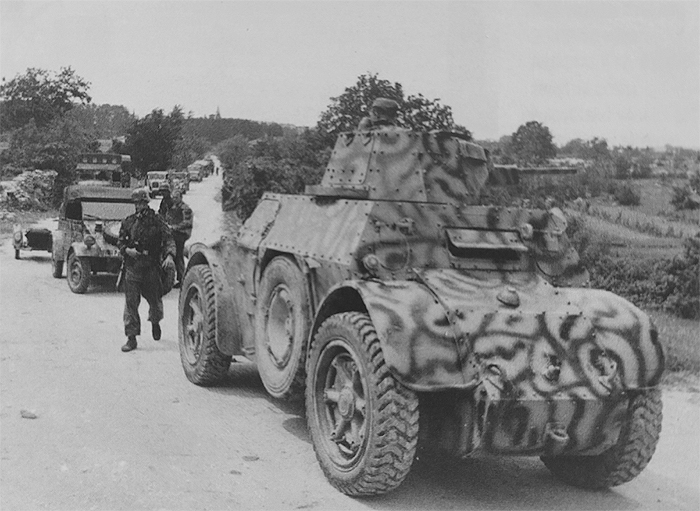
Panzerspähwagen AB41 201(i) deployed most likely somewhere in northern Italy, source: flickr.com with the permission of the publishing user, edited
The principal manufacturers of the AB41 were, as already noted, FIAT-SPA and Ansaldo — though in the latter case it would be more accurate to say not Ansaldo, but Fossati. Final assembly of the vehicles took place at the Genoese suburb of Sestri Ponente, in the factory of Gio. Fossati & C., a subsidiary of Ansaldo. A considerable number of other firms were of course involved in production as well. FIAT-SPA supplied the engines and load-bearing frames; frames were also supplied by Lancia, and armour plate by SIAC. Magneti Marelli provided radio sets, batteries and starters. Tyres came from the Pirelli factories, and sighting equipment from San Giorgio.
Production for the Wehrmacht
This is perhaps the right moment to move forward in time to September 1943 and revisit the German operation Achse mentioned at the outset. As already noted, the disarmament of the Italian Royal Army yielded nearly a thousand armoured fighting vehicles of all types, including approximately two hundred AB41 armoured cars. A full 20 vehicles were reportedly seized directly at the Ansaldo-Fossati factory in Turin. The German Army incorporated these vehicles into its inventory under the new designation Panzerspähwagen AB41 201(i), where the letter "i" in brackets indicated the vehicle's origin (italienisch = Italian).
The Germans assessed the AB41 as a relatively promising type, and on 13 November 1943 decided to resume its production — the factories in northern Italy were, after all, under their control. Output, however, proceeded at a very sluggish pace, and by December 1944 only 23 new vehicles had been built for the German Army. Some of the captured AB41s were assigned to the newly formed Panzer-Ausbildungs-Abteilung Süd, a training battalion tasked with familiarising German soldiers with captured Italian armoured equipment. Within combat units, Panzerspähwagen AB41 201(i) vehicles were allocated primarily to those serving directly in Italy — where they found their way to, among others, the 44th, 65th, 71st, 232nd and 278th Infantry Divisions. Some vehicles, however, saw service on other fronts as well. The 2. Fallschirmjäger-Division, for instance, took an unspecified number of AB41s with it to the Eastern Front. Others were deployed against partisans in the territory of the former Kingdom of Yugoslavia, serving with units such as the 100. Jäger-Division and Polizei Regiment "Bozen." Photographs also show the wreck of an AB41, abandoned by its crew on the streets of Berlin itself in late April or early May 1945.
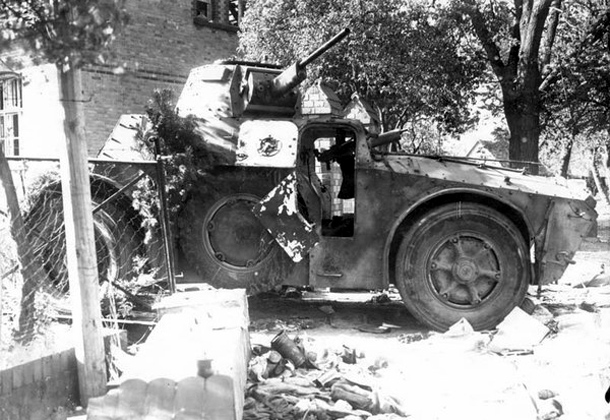
this abandoned wreck of a Panzerspähwagen AB41 201(i) was reportedly found in captured Berlin in May 1945, source: flickr.com with the permission of the publishing user, edited
German crews modified their captured vehicles in various ways to suit their own preferences. Sometimes they limited themselves to applying a new camouflage scheme, but photographs also show vehicles fitted with additional appliqué armour on the front hull wall, or with extended front mudguards to protect the front wheel tyres from enemy fire.
ARTICLE
CONTENTS:
Reproducing text from the Panzernet website without the written consent of the operator is prohibited.