TANK T-25
in search of a new light tank
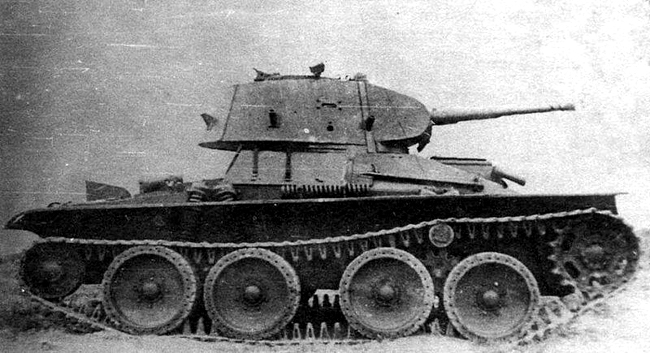
T-25 prototype, source: Wikimedia, Public domain, edited
Origins of the Project
The T-25 project was one of a series of attempts to find a successor to the ageing light tank T-26. The design originated at the design bureau of the Stalingrad Tractor Factory (STZ — Stalingradsky Traktorny Zavod). According to some sources, the project was submitted to the Red Army's Automotive and Armour Directorate (ABTU — Avtobronетankovoye Upravleniye) as early as 1937, but at the time attracted no interest. The army revived it a year later, most likely because other projects had failed to produce a satisfactory replacement for the old T-26.
Development work on the new tank therefore did not actually begin until 1938. The project received the factory designation STZ-24, while the army assigned its prototype the index T-25. It was a light convertible tank — one capable of running both on tracks and on wheels — and was intended to make use of a number of design elements from the old T-26 in order to simplify development and reduce production costs. When travelling on roads, the tracks could be removed and the tank could then move at considerably higher speeds than were possible with tracks fitted.
The First Prototype
The prototype of the new tank was built in early 1939. The T-25 took over a number of components from the T-26 — probably the 1938 and 1939 models — including the conical turret, the engine, part of the drivetrain, and the entire rear section of the hull with the engine compartment. The gearbox was positioned at the front of the hull and connected to the engine by a driveshaft, in exactly the same way as on the T-26. The running gear and the forward half of the hull, on the other hand, had nothing in common with the older tank.
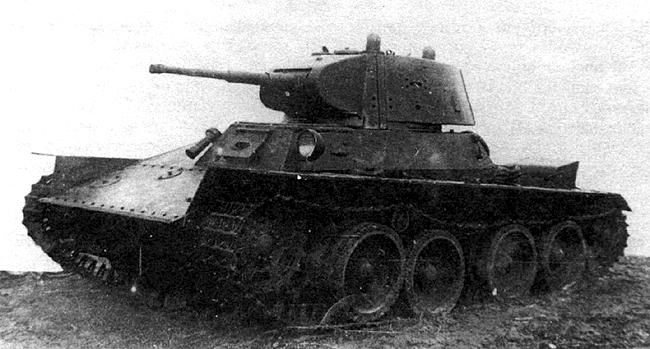
T-25 prototype, source: Flickr.com, Public domain, edited
Technical Description
The T-25's running gear consisted of four road wheels on each side. These were large-diameter solid wheels fitted with rubber rims to absorb the shocks from contact with the tracks. The wheel suspension and springing system was derived from the BT-type convertible tank and used coil springs. On the two rear road wheels, the springs were positioned in a rather unconventional location — outside the hull, visible in side view. This arrangement proved somewhat unfortunate during testing, as the exposed springs were easily damaged. The running gear was completed by a toothed drive sprocket at the front, a smaller idler wheel at the rear, and a single return roller positioned above the gap between the first and second road wheels.
The hull front consisted of an upper and a lower plate joined at a fairly sharp angle. The lower plate was 24 mm thick and was the heaviest armour on the entire tank. The upper plate was only 16 mm thick, but was steeply angled, which improved its resistance to penetration. On the left side, the driver's cab projected from the upper hull plate, with a 20 mm thick front wall. In this front wall was a vision port fitted with an upward-opening cover; when the cover was closed, the driver could still observe through a vision slit in it. The driver entered and exited through a hatch in the roof of his cab, directly above his seat. The hull walls were joined partly by welding and partly by riveting.
The turret had an oval footprint and tapered upward. From its front face projected the gun mount housing the cannon and its coaxial machine gun. The cannon was the 20K of 45 mm calibre, and the machine gun was the DT of 7.62 mm calibre. Whether the T-25 also carried a second machine gun in the rear wall of the turret is uncertain. Photographs clearly show an opening in the rear turret wall that matches a machine gun ball mount in both size and shape — but this opening is blanked off. Some sources do state that the T-25 was armed with two machine guns, and since there was certainly no machine gun in the hull, the rear turret wall would be the only remaining candidate. It is therefore possible that the blanking plate was not a permanent seal but simply a cover that could be opened to allow a second machine gun to be fired from that position. The number of machine gun rounds carried is cited in various sources as anywhere between 1,953 and 2,018 — which points toward a single machine gun, though not conclusively. What is certain is that the turret housed the two remaining crew members: the loader and the commander, who also served as gunner.
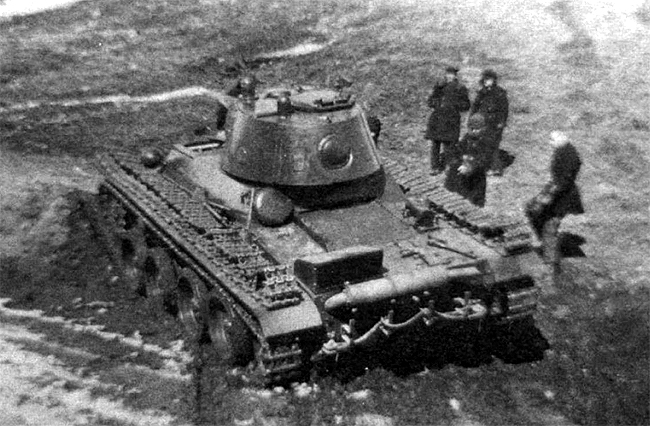
T-25 prototype during trials — note the blanked-off opening in the turret rear, source: Flickr.com, Public domain, edited
The engine in the rear of the hull was again taken from the T-26 — an air-cooled four-cylinder unit producing a maximum of around 97 horsepower at 2,200 rpm. The gearbox offered five forward gears and one reverse. The eleven-tonne prototype could reach a maximum speed of 27 km/h on tracks; its speed on wheels I was unable to find recorded anywhere.
The prototype underwent trials in September 1939, and the results were rather disappointing. The T-25 suffered from a high rate of mechanical failures. Its armour was thicker than that of the older T-26, but not by any impressive margin. Cross-country speed was also too low. The designers therefore began working on a revised version of the prototype, given the factory designation STZ-35. The main improvements were to be a more powerful 130-horsepower engine and increased frontal hull armour of up to 30 mm. By this point, however, the army commission was thoroughly saturated with projects purporting to replace the T-26 while delivering no meaningful improvement, and it dismissed the STZ-35 proposal outright. With that, the brief history of the T-25 came to an end — the tank remained a single prototype.
Technical Specifications
Weight |
11.07 t |
Length |
4.85 m |
Width |
2.68 m |
Height |
2.37 m |
Engine |
T-26 |
Maximum output |
97 hp |
Maximum speed |
27 km/h (on tracks) |
Fuel capacity |
292 l |
Armament |
1x 45 mm cannon 20K 1x(2x) 7.62 mm DT machine gun |
Crew |
3 men |

ARTICLE
CONTENTS:
Reproducing text from the Tankist website without the written consent of the operator is prohibited.