"RUSSKIY RENO"
the Soviet copy of the Renault FT-17
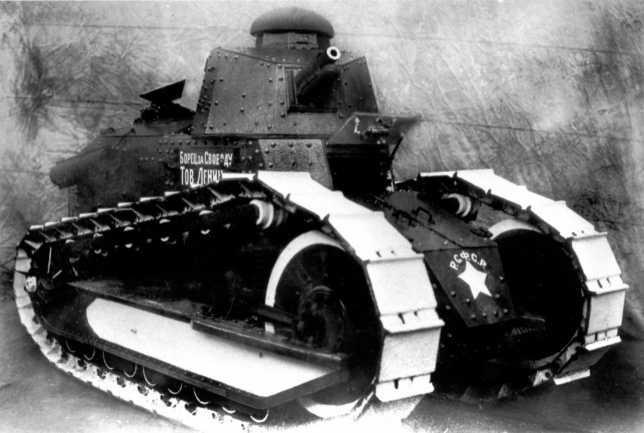
the first Russkiy Reno built, named "Fighter for Freedom, Comrade Lenin", source: Wikimedia, Public domain, edited
The Captured Renault FT-17
The Soviets owe their very first tank, paradoxically, to an ally of their enemy — France. During the Russian Civil War, France and the other Western powers supported the anti-Bolshevik opposition, and as part of that support they supplied military equipment, including Renault FT-17 light tanks. It was precisely this vehicle that served as the basis for the development and production of the first Soviet tank ever built — a machine known simply as the Russkiy Reno.
In December 1918, France sent twenty of these tanks to the Black Sea port of Odessa as aid to the "White" forces of General Denikin. The shipment comprised two variants: the so-called Char à canon 37, armed with the 37 mm Puteaux SA18 gun, and the Char mitrailleur, which carried only an 8 mm Hotchkiss M1914 machine gun. The Renault FT-17 was a highly modern design for its time — a light tank with a two-man crew and a single fully rotating turret housing all the armament. From February 1919 the delivered tanks were committed to fighting the Bolsheviks, and as early as March of that year, units of the 2nd Ukrainian Front managed to capture one of the French vehicles near the village of Berezovka, north of Odessa. Several more were captured during fighting around Odessa in the weeks that followed — five additional tanks are usually cited.
The soldiers sent the first captured tank as a gift to the leader of the revolution, Vladimir Ilyich Lenin, accompanied by a letter vividly describing their heroic capture of the enemy vehicle with their bare hands. The tank subsequently took part in the May Day military parade on Red Square. The Soviets were not producing any tanks of their own at the time, but they were beginning to appreciate their importance — Lenin himself included, who reportedly proposed using the captured vehicle as the basis for building a tank of their own. The War Industry Committee accordingly tasked the Krasnoe Sormovo factory in Nizhny Novgorod in August 1919 with coordinating the work of producing a copy of the French tank that could be manufactured domestically in the Soviet Union.
The Soviet Copy
In September 1919 the captured tank arrived from Moscow at the Nizhny Novgorod factory to serve as the reference for development work. It reportedly arrived not in one piece but disassembled into parts, having presumably already been examined in Moscow. The engineers at Krasnoe Sormovo accepted the shipment without checking it for completeness. A technical group was then formed under the direction of designers Khrulev and Nefyodov, tasked with documenting the tank's components and creating the technical drawings needed to produce a copy. As the engineers set to work, they began discovering that a number of parts were missing. Most critically, the entire gearbox had completely disappeared. Their comrades therefore sent an inquiry to Moscow asking why these components had not been included in the shipment — only to be told that everything had been dispatched and that the missing parts must have been stolen along the way.
The study of the tank and the preparation of technical documentation ultimately took from October to December 1919. The components and drawings were then distributed to other factories that were to contribute to the production of the first Soviet tank. Armour plate was to be supplied by the Izhora plant in Leningrad, and the engine by the Moscow factory AMO (Avtomobilnoye Moskovskoye Obshchestvo — the Moscow Automobile Company, from which the ZiL truck manufacturer later emerged).
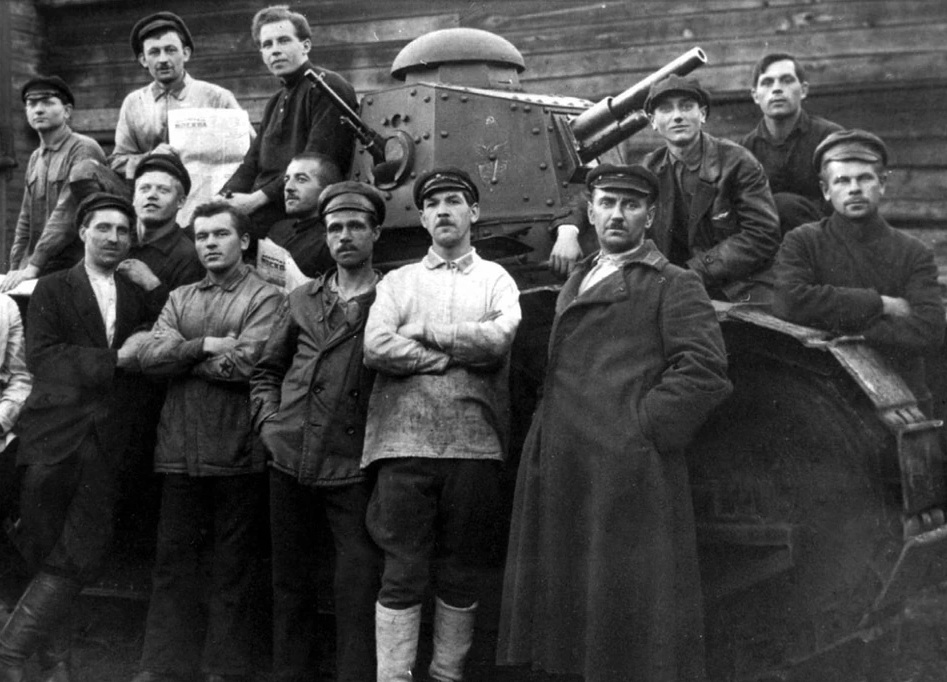
Russkiy Reno with combined armament, source: Wikimedia, Public domain, edited
The Soviet designers faced a whole range of problems. For instance, the original French engine and armament were simply not available to them. Copying and setting up production of the original gun would have been unnecessarily expensive and complicated, and manufacturing a copy of the original Renault engine also proved too complex — in all likelihood some of its components had been stolen as well, leaving it incomplete.
It was for this last reason that the Moscow AMO factory was brought into the project. Under a 1916 agreement with the Italian firm Fiat, AMO had been due to begin licence production of the Fiat 15 TER truck — a plan that was derailed by the Bolshevik Revolution, though a number of trucks had been delivered from Italy to Moscow before the revolution broke out. The Soviets therefore decided to make use of the Fiat engine, which they had in complete condition and which appeared suitable for the purpose. The necessary adaptation for tank use was carried out by designer V. Kalinin. The Russkiy Reno thus received a four-cylinder water-cooled petrol engine producing a maximum of 33.5 horsepower at 1,480 rpm. Fuel was stored in two tanks with a combined capacity of 90 litres. By today's standards such an output seems laughably inadequate for a tank engine — but it should be remembered that the original French engine produced only marginally more, at exactly 39 horsepower. The engine was started using a hand crank, operable either from outside the vehicle or from within the fighting compartment. The seven-tonne tank could achieve a maximum speed of 8.5 km/h and had an operational range of around 60 km.
It is clear from the sources that the missing gearbox presented the builders' greatest single challenge. It is, however, very likely that even had it been available, copying the French original would not have been the most efficient use of time and money — and so work could proceed without it. The more practical solution was to use something already manufactured domestically. The sources do not go into detail about how this problem was resolved, noting only that designer V. Kalinin again worked on the gearbox — though whether it too came from the AMO factory and was likewise derived from the Fiat truck is not mentioned. The result, in any case, was a gearbox with four forward gears and one reverse.
The running gear was copied without modification. On each side it consisted of nine paired small-diameter road wheels fitted with rubber tyres. The first three wheels were grouped together in a single bogie, while all the remaining wheels were paired in bogies of two — giving four bogies per side. The rear two bogies with a total of four wheels, and the front two bogies with a total of five wheels, were each connected to a shared leaf spring. At the very front was the idler wheel — a solid, full-width wheel and the largest in the entire running gear assembly. It was set forward of the hull and sprung independently by a coil spring. At the rear was the toothed drive sprocket. All wheels were partially covered on the outer side by a flat girder. The upper run of the track was supported by a system of seven small return rollers. The track itself was 335 mm wide and consisted of 32 links.
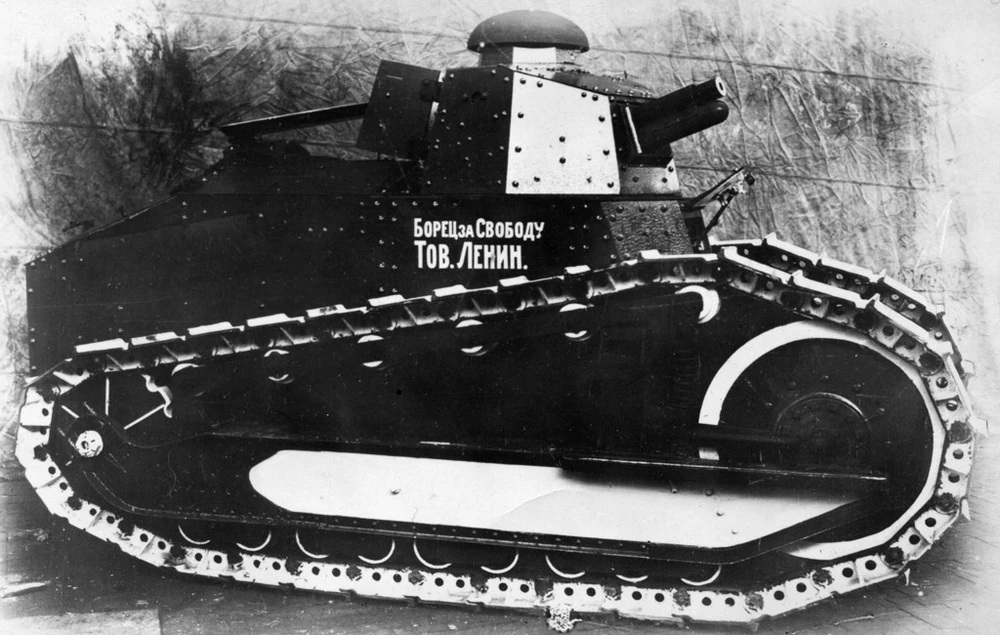
the first Russkiy Reno built, named "Fighter for Freedom, Comrade Lenin", source: Wikimedia, Public domain, edited
As already noted, armour production for the Soviet tank was entrusted to the Izhora plant. There is a curious note in the sources suggesting that this factory supplied only raw armour plates, not cut to shape or drilled for riveting — meaning the workers at Krasnoe Sormovo had to shape the plates themselves, and first had to manufacture the necessary tools to do so. Armour thickness ranged from 16 mm on the frontal plates, through 8 mm on the sides and roof, down to 6.5 mm on the hull floor. Riveting was used at the joints. The hull itself was quite narrow. At its front was the driver's position, who entered and exited through a large hatch in the upper face of the hull nose — this entire forward face in fact formed the two-part hatch cover. Immediately behind it began the front wall of the raised driver's cab, fitted with a vision port. In combat, the port was closed with a cover and the driver observed through a slit in that cover.
On the roof of the cab sat the tank's fully rotating turret. It was octagonal and riveted. The armament was mounted in the turret's front face. Two of the eight rear panels — or rather the cover over them — were taken up by the commander's entry and exit hatch. The turret roof had a sloped front section and a flat rear section; in the latter was the commander's cupola. Fitted with vision ports on all sides and raised to roof level, it gave the commander an excellent all-round view. The cupola had a rounded fixed cap that could not be opened. It is worth noting that the commander's cupola was a remarkably progressive design feature for its era — one that tank designers would effectively "rediscover" during the Second World War. The engine, gearbox, and fuel tanks were housed in the rear of the hull, with access panels in the upper deck. A tool box was hung on the left side of the engine compartment above the tracks, while the exhaust was on the right. At the very rear of the tank a "tail" was fitted — a device intended to prevent the tank from tipping backwards when crossing difficult terrain.
As already established, the crew consisted of two men — the same as the French original. The driver sat in the forward section of the hull, while the commander, who also served as gunner and loader, was stationed in the turret. The commander either stood or could "sit" on a canvas strap slung across the fighting compartment.
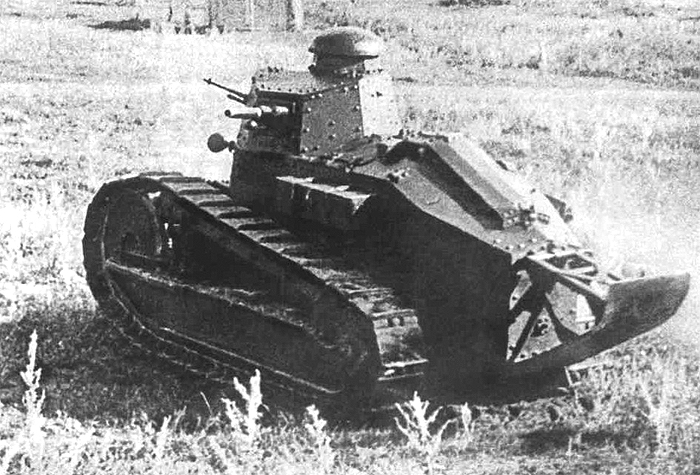
Russkiy Reno with combined armament, source: Wikimedia, Public domain, edited
The tank's armament also posed a challenge. The French Puteaux gun was naturally unavailable, so an alternative weapon had to be found. The choice fell on a different gun, originally also French — the 37 mm Hotchkiss naval gun. The Russian Navy had purchased several hundred of these in the 1880s for its ships. For installation in the tank, the gun was modified at the workshops of the Krasny Putilovets plant in Petrograd. Two versions of the weapon were produced: one with a barrel of 16.5 calibres and another with a full 21-calibre barrel. A notable feature was a padded shoulder rest that made it easier for the gunner to operate the weapon. The tank carried only high-explosive fragmentation ammunition for the gun. Shells left the barrel at 442 m/s, with an effective range of around 400 metres (maximum range was 2,000 metres). The rate of fire was relatively high, at around 10 to 12 rounds per minute.
The Soviets had originally planned to produce the tank in two armament variants — just like the French original — meaning either with a gun or with a machine gun. The machine gun intended was the original Hotchkiss M1914 of 8 mm calibre, though where the Soviets planned to obtain these French weapons is not made clear by the sources. The plan called for five tank units, each consisting of one gun tank and two machine-gun tanks, for a total of fifteen vehicles. A requirement then emerged, however, for a variant carrying both types of armament. Several proposals were apparently drawn up, but the most straightforward to implement was that of engineer Glazov, which called for mounting the gun in the front wall of the turret and the machine gun in a side wall — avoiding the need for a major turret redesign or an entirely new turret. Little thought was given to the practicality of this arrangement, however. With both weapons installed, the small turret left very little room to manoeuvre, and the commander had to shift whichever weapon he was not currently firing out of the way to operate the other. It also added yet another task to his already full workload — loading and firing the machine gun.
Production
Actual production of the new tank did not begin until May 1920, and the first example was completed in August of that year. Trials began on 31 August and continued until 12 October, when the tank was approved for service. The first example was given the rather flattering combat name "Fighter for Freedom — Comrade Lenin", painted on its side. Production continued at a pace that can only be described as snail-like — typically one or two vehicles per month. By May 1921 the ordered series of fifteen tanks had been completed, and production was brought to a close. All the vehicles built eventually received combat names: Karl Marx, Red Star, Proletarian, and Paris Commune among them.
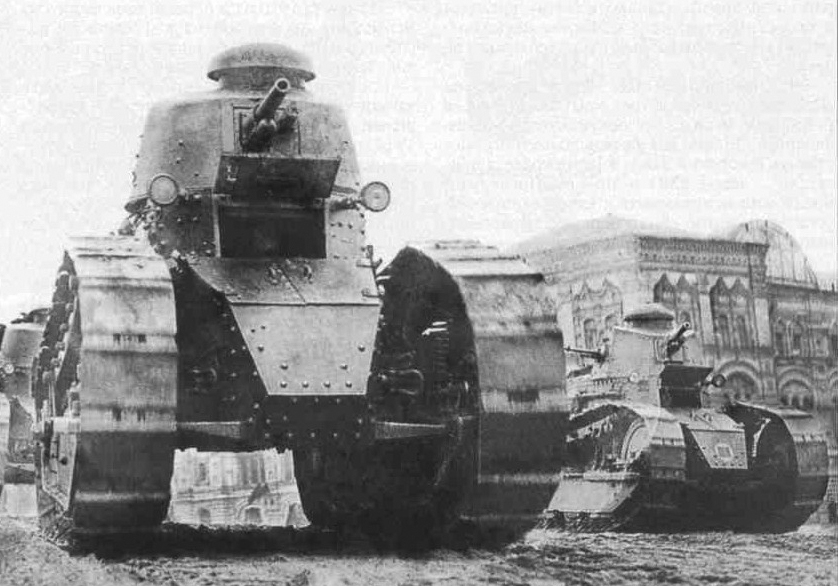
captured Renault FT-17 (foreground) and Russkiy Reno with combined armament during a military parade, source: Wikimedia, Public domain, edited
Only eight of the tanks built received the combined armament; the remainder were fitted either with the gun alone or the machine gun alone — though some sources suggest that no purely machine-gun-armed tank was built at all, and that three vehicles were completed entirely without armament.
The only combat the Russkiy Reno tanks are known to have seen was during the Civil War. The rest of their service life was spent in peacetime. They were officially retired from service in 1930. None of the original vehicles have survived to the present day — the examples that can be seen as monuments in Gorky or at Kubinka are replicas built at a later date. Besides the name Russkiy Reno, the tank is sometimes referred to as the Type M tank, or simply Tank M, where the letter M stood for malyy (small). At the beginning of 1921, when the Soviet Army had fewer than a hundred tanks in total — all but the Russkiy Reno being captured vehicles — and only three types in service, such a designation was sufficient.
The first Soviet tank provided an invaluable lesson for the country's then-underdeveloped industry. The experience gained during its development was put to extensive use in the construction of subsequent indigenous tank designs. Vehicles such as the T-18 already bear an unmistakable visual resemblance to the Russian FT-17 at first glance.

ARTICLE
CONTENTS:
Reproducing text from the Tankist website without the written consent of the operator is prohibited.