AT-1
self-propelled gun on the T-26 tank chassis
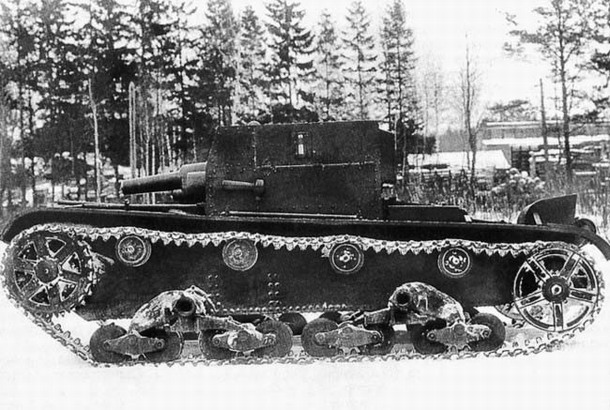
prototype of the AT-1 self-propelled gun, source: Flickr.com with permission of the publishing user, edited
Origins
In 1935, tank designer Ginsburg produced a highly interesting yet little-known combat vehicle. Its designation AT-1 stood for Artilerijski Tank — literally "artillery tank" — though in modern terminology it would be more accurately described as a self-propelled gun on a tank chassis. The vehicle was intended to provide direct fire support to light tanks and infantry.
Design Description
The AT-1 was built on the chassis of the production T-26 tank. It retained the complete running gear, consisting of eight small road wheels on each side paired into bogies, with each pair of bogies suspended on a pivoting arm fitted with a leaf spring. At the front was a sprocket drive wheel and at the rear an idler wheel, both of the spoked type. Four evenly spaced return rollers supported the track from above.
The hull tub and drivetrain components were also carried over from the T-26. In place of the original turret, however, a fixed rectangular superstructure was mounted in the centre of the hull, with its walls joined by riveting. The rear and side walls of the superstructure were perpendicular to the ground, while the front wall was angled — its lower half vertical and its upper half slightly sloped. Armour thickness on the superstructure ranged from 6 to 15 mm.
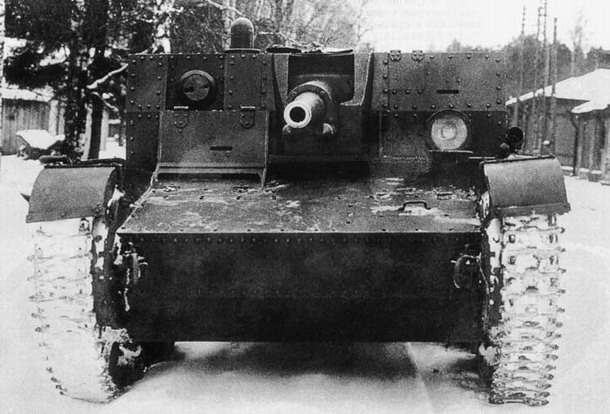
prototype of the AT-1 self-propelled gun, source: Aviarmor.net with permission of the operator, edited
Mounted in the centre of the superstructure's front wall was the vehicle's main weapon: the PS-3 tank gun in 76.2 mm calibre. This represented a substantial increase in firepower over the original T-26 light tank, which was armed with a 45 mm gun (with the exception of the T-26A variant). Installing such a heavy weapon was made possible by removing the turret and replacing it with a simple fixed superstructure, which saved considerable weight and freed up the necessary load capacity in the chassis.
The gun could traverse 20° to either side, with elevation ranging from -5° to +43°. In addition to the main gun, the AT-1 carried two 7.62 mm DT machine guns. One was mounted in a ball mount on the right side of the front wall above the driver's position. The second machine gun was carried loose inside the fighting compartment. Ammunition stowage comprised 40 rounds for the gun and 1,827 rounds for the machine guns. On the left side of the front wall was a large searchlight protected by a hinged metal cover.
A notable feature of the superstructure was the large closeable openings in its side and rear walls. The rear wall had a single opening that occupied roughly the upper two thirds of its height and almost its full width, closed by a single-piece cover on three hinges. The openings in the side walls were similarly large relative to the available surface area, each also covered by a single-piece hinged panel. These apertures are generally cited as ammunition loading hatches, though their unusually large size and number make this explanation somewhat unconvincing on its own.
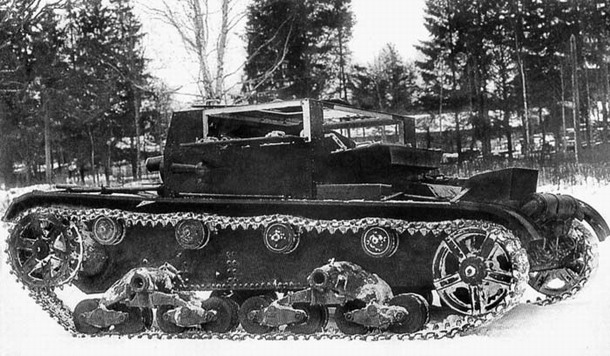
AT-1 with fighting compartment covers open, source: Flickr.com with permission of the publishing user, edited
Two further rectangular openings were located in the roof of the superstructure, serving as crew entry and exit hatches, each closed by a single-piece hatch cover. With all openings in the walls and roof simultaneously open, the vehicle looked more like a convertible than an armoured fighting vehicle. The superstructure was relatively low, giving the whole vehicle an overall height of just 182 cm (measured without the periscope projecting above roof level). In combat this would have conferred a notable advantage, as the vehicle would have been difficult to spot and even harder to hit.
The rear of the hull housed the engine compartment, containing a 90 hp engine also taken from the T-26. The gearbox offered five forward speeds and one reverse. Fuel capacity was 182 litres, providing a road range of approximately 140 km and roughly 110 km cross-country. Maximum road speed was 30 km/h, with off-road speed approximately half that.
The crew consisted of three or four men — the exact number was never definitively settled, and both configurations were trialled. In any case, the driver was a permanent member of the crew and the only man seated inside the hull proper, specifically in the front right position — unchanged from the T-26 layout. The remaining crew — the commander and one or two gun operators — were seated inside the superstructure. The driver had his own entry hatch in the front wall in front of his seat, while the rest of the crew used the roof hatches. Had the vehicle entered series production, a three-man crew would most likely have been chosen, primarily due to the limited interior space of the superstructure.
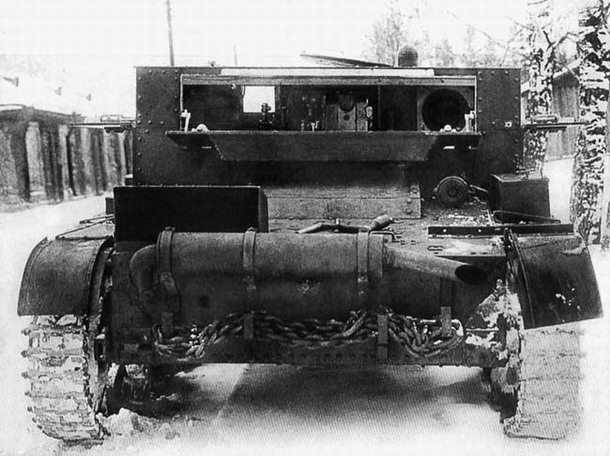
AT-1 with fighting compartment covers open, source: Flickr.com with permission of the publishing user, edited
The AT-1 was built as a validation series of ten vehicles. Despite exhibiting no fundamental flaws, it was ultimately not approved for series production. This outcome was partly driven by the generally negative attitude among military officials of the time towards such "novelties" as the self-propelled gun concept. And yet it was a genuinely interesting idea with considerable potential for practical application — a point underscored by the simple fact that the AT-1 was essentially the same concept as the highly successful German Stug III assault gun. That, however, remains pure speculation, as the AT-1 ultimately faded into the footnotes of history.
Technical Specifications
Weight |
9.6 t |
Length |
4.62 m |
Width |
2.45 m |
Height |
2.03 m |
Maximum power |
90 hp |
Speed – road |
30 km/h |
Speed – cross-country |
15 km/h |
Fuel capacity |
182 l |
Range – road |
140 km |
Range – cross-country |
110 km |
Armour |
6 – 13 mm |
Armament |
1 × PS-3 gun, 76.2 mm 2 × DT machine gun, 7.62 mm |
Crew |
3–4 men |

ARTICLE
CONTENTS:
Reproducing text from the Tankist website without the written consent of the operator is prohibited.