BAI
"Bronevoy Avtomobil Izhorskiy"
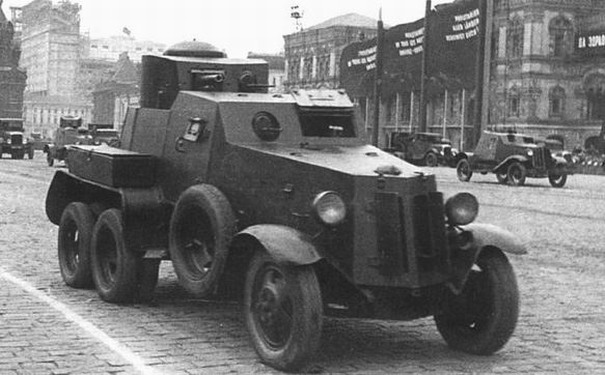
BAI at a military parade on Red Square, source: Wikimedia, Public domain, edited
Origins of the Vehicle
The BAI armoured car was developed in 1932 at the Izhora plant under the direction of designer A. D. Kuzmin. Its foundation was the three-axle chassis of the Ford Timken truck, which was being manufactured under licence (a year earlier, the same chassis had served as the basis for the armoured car BA-27M, among others). The designation BAI was an acronym for the straightforward name Bronevoy Avtomobil Izhorskiy — literally, the Izhora Armoured Car.
Design and Construction
The front wheels were of a simple design and were steerable. The two rear driven axles were fitted with dual wheels. The hull of the vehicle did not depart in any significant way from the standard adopted by Soviet armoured cars of the early 1930s. It was constructed from 8 mm steel plates joined by welding. At the front was the engine compartment, housing a GAZ-AA petrol engine producing 40 horsepower. Air intake for the engine was provided by a pair of rectangular openings in the front mask, which could be closed with covers. On both sides of the engine compartment there were service access panels, likewise protected by closeable covers.
The engine compartment widened and rose towards the rear, transitioning into the crew compartment. Behind the angled front wall of the cabin, the roofline continued to rise gently. However, just behind the crew area the roof angled back down again, leading to a lower flat platform in the centre of which sat the rotating turret. The vehicle's crew consisted of three men. The driver and the machine gunner sat side by side in the hull beneath the raised section of the roof — the driver on the left, the machine gunner on the right. The driver's forward visibility was provided by a fairly large rectangular opening in the front wall directly in front of his position, which could be closed with a single-piece cover in the event of danger, leaving only a narrow observation slit. To the right of the driver's vision port was the firing embrasure for the 7.62 mm DT machine gun.
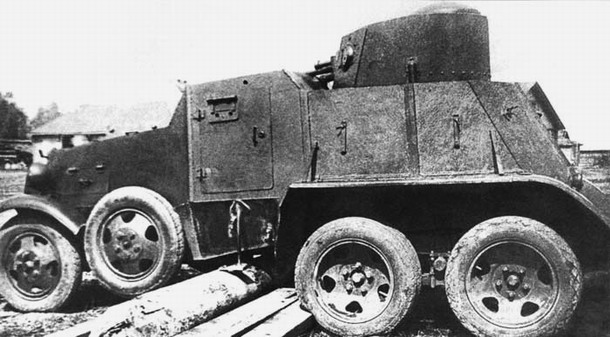
Armoured car BAI, source: Wikimedia, Public domain, edited
The third crew member was the commander, who simultaneously served as gunner for both the main gun and the second machine gun, as well as loader for both weapons. The commander's station was in the rotating turret. The side and rear walls of the turret were rounded, giving it a horseshoe-shaped floor plan. The front face of the turret was formed by two angled flat plates. In the right-hand plate was the vehicle's main armament — a 37 mm gun — while to the left was a second DT machine gun. Ammunition stowage comprised 34 rounds for the gun and 3,024 rounds for both machine guns combined. In the turret roof was a circular hatch with a domed single-piece cover that opened towards the rear of the vehicle.
The rear of the hull was formed by two angled flat plates. In the right-hand plate were the large crew entry and exit doors, which also incorporated a closeable vision port. Doors were likewise fitted on both sides of the driver and machine gunner's compartment, each with their own side-facing vision ports. The front wheels were protected by mudguards carried over from the Ford truck along with the rest of the chassis. Both rear axles shared a single long common mudguard. In the space between the front and rear mudguards, a spare wheel was mounted on each side of the hull. A notable design feature was that this spare wheel was capable of rotating freely — and it was mounted so low that its tyre extended below the level of the chassis. When crossing uneven terrain, the spare wheel therefore acted as a skid, protecting the undercarriage from damage.
Testing of the new vehicle took place in 1932 and production was approved, though the exact number of units built is not known — in any case it was only a small series. Details of any combat deployment of these vehicles during the Second World War are similarly unknown.
Technical Specifications
Weight |
5 t |
Length |
4.77 m |
Width |
2.02 m |
Height |
2.35 m |
Engine |
GAZ-AA |
Max. power |
40 hp |
Top speed |
63 km/h |
Fuel capacity |
40 l |
Road range |
150 km |
Turret armour |
8 mm |
Hull armour |
8 mm |
Armament |
1 x gun 37 mm 2 x DT machine gun 7.62 mm |
Crew |
3 men |

ARTICLE
CONTENTS:
Reproducing text from the Tankist website without the written consent of the operator is prohibited.