BA-27
The first Soviet series-produced armoured car
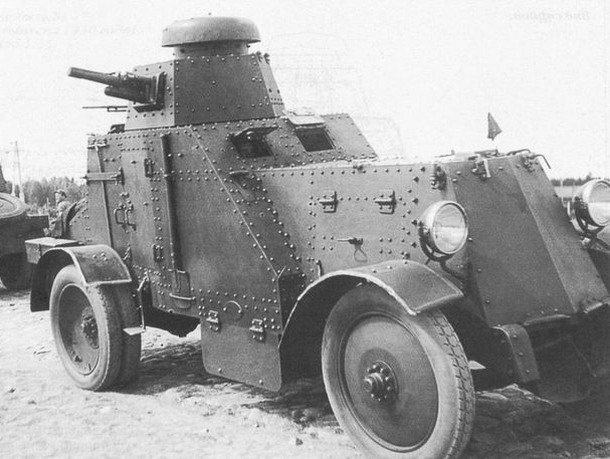
Armoured car BA-27, source: Aviarmor.net with permission of the operator, edited
Origins of the Vehicle
After the end of the First World War and the subsequent civil war, the Red Army was left with a wide assortment of armoured cars. These included vehicles imported from abroad, those built under licence, and machines captured from the enemy during combat. Such a motley collection was highly problematic from a maintenance standpoint and offered little prospect for coherent development — not to mention that the majority of these vehicles were already obsolete by that time. It comes as no surprise, then, that the first Five-Year Plan included provisions for the development and subsequent production of modern armoured cars of domestic origin.
Development of the new vehicle began in 1927 at the Izhora plant in Leningrad. Just one year later, series production was already underway. The first Soviet armoured car received the designation BA-27 (BA standing for "Bronevoy avtomobil" — armoured car). It was, however, a machine of decidedly spartan construction. The foundation was the two-axle chassis of the AMO-F-15 truck. The front steerable axle was fitted with simple wheels on standard pneumatic tyres, while the rear drive axle was equipped with dual wheels.
Design and Construction
Mounted on the chassis was a riveted hull made from flat armour plates just six millimetres thick. The roof plate was only five millimetres, and the floor a mere three. The engine was located at the front, in the narrowed forward section of the hull. The powerplant was a GAZ-M four-cylinder petrol engine with a maximum output of 40 horsepower. Access panels in the sides of the engine compartment allowed servicing of the engine. Behind the flat engine bonnet rose the front wall of the crew compartment, fitted with two rectangular vision ports with openable covers. In combat conditions the covers were closed, leaving only narrow slits for observation. A similar vision port was also provided in the rear wall of the hull. On the roof sat a rotating six-sided turret, borrowed from the T-18 tank. All of the vehicle's armament was housed in the turret: a 37 mm Hotchkiss gun and a 7.62 mm DT machine gun.
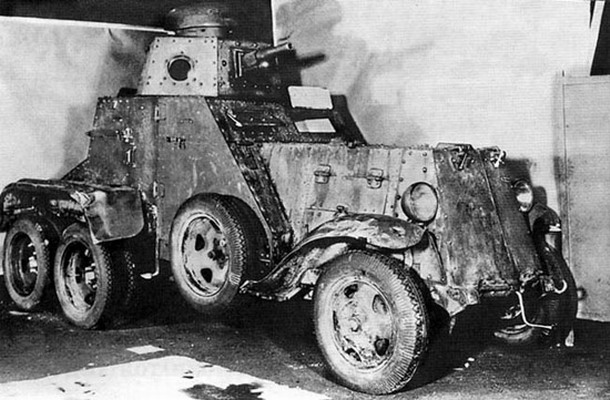
Armoured car BA-27M, source: Aviarmor.net with permission of the operator, edited
The crew consisted of three men: two drivers and one gunner, who simultaneously served as commander and loader. Having two drivers was not unusual for armoured cars of the period. Reversing such a vehicle without any rearward visibility was extremely difficult, and designers frequently solved this problem by adding a second driving position facing the rear. In the BA-27, the two drivers sat back to back, with the third crew member standing between them to operate the weapons in the turret. Large doors in both side walls of the hull, along with a hatch on top of the turret, provided entry and exit for the crew.
Production ran from 1928 to 1931, during which time approximately one hundred vehicles rolled off the assembly lines. The BA-27 was not a vehicle of outstanding qualities. Its development had taken only a single year, so it is hardly surprising that it suffered from a number of design shortcomings and a high rate of mechanical failure. The two-axle chassis restricted the vehicle to hard-surfaced roads, and its cross-country performance was poor. This was compounded by the fact that the weight was distributed across only two axles and a small number of wheels, resulting in relatively high ground pressure. The engine output was also less than ideal for a vehicle weighing over four tonnes — a point illustrated by the top speed of just 30 km/h.
On the positive side, the BA-27's armament was one of its genuine strengths. The 37 mm gun gave it a firepower advantage over most armoured cars of its era. Despite all its shortcomings, in the situation the Red Army found itself in at the time, the BA-27 represented a step in the right direction.
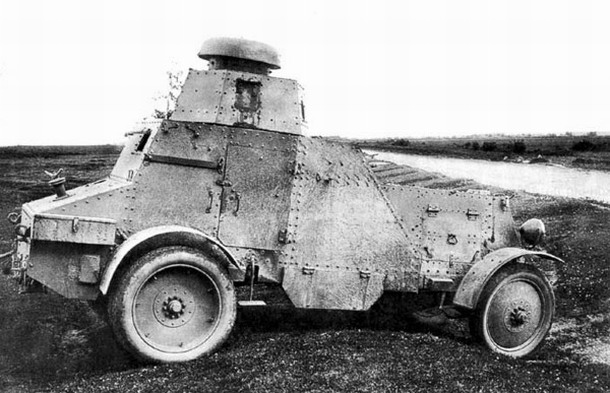
Armoured car BA-27, source: Aviarmor.net with permission of the operator, edited
The Upgraded BA-27M
In 1931, the original BA-27 was replaced in production by a newer variant designated the BA-27M. This vehicle used a new chassis taken from the Ford Timken truck, which was being manufactured under licence. The new three-axle chassis brought better weight distribution and, consequently, improved driving characteristics. The engine itself remained unchanged, but a new gearbox was fitted, and it was thanks to this that the vehicle's top speed on road increased to 48 km/h. The fuel tank capacity was doubled — from 75 to 150 litres — and the operational range doubled accordingly, from 150 to 300 kilometres.
The hull of the BA-27M was essentially identical to that of the BA-27, constructed from flat 6 mm steel plates joined by riveting. Long mudguards appeared above the rear wheels, and on each side of the vehicle there were large crew entry doors positioned above them. A spare wheel was mounted on each side between the front and rear mudguards — on the older BA-27 the spare had been fixed to the rear. The turret and armament remained unchanged. The crew was expanded by one additional member, whose place was in the turret with the specific role of operating the machine gun. In theory this was meant to increase the vehicle's combat effectiveness, since it was now possible to fire the gun and the machine gun simultaneously. However, given how cramped two gunners were in the small turret, the practical benefit of the extra crew member is rather questionable. The exact number of BA-27Ms produced is not known. A significant drawback shared by both variants was the absence of a radio set.
Both the BA-27 and the BA-27M survived to see the beginning of the Second World War, though whether they actually took part in any of its fighting remains unknown.
Technical Specifications
|
BA-27 |
BA-27M |
Weight |
4.3 t |
4.5 t |
Length |
4.62 m |
4.83 m |
Width |
1.71 m |
1.93 m |
Height |
2.52 m |
2.54 m |
Engine |
GAZ-M |
GAZ-M |
Max. power |
40 hp |
45 hp |
Top speed |
30 km/h |
48 km/h |
Fuel capacity |
75 l |
150 l |
Road range |
150 km |
300 km |
Armour |
8 mm |
8 mm |
Armament |
1 x Hotchkiss gun 37 mm 1 x DT machine gun 7.62 mm |
1 x Hotchkiss gun 37 mm 1 x DT machine gun 7.62 mm |
Crew |
2 men |
2 men |

ARTICLE
CONTENTS:
Reproducing text from the Tankist website without the written consent of the operator is prohibited.