VK 65.01 (H)
unrealised heavy tank project
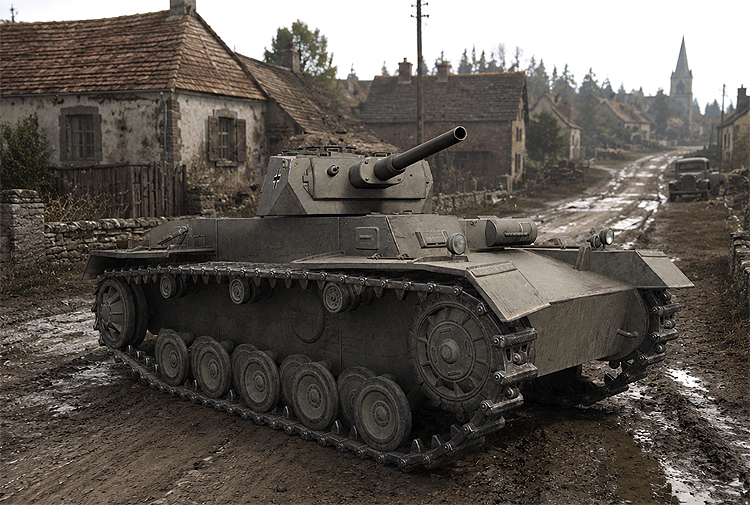
This is roughly what the heavy tank VK 6501 (H) could have looked like, had it ever reached production. Source: generated by AI
From 1938, Henschel worked on a heavy tank in the 65-tonne weight class under the designation VK 6501 (H). This heavily armoured vehicle was intended to serve as a breakthrough tank capable of punching through the most heavily defended sections of the front.
According to the designers' plans, the tank's running gear would consist of ten double road wheels of small diameter on each side, arranged in two rows that partially overlapped one another. Above them, three small return rollers were symmetrically spaced to support the upper run of the track. The assembly was completed by a drive sprocket at the front and an idler wheel at the rear, both of relatively large diameter and of the spoked type.
The hull resting on this running gear bore a basic resemblance to that of the PzKpfw IV. The turret was to be taken directly from that tank without any modifications. The only change under consideration was the replacement of the main gun with a more powerful 105 mm cannon, though no final decision was ever made on this. The frontal hull plate was 100 mm thick, with the remaining walls measuring 80 mm. In addition to the cannon, the tank was to carry supplementary armament in the form of three heavy machine guns. The first was inherited along with the turret and positioned in its front wall to the right of the main gun. The other two were mounted in small rotating ball turrets in the front section of the hull, and both were likely operated by the radio operator.
The crew composition, roles and positions within the vehicle followed standard German practice. The driver was seated in the left half of the front hull section, with the radio operator to his right. The commander, gunner and loader each had their stations inside the turret.
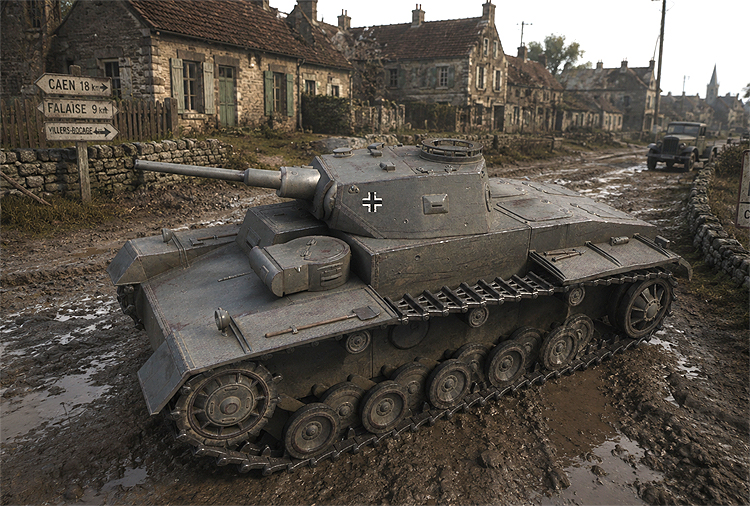
This is roughly what the heavy tank VK 6501 (H) could have looked like, had it ever reached production. Source: generated by AI
The chosen powerplant was the Maybach HL 224, a petrol-fuelled twelve-cylinder engine with a displacement of 21 litres and a maximum output of 600 horsepower at 3,000 rpm. Even with this engine, the 65-tonne giant was expected to reach a top speed of only around 25 km/h.
The Waffenamt authorised the construction of two prototypes to evaluate the new vehicle's characteristics. In the end, only one was ever built, and even that remained incomplete. The entire project was cancelled in 1942, the same year production of the heavy tank Tiger began — a vehicle that outperformed the VK 6501 in every respect and far better suited the current needs of the German army.
Reproducing text from the Panzernet website without the written consent of the operator is prohibited.