PORSCHE TYP 245-010
a tank against ground and air targets
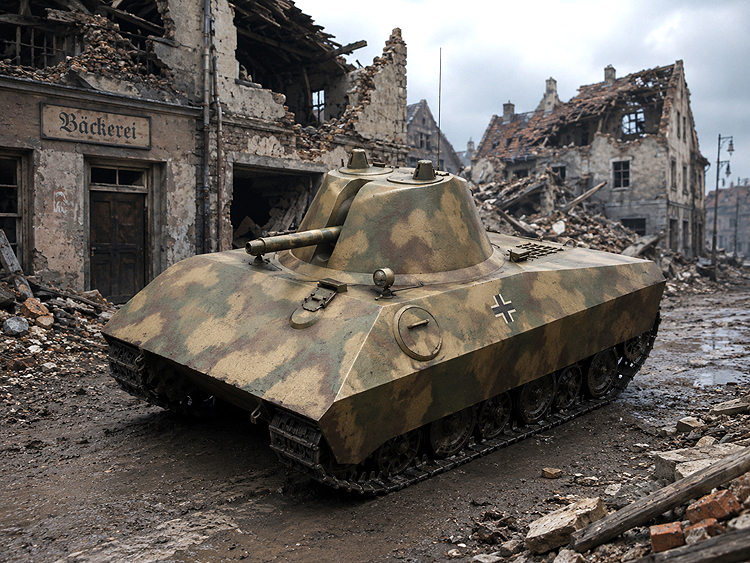
Theoretical appearance of Porsche's Typ 245-010 dual purpose tank designed to fight both ground and air targets, source: generated by AI
Birth of an Idea
By mid-1943 the Germans had nearly two years of fighting against the Red Army behind them. Their losses in men and equipment had reached staggering figures, and the Wehrmacht was inevitably losing the initiative – and not only on the ground, but in the air as well. The Soviet Air Force had long since recovered from the catastrophic defeats of 1941 and now had new fighter types, an abundance of pilots, and a wealth of hard-won experience. It is therefore hardly surprising that Russian air attacks were becoming an increasingly serious problem for German armoured units. By May 1943 the situation was serious enough for the matter to be placed among the main topics on the agenda of two German military-technical commissions – the so-called Panzerkommission (concerned with the development of new tanks) and the so-called Waffenkommission (concerned with weapons development more broadly) – at a joint meeting held on 27 May 1943.
The participants reached essentially two main conclusions on this subject. Firstly, it was decided that every German tank regiment would receive 18 self-propelled anti-aircraft guns on fully tracked chassis – so-called Flakpanzers – to improve air defence. Since the Germans were not producing any series Flakpanzers at the time, such vehicles had to be developed and put into production with urgency. The second conclusion was that existing combat tanks were simply too vulnerable to air attack, and that the German Army should therefore consider developing an entirely new type of tank significantly better suited to resist it.
One of the members – and later even the chairman – of the aforementioned Panzerkommission was the versatile engineer and Hitler's personal friend, Prof. Ferdinand Porsche. Porsche immediately recognised a major commercial opportunity and seized it with characteristic creativity. Why should the Army develop a new type of combat tank resistant to air attack and separately build Flakpanzers to escort it? Would it not be far more efficient to create a single combat vehicle capable of fulfilling both roles simultaneously – a tank able to engage both ground and air targets?
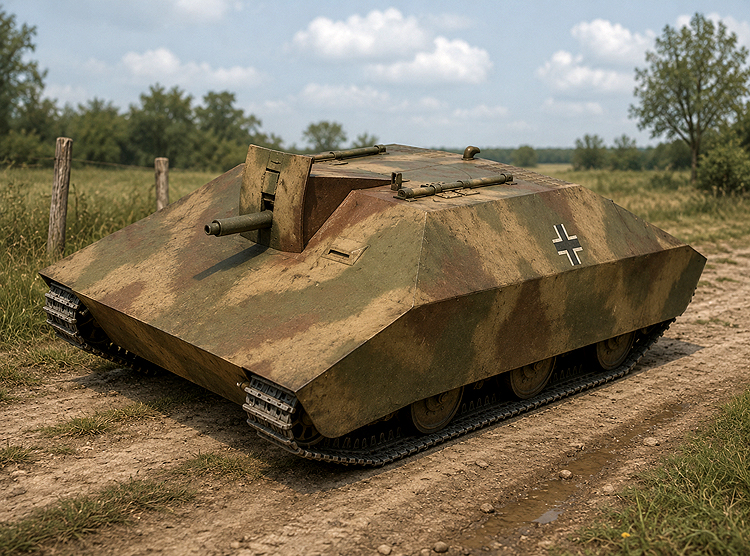
Approximate theoretical appearance of the turretless variant of the Typ 245-010, source: generated by AI
Porsche's "Baby"
For collaboration on the project, Porsche turned to Rheinmetall, which was to supply the necessary armament; everything else he took upon himself. Internally, Porsche tracked the new project under the designation Typ 245-010; the official name presented to the Army, however, was leichter Panzerkampfwagen zur Verwendung gegen Erd- und Luftziele mit 5,5 cm vollautomatischer Waffe – literally "light tank for use against ground and air targets with a fully automatic 5.5 cm weapon."
The first design for the new armoured vehicle saw the light of day on 14 July 1943. It was a turretless vehicle with its armament mounted directly in the hull. The tank's running gear was to have six road wheels 600 mm in diameter, which were fitted – as a cost-saving measure – with only a thin rubber layer beneath a steel rim, similar to the arrangement on late production versions of the Tiger. The wheels were to be suspended in pairs on a shared swinging arm, sprung by a vertically mounted conical coil spring (a so-called volute spring). The toothed drive sprockets were to be at the rear, with idler wheels at the front. The tracks were to be 480 mm wide.
From the pointed nose of the hull, a sloped front wall of the fighting compartment rose above the level of the first road wheel. The vehicle's main weapon – the automatic MK 112 (MK = Maschinenkanone) cannon of 55 mm calibre, which was at that point still in an early stage of development – passed through the centre of this wall. To the left of the gun, a driver's vision port was fitted in the front wall of the compartment. Behind the fighting compartment lay the powerplant section, whose heart was the Porsche Typ 101 petrol engine – an air-cooled V-10 of 15 litres displacement, producing 310 hp at 2,500 rpm. To save space (specifically hull length), the engine was mounted transversely rather than longitudinally. Behind it sat a hydraulically controlled gearbox and final drives leading to the rear drive sprockets. The fuel tank – or tanks – was positioned beneath the floor of the fighting compartment. Cooling air vents and an exhaust outlet were provided in the hull roof, and a large hinged panel in the sloped rear wall of the hull gave service access to the powerplant.
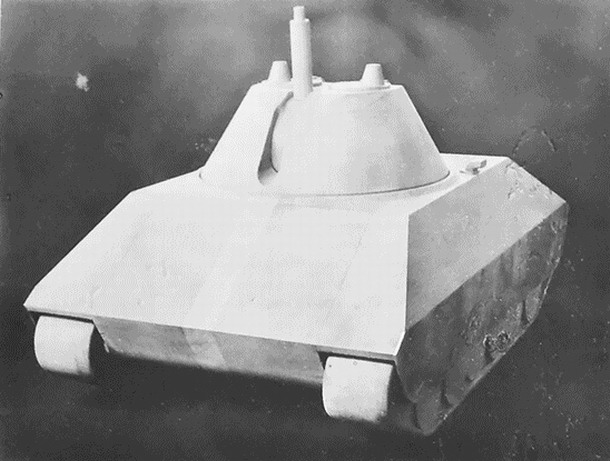
Wooden mock-up of the planned Porsche Typ 245-010 tank – the enormous vertical gun elevation range reflects the vehicle's dual role, source: Flickr.com with permission of the publishing user, edited
The MK 112 Cannon
Let us return to the tank's armament – the automatic MK 112 cannon. Rheinmetall was developing this weapon primarily for the German Luftwaffe, and as a result the development placed great emphasis on minimising the weapon's weight. In its first development version the cannon weighed approximately 300 kg; in the second, improved version this was reduced to just 275 kg. In the proposed turretless tank, the cannon was to be mounted on a rotating pedestal concealed inside the hull. During travel, and when engaging ground targets, the barrel would be lowered into the opening in the front wall of the hull. In this position the weapon had only a limited traverse – as with other vehicles mounting their armament in a fixed casemate – specifically 5° to either side. To engage aerial targets, the enormous two-part roof hatch simply had to be opened and the barrel raised. The opening in the roof was large enough that once the barrel was elevated to 25 degrees or more, the weapon was free to traverse through the full 360°.
The MK 112 was belt-fed and in fully automatic mode achieved a rate of fire of approximately 300 rounds per minute – a truly impressive figure given that each projectile weighed 1.485 kg. The proposed tank was to carry a supply of 300 rounds stowed along the sides of the fighting compartment. Once a belt was expended, the gunner (or the commander) had to load a fresh one. Sources do not specify how many rounds each belt contained, though the number must have been limited to keep handling manageable. Given that the cannon could rotate freely on its pedestal while the ammunition remained fixed along the sides of the compartment, reloading the weapon could have been quite an eventful business. In any case, the MK 112 never reached series production. By the end of the war only 15 prototypes had been built, which subsequently underwent intensive trials conducted by the German Luftwaffe.
Improved Version
The design solution described above – in which the cannon could only rotate freely when elevated to 25 degrees or more – evidently did not find favour with the soldiers, and so on 5 August 1943 Porsche presented a fundamental improvement. The entire rotating pedestal, together with the weapon (and presumably its crew), was to be made extendable – in other words, it would be raised above the roof of the compartment, where it could rotate freely at any elevation, including zero (i.e. when engaging ground targets). The extension involved lifting the pedestal by 40 cm. The sources do not describe the mechanism by which this was to be accomplished, how long it would take (and thus how quickly the vehicle would be ready to open fire), or how the crew of the weapon – now raised above the compartment roof – were to be protected. In any case, it was a solution worthy of Porsche's legendary imagination, fully in the spirit of "why do it simply when you can do it in a complicated way." It should also be noted that the vehicle was apparently to be equipped with two separate sights: one for engaging ground targets and one for aerial targets.
The tank's crew was apparently to number just three men: a driver, a commander, and a gunner. A dedicated loader was not needed precisely because the cannon fed from a belt – the necessity of loading a fresh belt after a given number of rounds did not justify adding a fourth crew member. For entry and exit, all three men would most likely have used the large roof opening that also served to extend the cannon. Porsche submitted two weight calculations to the Army, showing the vehicle's total weight at different armour thicknesses. With 50 mm of armour on the front, 30 mm on the sides, and 20 mm at the rear, the total weight came to 16.5 tonnes. With the front armour increased to 60 mm, the sides to 40 mm, and the rear to 25 mm, the turretless Typ 245-010 weighed in at 18.5 tonnes.
The Rotating Turret Version
Porsche himself appears to have recognised fairly quickly that his turretless tank had a number of shortcomings. It had no secondary armament for engaging enemy infantry, for instance. More significantly, it lacked the very resistance to air attack that had been called for – the flat roof plate with its enormous central hatch was in this respect an extremely vulnerable point. As early as 2 August 1943, therefore, Porsche presented a further version of his "universal" tank, this time fitted with a conventional rotating turret. The running gear, overall vehicle dimensions (except height, naturally), engine, and gearbox were all identical to the first turretless design. The hull, however, was substantially redesigned, particularly at the front. The front hull plate was no longer formed by two panels of differing slope but by a single flat plate rising from the hull nose to the top of the hull. The cooling air vents remained in the hull roof behind the fighting turret, as did the exhaust outlet.
The fighting turret was positioned well forward, practically at the very edge of the front hull plate. Both the turret and – wherever possible – the armoured hull were to be cast rather than fabricated. The turret was broadly in the shape of a truncated cone, with wall inclination of 30 degrees and a thickness of 40 mm. The turret roof, at only 20 mm, remained a somewhat vulnerable point in terms of air attack, but its area was many times smaller than the flat roof of the preceding turretless variant. A long, narrow slot in the turret front and roof accommodated the gun barrel and allowed vertical movement ranging from –8 to +82 degrees. An internal mantlet was connected to the barrel, filling the slot in the outer turret walls and maintaining the continuous integrity of the armour protection. To the right of the gun barrel was the machine gun embrasure; the machine gun was mounted entirely independently of the cannon. Two crew hatches were fitted in the turret roof, with a grenade launcher at the rear, its body fixed inside beneath the roof. Periscopes were installed in the hatch covers: the one on the right was a fully rotating type for the commander, while the one on the left was part of the gun sight and served the gunner.
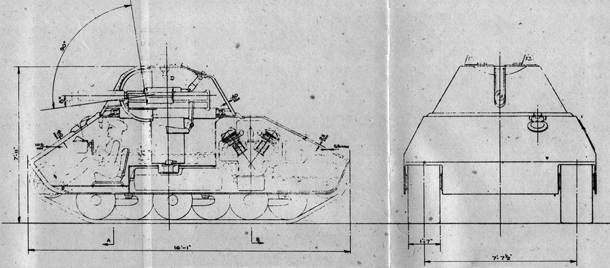
The cross-section on this drawing clearly shows not only the driver's position but also the location of the fuel tank beneath the turret and the transversely mounted engine, source: Flickr.com with permission of the publishing user, edited
This time Porsche did not offer separate calculations for a lighter and a heavier version of the vehicle. The front hull plate was to be 60 mm thick at an inclination of 55 degrees; the rear plate, 25 mm thick, was to be inclined at an even steeper 62 degrees; and the side plates, 40 mm thick, were angled at 28 degrees. The driver's position was on the left at the front of the hull, and he looked out through a vision port in the front plate. Behind the driver was an open passageway into the space beneath the turret, so under normal circumstances he would board and exit the vehicle through the hatches in the turret roof. If that was not possible, or speed was of the essence, he could also leave his position through an emergency hatch in the left side wall.
The Typ 245-010 with fighting turret was to weigh approximately 18 tonnes and achieve a maximum speed of up to 65 km/h. The tank was to be 4.88 metres long, 2.92 metres wide, and 2.575 metres tall, with a ground clearance of 0.445 metres. Road range was expected to be around 240 km and cross-country range around 150 km. Porsche had managed to keep the overall hull length at a reasonable figure, achieving a very favourable ratio of track contact length to track gauge – a value of 1.2 to 1.3 promised excellent manoeuvrability.
The addition of the fighting turret allowed Porsche to increase the on-board ammunition supply from 300 to 350 rounds. The belts were now to be stowed in the forward part of the hull to the right of the driver. The crew remained at three men – driver, commander, and gunner – so again there was no dedicated loader, and changing the ammunition belts presumably fell to the commander, who had far easier access to the stowage location than the gunner. Nor was there a dedicated machine gunner, which meant the tank commander was simultaneously expected to perform three distinct roles: commanding the crew in the full sense (observing the battlefield, designating targets, directing speed and direction of movement, and so on), occasionally lifting and loading fresh ammunition belts, and operating the machine gun – and sources do not even mention who was supposed to handle the radio. This ran directly counter to one of the hard-won principles of German tank crew doctrine, under which the commander was traditionally commander and nothing else, free from any distraction. When one also considers that this particular commander would have been expected to monitor not just the ground situation but the sky above as well, it becomes clear that in combat he would inevitably have been hopelessly overwhelmed.
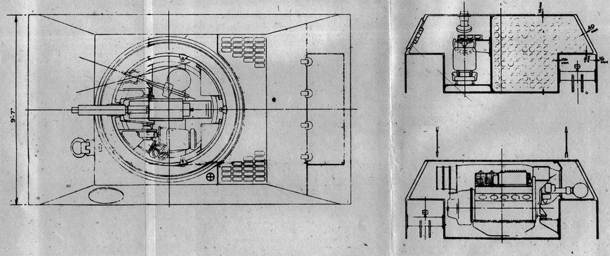
This drawing (see the cross-section at top right) beautifully illustrates the enormous ammunition stowage to the right of the driver's seat – the automatic cannon was a hungry beast, source: Flickr.com with permission of the publishing user, edited
Open Questions
The enclosed fighting turret raises a number of additional questions. None of the sources, for instance, addresses how ventilation was to be managed. Imagine a 55 mm cannon firing 10 rounds in two seconds – the fighting compartment would inevitably have been filled with acrid propellant fumes. The sources are also silent on where the spent cartridge cases would end up, and these were by no means small – each empty case was 175 mm long. At the cannon's prodigious rate of fire, the crew would have found themselves literally wading through spent brass within a matter of minutes.
Porsche's proposal for a "multi-purpose" tank evidently failed to impress the Army – in either the turretless or the turreted variant – and was rejected. This was entirely the right decision, for a whole host of reasons. The vehicle was a completely new design, developed virtually from scratch, meaning that its development and subsequent refinement would inevitably have taken a very long time. Introducing a new combat vehicle type would also have placed additional demands on crew training, maintenance, and spare parts logistics – the last thing the Germans needed in mid-1943. The MK 112 cannon itself was, at the time in question, literally in its infancy, and as history would show, its development never matured to the point of series production before the end of the war. The tank's engine – the Porsche Typ 101 ten-cylinder – had already been used in Porsche's prototype entry for the Tiger (VK 45.01 (P)) competition, where trials had revealed it to be unreliable and troublesome.
And then there is the concept itself. In theory it may have sounded attractive – why build combat tanks and then additional Flakpanzers to escort them, when a single type could do both? In practice, however, a "hybrid" designed to do several things rarely matches a vehicle purpose-built for one. As a conventional battle tank the Typ 245-010 would have been very weak. Its weapon would not have matched the anti-armour performance of the already-outdated Panzer III, and in its turretless form it would have also fallen short in crew protection. Against aircraft, the turreted variant would have suffered from restricted visibility and a correspondingly limited ability to track fast-moving targets. The development of this complex vehicle was therefore passed over in favour of far simpler and cheaper Flakpanzers converted from the already-in-production Panzer IV.

ARTICLE
CONTENTS:
Reproducing text from the Panzernet website without the written consent of the operator is prohibited.