P.1000
when megalomania defeats common sense
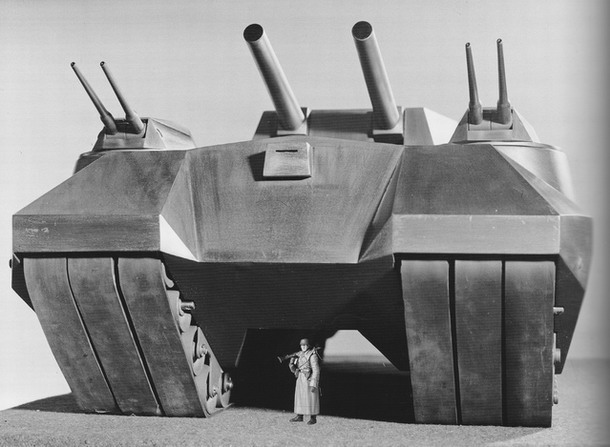
Scale model of the super-heavy tank P.1000 in the three-turret variant with the shorter version of the 280 mm guns. The figure of a soldier in front of the tank is intended to provide scale and convey just how enormous this vehicle was, source: Flickr.com with permission of the publishing user, edited
Origins of the Project
Behind this monstrous tank concept, weighing somewhere between 800 and 1,000 tonnes, stood essentially just two individuals: Adolf Hitler, a megalomaniac obsessed with grand projects, and Eduard Grote, a designer driven by the ambition to build something the world had never seen. When these two met, practicality and pragmatism went out of the window and their obsessions took over.
Eduard Grote was by all accounts a very talented engineer who in the 1920s ran his own firm in Leipzig, in eastern Germany, and held several patents relating to the cooling and lubrication of diesel engines. He later apparently went to work for Rheinmetall. Around the turn of the 1930s, Grote was invited to the Soviet Union – then a young communist state whose army was scouring the world for inspiration and expertise in the construction of its own armoured fighting vehicles. Pre-Hitler Germany and the USSR had in fact been collaborating quite actively in the field of armoured technology. Grote therefore relocated to the USSR with his team, most likely in 1929 or 1930, and there led the development of several new tank types for the Red Army (among them the tank TG).
In March 1933 Grote, while still in the USSR, drew up a proposal for a huge "coastal defence" tank weighing in the region of 1,000 tonnes. According to some sources he was given this assignment by Mikhail Tukhachevsky himself, the future Marshal of the Soviet Union who was then overseeing the modernisation of the Red Army. This seems unlikely, however, since Tukhachevsky understood armoured warfare and it is hard to imagine him commissioning the development of such an absurd "tank." It is quite possible that Grote produced the proposal on his own initiative, which would also explain why the Soviets rejected it.
The first scale model of the P.1000 tank was built in October 1942. Its four secondary turrets were, however, so poorly positioned that they would have obstructed the rotation of the primary fighting turret. Note also the enormous road wheels, source: Flickr.com with permission of the publishing user, edited
When Hitler came to power in Germany in 1933, military cooperation with the USSR came to an end, and Grote returned home along with many other Germans. In the second half of the 1930s he apparently worked for Krupp of Essen, contributing to engine and gearbox designs for various military vehicles. Sometime around 1940, Grote took up a position in the Ministry of Armaments as a special plenipotentiary for submarine development. It was in this capacity that he came to meet Hitler personally in June 1942. During an informal conversation the subject of super-heavy tanks evidently arose, along with Grote's Soviet experience. Hitler was apparently very struck by the fact that the Soviets had been "flirting" with the idea of something like this nearly a decade earlier. This left him with the impression that the Bolsheviks had a head start on the Germans in some area, and that was something he found inherently intolerable.
Grote Gets to Work
Hitler therefore tasked the Minister of Armaments, Albert Speer, to commission Grote to produce a feasibility study for a super-heavy tank for the German Army – without spending much time on any detailed analysis of how such a machine could actually be used in practice. On 22 June 1942 Speer passed the Führer's request on to Grote. Grote – no doubt delighted at the chance to create something the world had never seen – threw himself into the work with enthusiasm. On 17 July 1942 he approached the chief designer at Krupp, Erich Müller, explaining that on the Führer's commission he was working on a project for an armoured vehicle weighing several hundred tonnes and was looking for a suitable powerplant. Grote had calculated that an extraordinary 16,000 horsepower would be needed to propel the vehicle and was considering providing this through the use of several marine engines. What he needed from Krupp, however, was assistance with transmitting the engines' power to the drive sprockets. Since Krupp had experience manufacturing high-power gearboxes, Grote asked Müller for a technical consultation.
On 13 August 1942 the first meeting between Ing. Grote and the Krupp team took place. Grote presented a tank design weighing approximately 800 tonnes, 35 metres long and 14 metres wide. The track contact length with the ground was to be about 21 metres, and by using six tracks each 1,200 mm wide, a very reasonable ground pressure of 0.54 kg/cm² was to be achieved. The details of the running gear had not yet been worked out, but Grote was reportedly already anticipating the need for drive sprockets with a diameter of 300 cm.
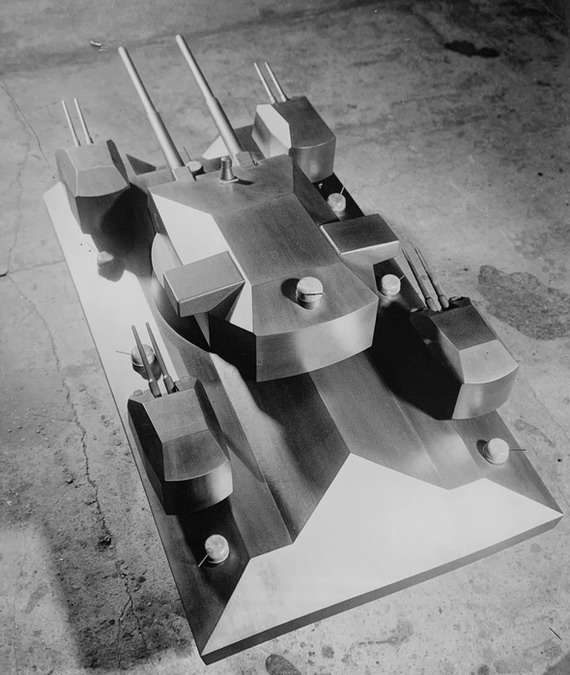
Top view of the first version of the P.1000 model, showing the arrangement of the eight small machine-gun cupolas and the widened extensions at the sides of the main fighting turret, which were to house a coincidence rangefinder, source: Flickr.com with permission of the publishing user, edited
An Engine for the Monster
When it came to the powerplant, Grote was considering two very different alternatives. The first was to use a pair of MAN V12Z 32/44 marine engines, each producing an output of 10,000 horsepower. The MAN V12Z 32/44 was a colossal 24-cylinder diesel with a displacement of an extraordinary 849 litres. A pair of these engines would indeed deliver a luxurious 20,000 hp – but there was one significant drawback: each such diesel weighed 56 tonnes, meaning two of them together would account for 112 tonnes. The second motorisation option envisaged much smaller and lighter Mercedes-Benz MB 501 engines, of which no fewer than eight would have to be installed in the tank. The MB 501 was also a marine diesel engine, used primarily to power fast attack boats – the so-called Schnellboot. It was a 20-cylinder unit of 134.4 litres displacement, producing a sustained output of 1,500 hp at 1,480 rpm (with a short-term maximum of 2,000 hp at 1,630 rpm). Compared to the MAN unit described above, the Mercedes was a relative minnow: it weighed a "mere" 4.22 tonnes and measured 388 cm long, 158 cm wide, and 171 cm tall. Eight of these engines together would deliver a sustained output of 12,000 hp at a combined weight of approximately 33.76 tonnes. Compared to the two-MAN-engine option, this solution offered 40% less power but also 70% less weight.
At the time of presenting this first proposal, Grote had not yet decided what armament the tank was actually to carry. In any case, he asked Ing. Müller to assign 20 Krupp employees to work with him on the further development of the project. Müller promptly declined, pointing out that at such an early stage there was no justification for committing such an enormous amount of manpower. Grote therefore most likely continued largely on his own. The two men apparently did not meet again until October 1942, when they discussed the armament of the new tank – which had by then acquired the designation P.1000 (the letter P most likely stood for Panzer, and the number indicated the expected weight in tonnes).
Armament
The two designers apparently agreed that the super-heavy tank should have five artillery turrets. The main turret was to be fitted with a pair of 280 mm guns, two smaller fighting turrets were each to carry two 128 mm guns, and the two remaining turrets were to house either 105 mm or 88 mm guns – again two per turret – giving a total of ten guns. In addition, the tank was to carry eight small cupolas mounting machine guns or 20 mm MG 151 cannons. Updated weight calculations by Grote dated 17 October 1942 showed the tank's weight had grown from 800 to 900 tonnes. The estimated breakdown of this weight among the main functional groups is also interesting: fully 300 tonnes was allocated to armament and ammunition, 400 tonnes to the armoured hull and turrets, 100 tonnes to the running gear and tracks, and a further 100 tonnes to internal systems – engines, gearbox, cooling, fuel tanks, and so on.
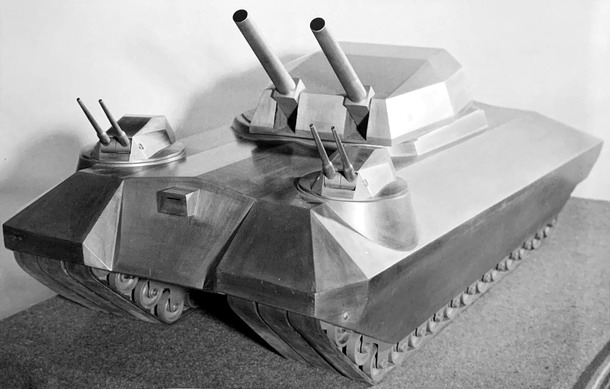
The second variant of the scale model had only three fighting turrets and more, smaller road wheels. Note also that the 280 mm guns in the primary turret have substantially shorter barrels than on the first model, source: Flickr.com with permission of the publishing user, edited
The first scale model of the proposed tank was most likely prepared by Grote on 17 October 1942. It made the illogicality – some might say outright stupidity – of the overall vehicle layout strikingly clear. The secondary fighting turrets protruded from the hull in such a way that they obstructed the rotation of the main turret, creating enormous "blind" arcs in which the main weapons could not be brought to bear (or only at considerable elevation). Interesting too is the fact that this model had a running gear with six large road wheels. By rough estimate, these wheels were some 2 metres in diameter, possibly even 2.5 metres. The weight of each such wheel could therefore be assumed to run into at least the hundreds of kilograms, making handling them in field conditions extremely complicated. One notable feature was the widened extension of the main fighting turret at its rear, where the lenses of an enormous naval coincidence rangefinder 10.5 metres long were to be housed.
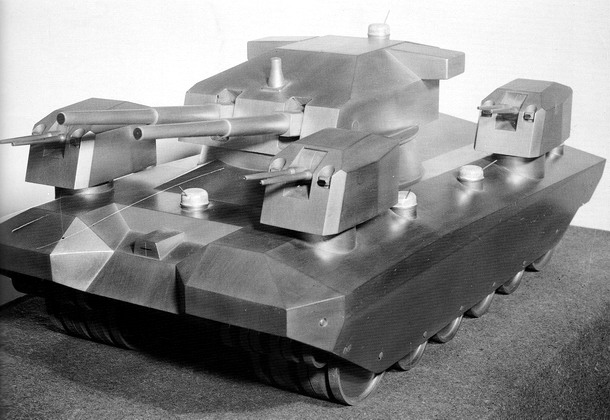
A new design and a new scale model were produced in December 1942. This version had only three artillery turrets – the main turret again with a pair of 280 mm guns, and two secondary turrets each carrying a pair of 128 mm guns, giving just six artillery weapons in total (two 280 mm, four 128 mm). The secondary turrets in this iteration were much lower than in the first design, so they no longer obstructed the rotation of the main turret – or did so only minimally. The 280 mm guns in the main turret had noticeably shorter barrels on the second model than on the first. The chassis of the new model featured twelve much smaller road wheels on each side, with additional wheels positioned above ground level to support the front section of the tracks. A third scale model was later produced, based on the second but now featuring three embrasures on each side – most likely for MG 151 automatic cannons. The side armour protecting the running gear was also redesigned in this version.
The first P.1000 model most likely envisaged the use of the naval guns 28 cm SK C/34 (SK = Schnelladekanone, literally "fast-loading gun"). The second model either used the older and shorter 28 cm SK C/28, or some custom-adapted version of one or the other weapon. In either case, the shells used for these guns weighed approximately 300 kilograms each. Manual loading was therefore out of the question, and Grote would presumably have planned to use the same powered loading mechanism as was fitted to these guns on battleships. A conveyor to bring shells up from their stowage in the hull to the turret would presumably also have been required. Both of these systems would, however, have been entirely unsuitable for use in a tank owing to their very considerable weight.
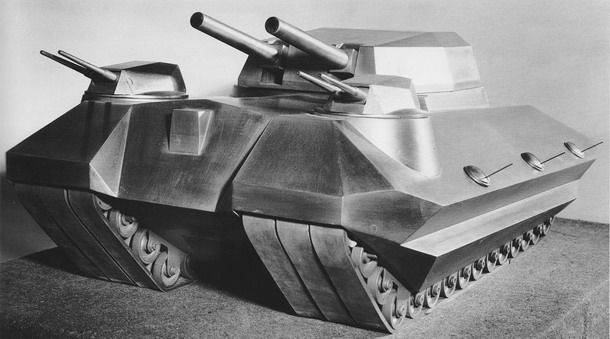
The third (and final) model was based on the preceding version but featured new cupolas for machine guns or rapid-fire cannons, as well as a different side armour arrangement, source: Flickr.com with permission of the publishing user, edited
According to some authors, the use of a gun turret from the decommissioned battleship Gneisenau was considered for the P.1000. This is most likely no more than a legend. Gneisenau had three main turrets, each housing three 28 cm SK C/34 guns, so a complex conversion from three to two guns per turret would have been required. The far greater obstacle, however, was the weight of the ship's turrets: each of Gneisenau's three main turrets weighed some 750 to 800 tonnes. Even with one gun removed, it would likely still have exceeded half the entire expected weight of the tank. As for the planned armour thickness or crew size, the sources offer little more than speculation rather than confirmed figures. According to some authors, the frontal armour was to be 250 mm thick, and the tank was to be crewed by up to 40 men – though this probably applied only to the most complex proposed variant with five fighting turrets.
End of the Project
The P.1000 tank is sometimes referred to in the literature by the name Ratte – meaning "rat." In official documents, however, this name apparently never appeared, and it may well be yet another legend. When exactly the P.1000 project was cancelled is also unclear from the sources, as is whether the decision was made by Albert Speer or by someone else. In any case, it was entirely the right decision. At the turn of 1942 and 1943, a thousand conventional tanks were of far greater value to Germany than a single thousand-tonne mastodon.
ARTICLE
CONTENTS:
Reproducing text from the Panzernet website without the written consent of the operator is prohibited.