L.K.A. 1 & L.K.A. 2
the export tank nobody wanted
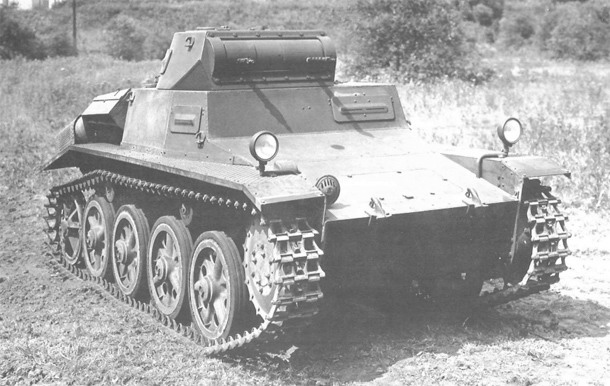
The sole prototype of Krupp's export tank L.K.A. 1, source: Flickr.com with permission of the publishing user, edited
The Export Tank Concept
The tank, as a new type of weapon, was born during the First World War and first saw action in 1916. In the two remaining years of that conflict the tank barely had time to demonstrate its full potential, yet even so it was clear to many that the age of tanks was not ending with the Great War – it was just beginning. This was the conviction not only of army commanders but also of the industrial firms that had been involved in producing the first tanks. These companies naturally viewed tanks from a slightly different angle than the soldiers themselves and saw in them above all an attractive commercial product.
The war was over, demand for tanks began to fall, and firms like Renault were wondering what to do next. If the domestic army was no longer buying tanks – in Renault's case the French Army – why not offer the product to other armies? After all, there were plenty of countries in the world whose military budgets and industrial base simply could not support the development of their own tanks. The ideal type for such less affluent nations would undoubtedly be a relatively cheap, small, and light tank – precisely like the Renault FT-17. Other industrial concerns, such as the British Vickers or the Czechoslovak ČKD, later began thinking along similar lines. And so something like a new category of tanks designed primarily for export came into being.
These tanks were not intended to be sold in large numbers to a single customer, but rather in smaller batches to as many customers – and countries – as possible. The requirements of different armies varied considerably, however: some wanted gun armament, others machine guns; some preferred a liquid-cooled engine, others air-cooled. Manufacturers therefore had to learn to adapt their tanks to customer preferences at least to some degree. And it worked. Markets for light tanks were found in poorer Balkan states, in the Soviet Union, and even in Latin America.
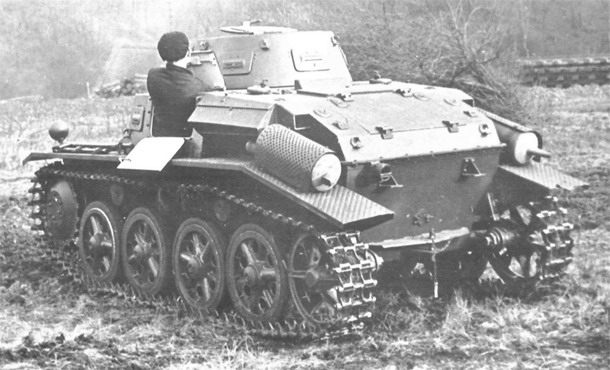
Although the L.K.A. 1 resembled the Panzer I, it was a vehicle developed entirely from scratch, source: Flickr.com with permission of the publishing user, edited
The Versailles Problem
Germany, with its advanced industrial base, would certainly have been capable of developing its own tanks, but for a long time something else stood in the way: the Treaty of Versailles, which strictly prohibited the Germans from developing or manufacturing tanks. The Germans did work on tank development in secret, but they could not openly test or use their vehicles, and offering them to foreign buyers was entirely out of the question. Among the firms involved in this covert German tank development was Krupp. Already in the 1920s Krupp had taken part in the Grosstraktor and Leichttraktor projects, but its real experience came in the first half of the 1930s during the development of the light tank Panzer I. Krupp developed the chassis, drivetrain, running gear, and armoured hull tub for that tank.
When Krupp delivered the first five pre-production chassis of the new tank to the Army in 1933, Adolf Hitler was already sitting in the Reich Chancellor's chair. He had little concern for compliance with the Treaty of Versailles, so it is no surprise that the German Army placed a straightforward order for a thousand new light Panzer I tanks in 1934. Series production of Germany's first tank could finally get properly underway. The Treaty of Versailles was thus torn up in all but name, Krupp had gained substantial new experience in tank development and production, and very soon began considering whether to offer its products to foreign buyers and claim a share of the market for itself.
Krupp's Export Tank
Krupp did not intend to offer the Panzer I abroad – that tank had been designed and built for the German Army. For export purposes an entirely new type was to be created, and so it was (though the inspiration from the Panzer I is strikingly obvious). The basic concept of the vehicle was discussed at an internal meeting on 9 May 1936. The key characteristics were: small, light, fast, and cheap. Weight was to be around just 4 tonnes, assisted by the smallest possible overall dimensions and the thinnest armour that could still withstand armour-piercing 7.92 mm ammunition – rifle and machine gun rounds – fired from 30 metres or more. The new export tank received the designation leichter Kampfwagen Ausland 1, literally "light combat vehicle for abroad," abbreviated to L.K.A. 1 (though in official communications with the Ordnance Office and sub-contractors the vehicle was also referred to as L 10 and M.G. K.A. (Maschinengewehr Kampfwagen Ausland)).
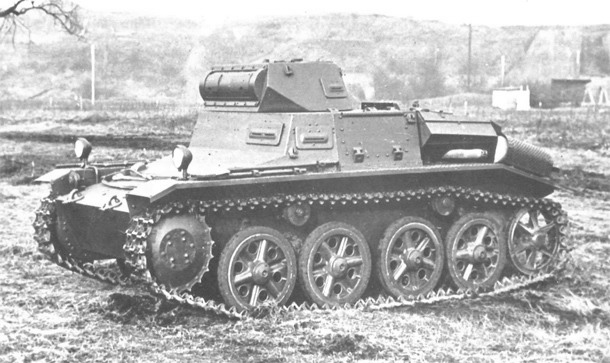
Another "promotional" photograph of the L.K.A. 1 export tank prototype, here without armament, source: Flickr.com with permission of the publishing user, edited
Design Description
Before continuing the story of the L.K.A. 1, it should be noted that this was not Krupp's only export tank project. Already around the turn of 1936–37 the company began work on a medium export tank, the M.K.A. (mittlerer Kampfwagen Ausland), armed with a 45 mm gun, and during 1937 the planned family of export tanks grew to as many as six different types. But we will take things in order. The first drawings of the light L.K.A. 1 were produced in July 1936. The vehicle's weight was estimated at 4.5 tonnes (for comparison, the Panzer I Ausf. A weighed 5.4 tonnes), and the expected maximum speed was 50 km/h (compared to 37 km/h for the Panzer I). The export tank was to have a two-man crew and its armament was to consist of two machine guns in a fully rotating turret – identical in this respect to the Panzer I. The chosen powerplant was an air-cooled Krupp eight-cylinder engine producing 85 hp, though with the stipulation that a liquid-cooled unit had to be installable at the customer's request. The gearbox was to have five forward and two reverse ratios, fuel capacity was 140 litres, and a radio set was to be fitted only if ordered by the customer.
Before Krupp could begin offering the new tank to foreign armies, it first needed approval from the German Ordnance Office. A meeting with its representatives was therefore held in October 1936, at which Krupp presented the new fighting vehicle and applied for the necessary authorisation. The Waffenamt approved the export but accompanied its decision with a list of conditions and restrictions covering various design details and materials.
Construction of the first prototype began in February 1937. According to the original plan it was to be completed by the end of April that year, but it was not actually ready until February 1938. The vehicle measured 380 cm in length, 190 cm in width, and 168.5 cm in height. Its weight matched the planned 4.5 tonnes, as did the maximum speed of 50 km/h. The chassis on each side consisted of four large road wheels with rubber tyres around their circumference. Two adjacent wheels were mounted on a shared bracket sprung by a leaf spring. At the front was a toothed drive sprocket and at the rear an adjustable idler wheel for track tensioning. The upper run of the track was supported by a pair of small return rollers. The tracks were 280 mm wide.
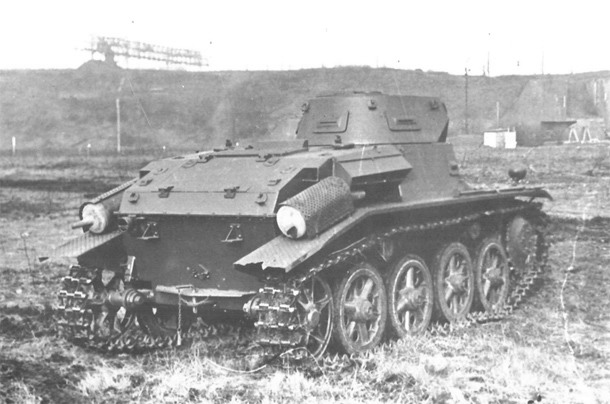
Prototype of the export tank L.K.A. 1, source: Flickr.com with permission of the publishing user, edited
The hull and turret of the L.K.A. 1 bore a strong resemblance to the PzKpfw I Ausf. A – except for the front hull plate and rear engine section, which were handled differently. This was not, however, a case of reusing components from the Panzer I; the L.K.A. 1 was genuinely developed from scratch to meet its own specification, and the similarity to the Panzer I was one of inspiration only – albeit very strong inspiration. On closer examination a number of details can be found in which the L.K.A. 1's hull and turret differed from the Panzer I Ausf. A, starting with the overall dimensions.
The basic layout of the L.K.A. 1 placed the engine at the rear, connected by a driveshaft to the gearbox at the front. In the middle of the hull was the crew compartment, with a rotating fighting turret on the roof. The driver sat on the left side of the compartment, with his main vision port directly ahead of him in the front wall of the compartment. A smaller secondary port was to his left, and a further port was in the right side wall – though this was too far from the driver to be of practical use and was most likely used by the commander when he was not standing in the turret. The driver's entry and exit hatch was cut across the edge of the left side and roof plates of the compartment, in the same manner as on the Panzer I.
The fighting turret was offset to the right of the vehicle's centreline. Like the hull, it was somewhat smaller than that of the Panzer I and featured differently designed vision ports and a different front plate with the weapon mantlet. The armament consisted of two machine guns of 7.92 mm calibre, though not the same type as those in the Panzer I. The smaller turret dimensions meant the L.K.A. had to use MG 13k machine guns with a shorter barrel. Ammunition stowage was 2,000 rounds. The mantlet allowed vertical weapon movement from –10 to +20 degrees; horizontal traverse was achieved by rotating the turret. The machine guns were operated by the commander, who sat and half-stood on the compartment floor with the upper part of his body in the turret. He had his own entry and exit hatch in the turret roof. In the engine compartment behind the crew compartment and turret sat the air-cooled petrol Krupp M 311 engine, followed by a Zahnradfabrik Z.G. 35 gearbox. The fuel tanks held 140 litres of petrol.
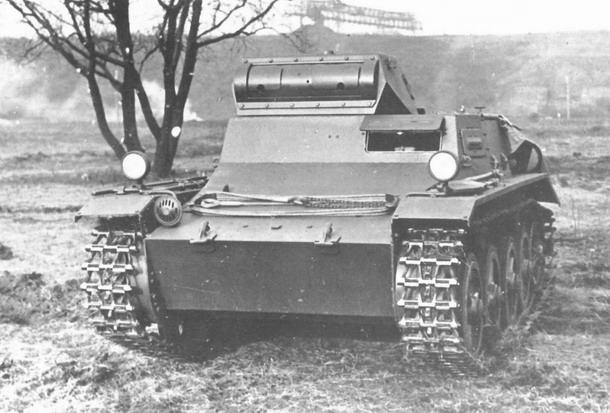
Prototype of the export tank L.K.A. 1, source: Flickr.com with permission of the publishing user, edited
A Gun Would Help
The one prototype built turned out to be the only one. Krupp manufactured it at its own expense, intending to recoup the development costs from future foreign sales – none of which ever materialised. Several commercial negotiations did take place, with delegations from Thailand, Switzerland, Turkey, Afghanistan, and Uruguay, but all interested parties ultimately decided against purchasing. As early as the first meetings in October 1936 – before the prototype had even been completed – a potential buyer raised the objection that the vehicle lacked a gun. Krupp was evidently well aware of this weakness, since in that same month the designers were tasked with investigating whether a 20 mm cannon could be installed in the L.K.A. 1. This was the beginning of what would later become the L.K.A. 2 project.
The analysis showed that the existing L.K.A. 1 turret was too small for the more powerful weapon and would need to be redesigned. The Ordnance Office, which was naturally informed of this plan as well, raised no objections, and in February 1937 a new fighting turret was designed to accommodate a machine gun and a KwK 30 rapid-fire cannon of 20 mm calibre side by side – the same weapon that armed the Panzer II. Construction of a second prototype, to be fitted with this new turret, began immediately. To distinguish the two vehicles, the gun-armed version received the designation L.K.A. 2, and its first prototype was completed in April 1938.
The sole surviving photograph of the L.K.A. 2 prototype shows that certain changes were also made to the hull. The left section of the front compartment wall ahead of the driver projected slightly forward, which now gave the driver a view to the right side as well. The original vision port in the right side wall of the compartment could therefore be dispensed with, as neither the driver nor the commander could make practical use of it in normal operation – both were too far from it. The L.K.A. 2 carried 150 rounds of ammunition for the cannon. Given the limited space in the turret, however, the gun ammunition had to be stowed in the hull compartment below the turret, which undoubtedly complicated the commander's job of operating the weapon. The L.K.A. 2 was naturally somewhat heavier than the machine-gun L.K.A. 1, weighing 5.2 tonnes. Here too Krupp's original intention went unfulfilled: the one example built was also the last, and no foreign buyer placed an order.
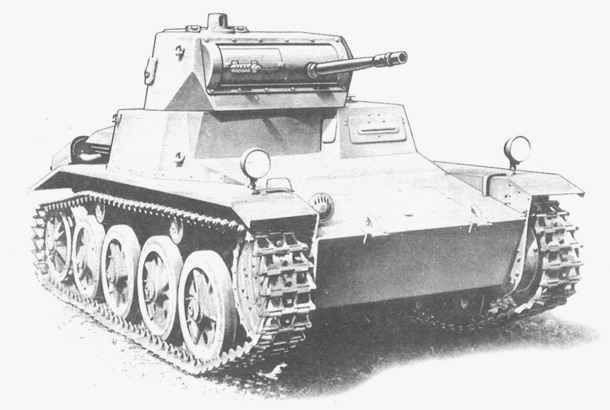
The only surviving retouched photograph of the L.K.A. 2 export tank prototype, armed with a 20 mm cannon, source: Flickr.com with permission of the publishing user, edited
In February 1937 Krupp also began development of another export tank type based on the L.K.A. chassis but armed with a 20 mm cannon. This type received the designation 2 cm K.A.v (the letter v stood for verstärkt, meaning strengthened or reinforced). As the name suggests, this variant was to have heavier armour, up to 30 mm on the front sections, raising the vehicle's weight to as much as seven tonnes. As early as March 1937, however, it was decided that the 2 cm K.A.v would not use the L.K.A. chassis but the larger and more robust chassis of the planned tank M.K.A.
ARTICLE
CONTENTS:
Reproducing text from the Panzernet website without the written consent of the operator is prohibited.