EINHEITSPANZER III/IV
Germany's attempt at a universal tank
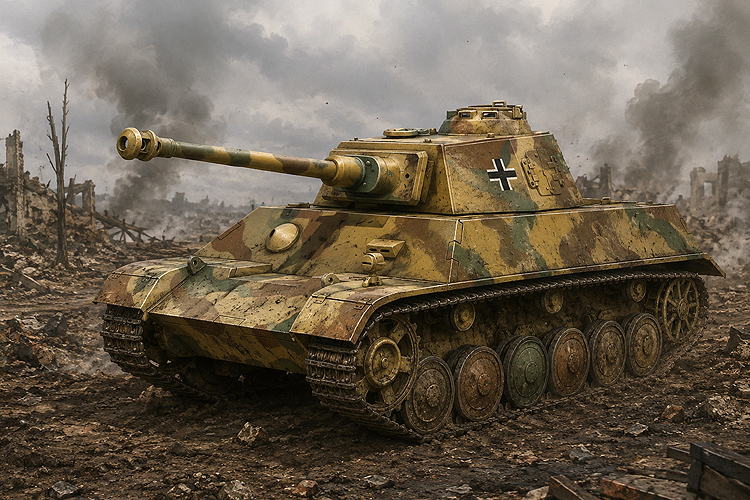
a possible appearance of the new unified tank on the Einheitsfahrgestell III/IV chassis, source: generated by AI
Combining two types
According to some sources, the first thoughts about creating a new universal tank type that would combine the best design elements of the existing Panzer III and Panzer IV emerged as early as late 1941. The motivation behind these ideas was the consolidation of production from two types into one, and the resulting simplification and cost reduction in maintenance support, spare parts logistics and — not least — crew and mechanic training. At that time, however, these thoughts appear to have yielded no tangible results. Somewhat later, in early 1943, the first actual chassis combining elements of the Panzer III and Panzer IV came into existence. This was not, however, developed as the basis for any new universal tank type, but rather as a carrier for self-propelled weapons. It accordingly received the designation Geschützwagen III/IV — Geschützwagen meaning "gun carrier" — and served as the basis for the tank destroyer Nashorn and the self-propelled howitzer Hummel.
Design description
The original idea of developing a universal tank was dusted off again only at the turn of 1943 and 1944, under the designation Panzerkampfwagen auf Einheitsfahrgestell III/IV — literally "tank on unified chassis III/IV". The specification for the new vehicle was approved at a meeting of the so-called Panzerkommission on 4 January 1944. The hull tub was to be taken from the Panzer IV, together with the Maybach HL 120 TRM engine with its radiator and fans. The SSG 77 gearbox along with the final drives, steering brakes and drive sprockets were instead taken from the Panzer III. The vehicle was, however, to receive new running gear consisting of six road wheels of 660 mm diameter on each side. The road wheels were doubled, with the track guide teeth passing through the gap between the two discs. As a cost-saving measure, the wheels were not fitted with the usual rubber tyre but with a steel rim over a thin layer of rubber. The wheels were suspended in pairs and sprung by leaf springs.
The Einheitsfahrgestell III/IV received new tracks 540 mm wide, and fuel tanks with a capacity 300 litres greater than those of the Panzer IV. The frontal armour of both the hull and the driver's compartment was redesigned as sloped. It remained "two-tiered", however, similar to the original Panzer IV — meaning that behind the sharply angled nose of the hull came a horizontal section, from which the front wall of the driver's compartment rose further back. In the centre of this horizontal section a recessed step was incorporated. Its purpose is not clear, but it must have served some function, as otherwise it would simply have been an unnecessary manufacturing complication. The upper plate of the hull nose was 60 mm thick and angled at 60 degrees; the lower nose plate was equally thick but angled at only 45 degrees. The front wall of the driver's compartment was 80 mm thick with a slope of 50 degrees. The 30 mm side walls of the hull were angled at 36 degrees.
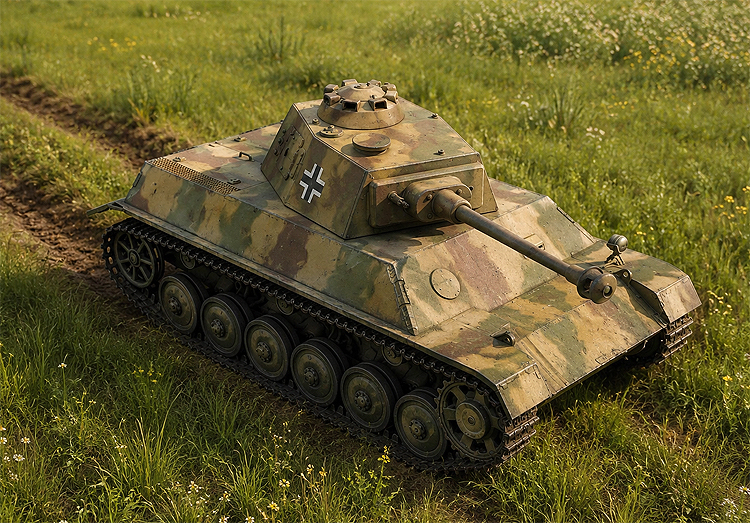
a possible appearance of the new unified tank on the Einheitsfahrgestell III/IV chassis, source: generated by AI
In the left section of the driver's compartment front wall was the driver's vision port. According to some depictions, the right section was to feature a hull machine gun port — though the machine gun was not integrated into the armour but was simply a closeable opening similar in design to that of the Jagdpanzer IV, sealed by a conically shaped cover. Other sources show the vehicle without this port — and therefore without a hull machine gun. The tank's crew would in all probability have been the standard five-man complement of driver, radio operator/machine-gunner, commander, gunner and loader. Due to the steep slope of the driver's compartment front wall, no room remained on its roof ahead of the turret for driver and radio operator entry hatches. All five crew members therefore had to use the turret hatches for boarding and exiting.
At the rear of the hull was the engine compartment, laid out very similarly to that of the Panzer IV. The turret — apart from minor details — corresponded to that of the Panzer IV Ausf. J, including the 75 mm KwK 40 L/48 gun. One of those differing details was the electrical supply to the turret, which was routed by a simple and inexpensive cable. As a result, the turret could not be traversed through a full 360 degrees but only 270 degrees to each side — meaning the entire rear hemisphere was covered "twice over", reachable by traversing either to the right or to the left. The ammunition supply carried consisted of 100 rounds for the gun and 3,150 rounds for the machine gun or guns.
A chassis for more than just a tank
The unified Einheitsfahrgestell III/IV chassis was intended to serve not only as the basis for the new tank but also for the tank destroyer Jagdpanzer IV — officially designated Panzer IV lang (E). In March 1944, the Weapons Office ordered the production of three pre-production prototypes of the new tank. Series production was planned to begin in February 1945. In July 1944, however, the Panzerkampfwagen auf Einheitsfahrgestell III/IV project was cancelled. Development of the Panzer IV lang (E) tank destroyer was to continue nonetheless. This step was connected with the general plan to gradually wind down Panzer IV production in favour of the Jagdpanzer IV, and also with the overall war situation, which demanded maximising existing production rather than introducing new types.
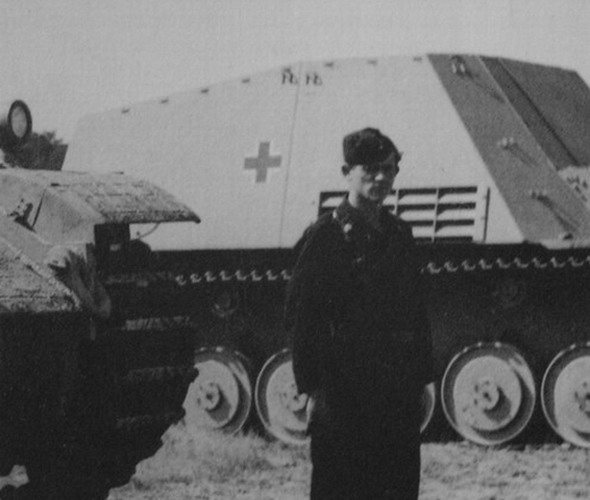
elements of the Einheitsfahrgestell III/IV running gear were tested in spring 1944 on an ammunition-carrier variant of the Geschützwagen III/IV, source: Flickr.com with the permission of the publishing user, edited
According to some sources, elements of the Einheitsfahrgestell III/IV running gear were tested in spring 1944 on five experimental Geschützwagen III/IV vehicles. Details of this testing are not known, but a photograph survives showing one such Geschützwagen III/IV — an unarmed ammunition carrier variant.

ARTICLE
CONTENTS:
Reproducing text from the Panzernet website without the written consent of the operator is prohibited.