SEMOVENTE da 75/34
Italian tank destroyer in German service
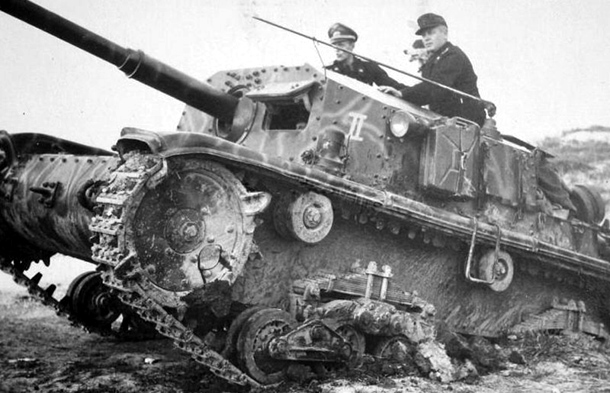
clearly visible on the drive sprocket of this Beute Sturmgeschütz M42 mit 75/34 851(i) are the four large teeth added by the Germans to prevent the tracks from slipping off under stress (one of the teeth is heavily deformed); source: Flickr.com with permission of the publishing user, edited
The Italian Self-Propelled Gun
At the turn of 1940 and 1941, the Italian Army was looking for ways to improve the combat effectiveness of its medium tank, the M13/40. Although the Italians progressively modernised it twice in the following years — producing the M14/41 and M15/42 variants — it was clear from the outset that no fundamental improvement in combat capability could be achieved this way. If this fighting machine was to remain relevant on future battlefields, it needed a far more radical upgrade. For inspiration, the Italians turned to their German allies. What caught their attention in particular was the German practice of using the chassis of the Panzer III tank as the basis for the assault gun StuG III. The turretless design of the assault gun made it possible to install a far more powerful weapon on an otherwise identical chassis than the original tank could carry. This was precisely what the Italians needed, and they resolved to follow the same path as the Germans.
The result of their efforts was the self-propelled gun Semovente M40 da 75/18. While the original M13/40 medium tank carried a 47 mm gun in a rotating turret, the self-propelled gun built on its chassis received a 75 mm weapon in a fixed superstructure. Strictly speaking, this was not a gun but a howitzer — the Obice da 75/18 Modello 1934. As the number after the slash indicates, the weapon had a barrel 18 calibres long. The Semovente da 75/18 entered series production in February 1941 and remained in production for approximately three years. For most of that time, the self-propelled guns were assembled at the Ansaldo plant in Genoa alongside the medium tanks on whose chassis they were based. As the M13/40 tank itself underwent successive modernisation to the M14/41 and then M15/42, the self-propelled gun's production had to follow suit, which brought about the Semovente M41 da 75/18 at the end of 1941 and the Semovente M42 da 75/18 a year later.
Although the self-propelled gun represented a significant leap in combat value over the original 47 mm tank, army representatives were aware that the Obice da 75/18 Modello 1934 howitzer still had considerable limitations. This was particularly true when it came to knocking out modern, heavily armoured Allied tanks, against which the weapon was only adequately effective when using shaped-charge ammunition. Moreover, the howitzer was not particularly accurate at longer ranges. As early as June 1941, the military therefore called for the Semovente to be re-armed with a more powerful gun that would allow the vehicle to effectively fulfil the role of a tank destroyer. The Italian Semovente was thus developing in the same direction as its original inspiration — the German StuG III — which had itself been re-armed with a longer and more powerful gun at the turn of 1941 and 1942 for exactly the same reason.
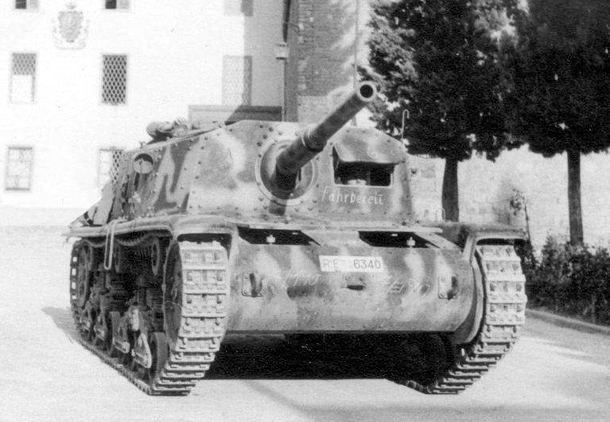
this Semovente M42M da 75/34 still carries its original Royal Italian Army registration R.E. 6340 (R.E. = Regio Esercito); the word Fahrbereit (ready for use) painted on the front armour plate indicates the vehicle successfully passed a German inspection; source: Flickr.com with permission of the publishing user, edited
Gun Against Armour
In response to the Italian Army's requirement, Ansaldo carried out an experimental re-arming of one Semovente M40 da 75/18 with the more powerful Cannone da 75/32 Modello 1937, which had a barrel 32 calibres long. This weapon was already being considered for the new heavy tank P26/40 then under development, so using it simultaneously in a self-propelled gun made clear economic sense. The demonstrator prototype of the Semovente M40 with this gun was probably ready by the end of 1941. The Army, however, was not satisfied with the chosen weapon, and in the spring of 1942 it issued a requirement for a modified gun with a barrel 34 calibres long, which was to replace the originally proposed 75/32 both in the new self-propelled gun and in the planned heavy tank P26/40. The new weapon was ready within a few months and was designated Cannone da 75/34 Modello SF.
As far as the Semovente was concerned, it became clear that the existing fighting superstructure did not have enough room for the longer and more powerful gun. The superstructure therefore had to be extended by 110 mm, moving its front wall further forward. The first — still incomplete — prototype of the self-propelled gun with the 75/34 gun and the extended superstructure was ready in October 1942, based on the Semovente M42 variant; the new version was accordingly designated M42M (the second M standing for "modificato", meaning "modified"). The complete prototype was apparently not finished until February 1943, with testing taking place in March of that year.
According to some sources, the gun on the new Semovente M42M da 75/34 was installed on the centreline of the front superstructure wall. Photographs clearly show this to be incorrect. The gun remained mounted slightly to the right, exactly as it had been on the earlier Semovente da 75/18. The new gun mounting, however, unlike those of the previous generations, allowed equal traverse to both sides — specifically 18° each way. The gun's vertical range ran from -12° to +22° (though -10° to +20° is sometimes cited). A total of 45 rounds of ammunition were carried on board (some sources say 46).
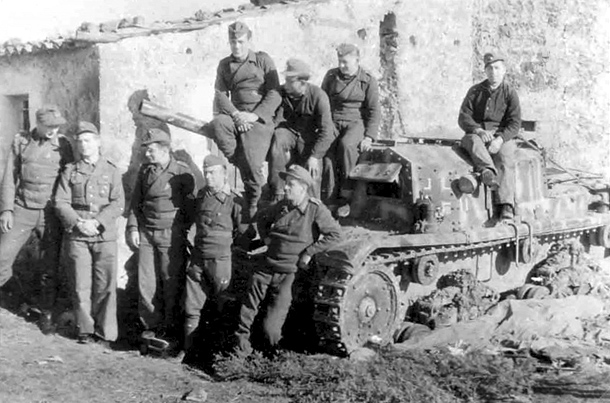
a captured Beute Sturmgeschütz M42 mit 75/34 851(i) somewhere in Italy; the soldiers are wearing the grey uniforms issued to assault gun crews; source: Flickr.com with permission of the publishing user, edited
Vehicle Description
As already noted, the chassis and most of the hull of the M42M assault gun were originally derived from the M15/42 tank. The vehicle had eight small-diameter rubber-tyred road wheels on each side, providing a smoother ride. Each wheel consisted of two discs, with the track guide teeth passing through the gap between them. The road wheels were connected in pairs into bogies, and two adjacent bogies were suspended from a shared swing arm sprung by a large leaf spring. With eight road wheels, this meant four bogies and two swing arms with springs. In addition to these, the running gear included a front drive sprocket, a rear idler wheel, and three return rollers supporting the upper run of the track. The tracks were 26 cm wide, each consisting of 86 links.
Along with the chassis and hull, various other elements were carried over from the original tank — most notably the FIAT-SPA 15TB Modello 1942 petrol engine with a displacement of 11.98 litres and an output of 190 horsepower at 2,400 rpm, as well as the five-speed gearbox and fuel tanks holding 338 litres of petrol (slightly different figures are also cited). The Semovente M42M da 75/34 weighed 15.3 tonnes (15.5 tonnes is also cited) and had a top road speed of up to 38 km/h (40 km/h is sometimes given). Road range was around 200 km. The arrangement of the engine and gearbox naturally followed that of the original tank — engine at the rear, gearbox at the front of the hull. The fighting superstructure, like the hull, was built around a structural frame of steel angle sections onto which armour plates were riveted. The front wall of the fighting superstructure was 50 mm thick, angled at just 5°; the side and rear walls were 25 mm. The 15 mm roof was not actually horizontal as it might appear at first glance, but sloped gently downward toward the rear.
The roof of the fighting superstructure featured two large hatches, serving both as crew entry points and for ammunition loading. To the right at the front was the opening through which the gun sight periscope extended, and behind it the commander's rotating periscope. To the left at the front was the driver's periscope, and at the rear a mount for the radio antenna. In front of the crew entry hatches was a mount for attaching the machine gun. In the centre of the rear superstructure wall was a covered air intake for the engine radiator, flanked by two small circular closeable loopholes for firing personal weapons from inside the vehicle.
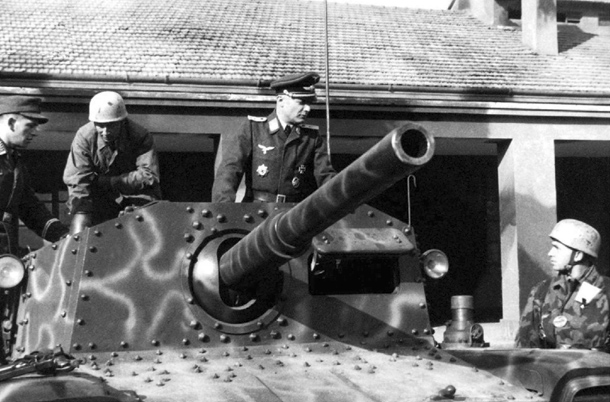
soldiers of the German Luftwaffe (including two paratroopers) examining a captured Semovente M42M da 75/34; source: Flickr.com with permission of the publishing user, edited
Behind the fighting superstructure was the engine bay. A large portion of the engine deck was taken up by two large access hatches for servicing the powerplant, and further aft by two louvred hot-air exhaust vents with a fuel filler neck between them. Cooling air for the engine was drawn in through the fighting superstructure, which was intended to ensure airflow through and cooling of the interior — the Italians had designed the original tank (and the first-generation self-propelled gun on its chassis) with hot African conditions in mind. On the rear wall of the hull, one spare road wheel was mounted along with a rack for five smoke grenades. The smoke grenade rack was a licensed copy of a German device known as the Nebelkerzenabwurfvorrichtung, which was commonly seen on the rear of German tanks. The rack allowed a smoke grenade to be remotely ignited and ejected from inside the fighting superstructure, providing the crew with a smoke screen to obscure enemy aiming if the vehicle found itself in a tight spot.
The crew of the Semovente M42M da 75/34 consisted of only three men, meaning two of them had to perform multiple roles. Besides the driver, there was a loader who also operated the radio, and a commander who simultaneously served as the gunner. The driver sat at the front left and controlled the vehicle using two conventional steering levers. Directly ahead of him in the front superstructure wall was his main vision port, fitted with a closeable armoured cover. The port contained no glass, so when open it was truly open — meaning the driver was well advised to keep it shut in combat and rely instead on the periscope, which opened onto the superstructure roof. The gunner/commander sat to the right of the gun and aimed the weapon using a periscopic sight that extended through an aperture in the roof. The third crew member, serving as both loader and radio operator, sat on the left behind the driver.
The radio set was positioned at the rear along the left wall of the superstructure, with the antenna mount on the roof directly above. The set was the Magneti Marelli Radio Fonica 1 per Carro Armato (also known as RF1CA), combining both a receiver and transmitter (described in the manual as "Apparato trasmittente ricevente"). According to some sources it had a transmission range of up to 8 km in voice mode and 12 km in Morse — figures that seem rather optimistic. Other sources put the range at only 2 km for voice and 4 km for Morse.
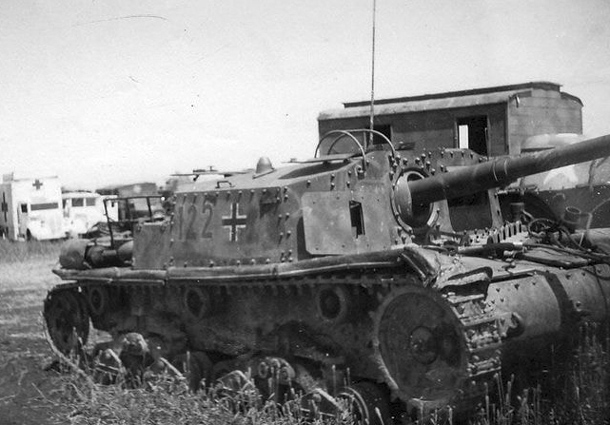
a knocked-out Beute Sturmgeschütz M42 mit 75/34 851(i); note the pair of sturdy wires the Germans attached to the superstructure roof as a protective "frame" for the gun sight; source: Flickr.com with permission of the publishing user, edited
The vehicle (or more accurately, the tank destroyer) was not fitted with any built-in secondary armament. The crew did, however, have at their disposal a standard Breda Modello 1938 machine gun in 8 mm calibre, fed from 24-round magazines. The vehicle carried 56 such magazines — a total of 1,344 rounds (some sources cite only 46 magazines and therefore 1,104 rounds). The machine gun could be used either handheld or mounted in a special bracket on the superstructure roof; the latter also allowed aimed fire at low-flying enemy aircraft. When not in use, the machine gun was stowed along the right side of the fighting superstructure.
Start of Production
As already mentioned, the first complete prototype of the Semovente M42M da 75/34 was most likely finished in February 1943, at the factory of Gio. Fossati & C. (a subsidiary of Ansaldo) in the Genoa suburb of Sestri Ponente. Series production began in May 1943, also at the Fossati plant. By the time Italy signed its armistice with the Allies in early September 1943, 94 vehicles of this type had been built according to some authors, while other sources give only 63.
Into German Hands
The mention of the Italian armistice finally brings us to the reason this vehicle features on our pages at all. On 10 July 1943, the Allies landed on the southern coast of Sicily. Over the following weeks they steadily pushed the Italian and German defenders north-westward toward the port of Messina. Any clear-eyed observer could see that Sicily would soon fall, and with it the Allies would gain an ideal springboard for an invasion of the Italian mainland. Within Italy, resistance to Mussolini was growing. The country's political leadership began to consider whether the time had come to reach some kind of agreement with the Allies. An American air raid on Rome on 19 July only heightened their concerns and accelerated their deliberations.
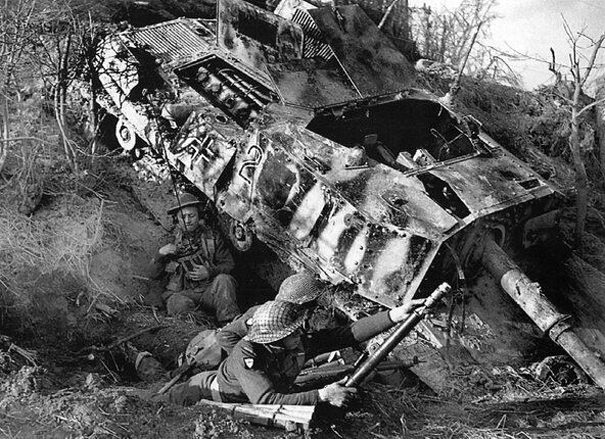
three British soldiers take cover behind a wrecked Beute Sturmgeschütz M42 mit 75/34 851(i); source: Flickr.com with permission of the publishing user, edited
And so it came about that at a meeting of the government (the Grand Council of Fascism) on 24 and 25 July 1943, Mussolini was removed from the post of Prime Minister and subsequently arrested. The newly appointed Italian Prime Minister Pietro Badoglio assured the Germans that Italy would remain their ally, but the Germans had already begun preparing for Italian treachery. And it duly arrived on 3 September 1943 — the very day the British landed on the Italian mainland — when the Italians signed an armistice with them. By the time this was made public, on 8 September, the Germans were ready and launched the operation codenamed Achse (Axis).
Among the main objectives of this operation were the occupation of as much Italian territory as possible and the disarming of the Italian Army. In the course of this disarmament, the Germans seized enormous quantities of weapons from their now former ally, including nearly a thousand armoured fighting vehicles of all kinds. Among these were 36 examples of the Semovente M42M da 75/34 self-propelled gun. The Germans took these vehicles into their own service under the designation Beute Sturmgeschütz M42 mit 75/34 851(i). In addition to the captured vehicles, the Germans also took over the Ansaldo and Fossati production plants and decided to continue building the type. They introduced a number of minor modifications, such as fitting four large new "teeth" to the front drive sprockets to prevent the tracks from slipping off under stress — for example in muddy terrain. On top of the original 36 captured vehicles, the German Army thus had a further 50 or even 78 brand-new examples built for it (sources again disagree). These self-propelled guns were subsequently deployed by the Germans not only in Italy but also in the Balkans.
ARTICLE
CONTENTS:
Reproducing text from the Panzernet website without the written consent of the operator is prohibited.