7.5 cm Pak 40 auf RSO
tank destroyer on a cargo tractor chassis
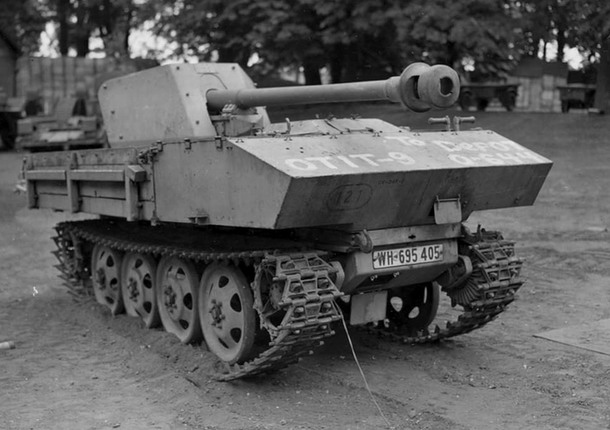
The Pak 40/4 anti-tank gun on a Raupenschlepper Ost chassis. For some reason the right track on this Allied-captured example is fitted in reverse. Source: internet, Public domain, edited
The Raupenschlepper Ost Tractor
The first autumn and winter on the Eastern Front brought the German army a series of unpleasant — and dearly paid for — lessons. Among them was the discovery that wheeled trucks and even half-tracked tractors were helpless against the oceans of autumn mud and mountains of winter snow. The Germans needed a new vehicle capable of carrying and towing loads under these extreme conditions. The basic requirements included low acquisition cost, the ability to enter series production very rapidly, no dependence on scarce raw materials such as rubber, excellent cross-country mobility, reliability in all climatic conditions, and a high ratio of tractive force to the vehicle's own weight. Speed was not a priority.
Steyr was tasked with developing such a vehicle. Its designers looked for inspiration directly at the source of the problem — Russia itself. What caught their attention was the small, fully tracked artillery tractor STZ-5. The way its engine was positioned allowed maximum use of the vehicle's floor area for cargo space. In summer 1942, Steyr submitted its tractor design to the army, making extensive use of components from the already-produced Steyr 1500 A cross-country vehicle. After successful evaluation trials, series production began in November 1942 under the designation Raupenschlepper Ost (crawler tractor East), abbreviated RSO. Initial frontline experience on the Eastern Front confirmed that the vehicle met the soldiers' expectations, and series production was ramped up significantly.
The RSO was a simple and robust vehicle capable of carrying 1.5 tonnes of cargo on its load bed and towing a further load of up to 2 tonnes. Thanks to its fully tracked running gear and a ground clearance of 55 cm, it could move through mud and deep snow with ease. Production apparently continued until the end of the war, with several firms joining Steyr in manufacture. Across three production generations designated RSO/01, RSO/02, and RSO/03, approximately 27,000 vehicles were built in total (other figures are also cited). Troops used these vehicles to transport all manner of loads and to tow lighter artillery weapons such as the 75 mm Pak 40 anti-tank gun or the 105 mm leFH 18 howitzer.
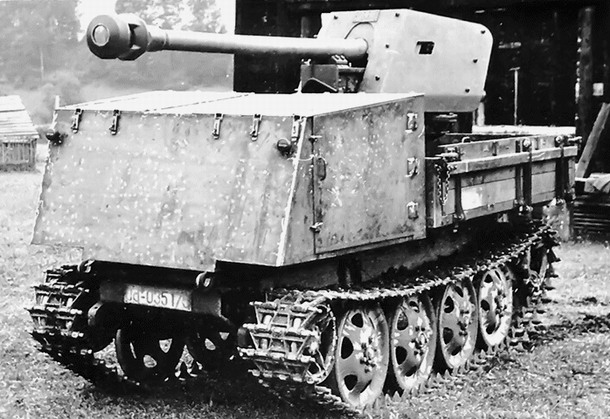
The prototype had a larger armoured cab and a higher gun pedestal. Source: Flickr.com, with permission of the publishing user, edited
Gun Carrier
1943 arrived, and the Pak 40 mentioned above had firmly established itself as the standard towed anti-tank gun of the German army. It was an excellent weapon, far more capable than the older 37 mm Pak 36 and 50 mm Pak 38. Unfortunately, the Pak 40 was also considerably heavier. At approximately 1.5 tonnes it was completely out of the question for its crew to move it under their own power — and the same applied to other heavy weapons (a period illustration HERE illustrates this very well). If no tractor was available and troops had to withdraw — which by 1943 was far from uncommon — the only option was to simply abandon the gun where it stood. Army command grew increasingly alarmed at the mounting reports of such needless losses of valuable weapons and decided to act.
If the weapon were an integral part of the tractor — or the tractor part of the weapon — it could never happen that no tractor was on hand when one was needed. The army therefore decided to combine both elements into a single vehicle, selecting the Pak 40 gun and the RSO tracked tractor for the purpose. The work was assigned to the suppliers of both main components — Rheinmetall-Borsig and Steyr — with Rheinmetall responsible for the overall vehicle concept. The gun mounting was to allow full 360-degree traverse and, ideally, the gun was to be easily removable for use independently on its wheeled carriage outside the vehicle. The RSO with Pak 40 was therefore not intended as a true tank destroyer to rival or replace other types such as the Marder III. The vehicle was conceived as a simple gun carrier — or "gun mover" — providing the Pak 40 with its own chassis and motive power. Its creators had no greater ambitions than that.
Rheinmetall submitted the first drawings at the end of May 1943. Initial practical trials apparently followed in June, during which a standard Pak 40 complete with wheels and trail legs was simply loaded onto the cargo bed of a standard RSO without its enclosed cab — the aim being to test the tractor's handling characteristics with this type of load. Live firing was out of the question at this stage, as the gun would likely have bounced out of the cargo bed. Construction of the first prototype followed, with live firing trials in July 1943. The first prototype had a somewhat higher gun pedestal than the later series vehicles and a differently designed driver's cab. Some authors describe the prototype cab as fully enclosed, though this is not entirely accurate. From available photographs it is clear that the armour was not high enough for the driver to sit inside with his head covered. The front wall of the armoured cab had no vision ports at all, and at least one photograph clearly shows what appears to be hinges along the upper front edge of the cab. It is therefore probable that the driver folded back the roof panel before climbing in and sat with his head protruding above the armour during travel.
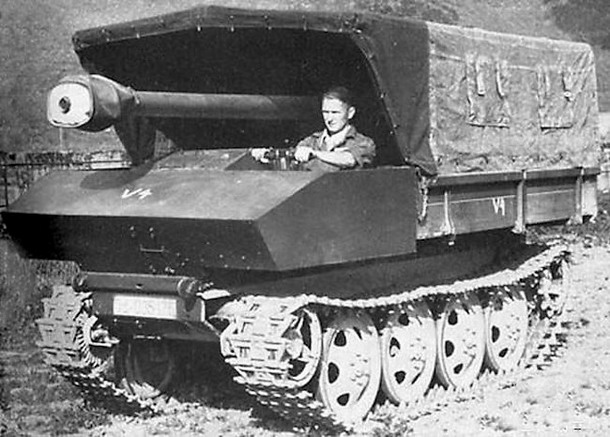
A canvas cover protecting both the gun and crew from the weather was also tested. It simultaneously disguised the fighting vehicle as a standard cargo tractor. Source: Flickr.com, with permission of the publishing user, edited
Whatever the exact design of the prototype cab, it was changed for series production. The reason was a desire to reduce the gun's firing height as much as possible. A lower pedestal and a lower driver's cab were therefore designed. The new prototype with the reduced pedestal and cab was ready as early as 30 July 1943, followed by further trials.
Vehicle Description
The original RSO tractor chassis was adopted for the new gun carrier with virtually no modifications. A load-bearing frame enclosed from below and the sides ran along the centre of the vehicle. In the central section of this frame sat the fuel tank with a capacity of 180 litres. Forward of the tank was the gearbox, providing four forward gears and one reverse. In front of the gearbox was the Steyr V-8 air-cooled petrol engine of 3.517 litres displacement, producing 80 horsepower at 3,000 rpm. The engine sat essentially at the level of the load-bearing frame, meaning most of it occupied the space inside the cab between the driver and his co-driver (the vehicle commander). A propeller shaft ran rearward from the gearbox, passing beneath the fuel tank and connecting at the rear to the final drives ending in toothed drive sprockets. The RSO had its drive sprockets at the rear. The front wheels served as track tensioners but also assisted steering, since they were fitted with brakes — which is why they too were designed as toothed wheels.
Besides the rear drive sprockets and front idler wheels, each side of the running gear included four large road wheels, suspended in pairs. The first two wheels were mounted on a shared swinging arm, as were the third and fourth. Both swinging arms were pivotally connected to a long tubular beam running along the main frame. This beam was connected to the frame at its midpoint by a pivot pin allowing the beam to rock forward and backward relative to the frame. At each end of the tubular beam was a leaf spring assembly whose ends were attached to the frame, providing suspension for the rocking movement. This is probably best understood from the images HERE and HERE. The tracks were 340 mm wide, each consisting of 69 links (though one source gives 65).
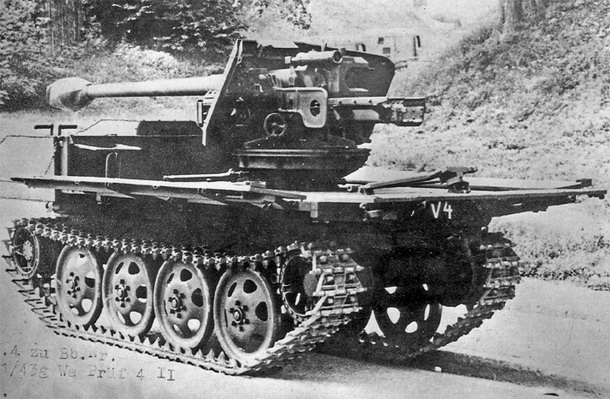
The rear view clearly shows the lower "series production" gun pedestal. Source: Flickr.com, with permission of the publishing user, edited
At the front of the vehicle was the already-mentioned cab for the driver and commander. "Cab" is perhaps a generous term. The low structure of flat sheet metal protected the bodies of both soldiers only to roughly two-thirds of their height — their chests, shoulders, arms, and heads all protruded above it. In truth, "protection" is scarcely the right word at all, since the low cab walls were welded from unhardened sheet metal just 3 mm thick, which would not have stopped even light small-arms fire. The driver operated the vehicle using the standard set of three pedals, a gear lever, and two brake levers. The open driver's and commander's positions could be closed with hatches — apparently used only when the vehicle was parked. Between the driver and commander sat the already-mentioned engine, whose cover formed the highest point of the entire cab.
Behind the front cab lay the load bed, in the centre of which the 75 mm Pak 40 gun was mounted on a low rotating pedestal. As modified for installation on the Raupenschlepper, the weapon received its own designation, Pak 40/4. The gun was installed complete with its shield. The area around the weapon was enclosed by a low fence of wooden planks that could be folded down to greatly increase the working space around the gun. Set into the floor around the gun were seven ammunition lockers, each holding four rounds — 28 rounds of 75 mm ammunition in total.
The gun pedestal allowed full 360-degree traverse. Vertical elevation ranged from –5 to +22 degrees (other sources give –5 to +14 degrees). For longer moves the gun was secured with two clamps — a front clamp to the recoil mechanism and a rear clamp to the recoil trough. Several types of ammunition were used with the gun. The most common anti-armour round was the Panzergranate 39, weighing 6.8 kg and leaving the muzzle at 790 m/s. At one kilometre range this round could penetrate 85 mm of sloped homogeneous armour. The considerably rarer sub-calibre Panzergranate 40, weighing 4.1 kg with a muzzle velocity of 990 m/s, could penetrate 97 mm of armour at one kilometre.
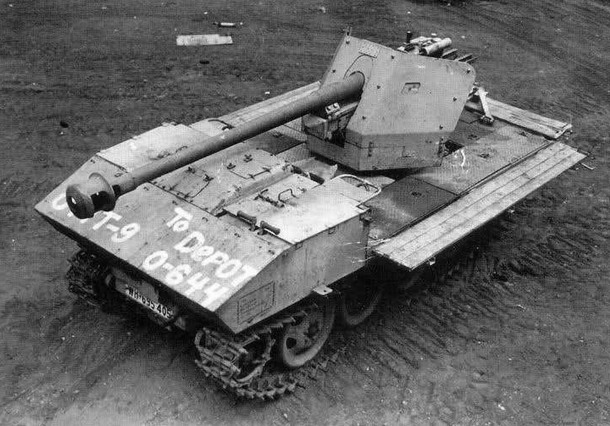
In this photograph the driver's and co-driver's positions are closed with their hatches. Source: internet, Public domain, edited
The gun was served by two men — a loader and a gunner. During moves these soldiers could sit on small seats on the rear wall of the driver's and commander's cab, though comfort was minimal (photo HERE). All crew members on board were essentially exposed to the elements. Photographs show that at least during the testing phase a large canvas roof existed that could be erected over the entire fighting area and partially over the driver's and commander's cab as well. The canvas simultaneously provided some disguise, since with the gun hidden the vehicle looked like an ordinary cargo tractor. Judging from available photographs, however, this canvas cover apparently saw little use in practice.
The new vehicle carried the straightforward designation 7.5 cm Pak 40/4 auf RSO. Its dimensions and weight are disputed in the literature. The vehicle's length is given as either 471 or 457 cm depending on the source, width as either 213 or 199 cm, and height as either 210 or 260 cm. Weight is given as either 5.2 or 5.4 tonnes. Sources are, however, broadly in agreement on maximum speed — a mere 17 km/h.
To recap: the prototype with the lowered cab and gun pedestal was completed on 30 July 1943. After thorough testing it was presented to Hitler on 1 October 1943. The Führer was satisfied with its design and specifications and ordered production of 60 vehicles for frontline evaluation on the Eastern Front, where the combat vehicle was to prove whether it would live up to its creators' expectations.
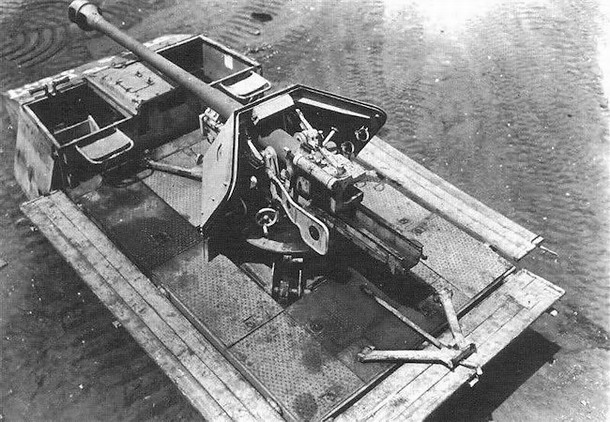
A view showing the open driver's and co-driver's positions, the small seats for the gun crew, and the ammunition locker hatches in the floor of the gun fighting area. Source: internet, Public domain, edited
On paper the 7.5 cm Pak 40/4 auf RSO offered considerable advantages. Compared with a towed gun on a wheeled carriage and its separate RSO tractor, the gun carrier was lighter, more manoeuvrable, required a smaller crew, and — most importantly — was always ready to move immediately. Its only real disadvantage was a greater firing height (the gun sat higher above the ground), making the crew behind it an easier target. In practice, however, those advantages were not quite as clear-cut as they appeared — but more on that in a moment.
Deployment and Assessment
During December 1943 and January 1944, the first 50 pre-production vehicles were completed and immediately dispatched to the Eastern Front for selected units. The lists of those units vary considerably between publications, but they certainly included infantry divisions, army-level tank destroyer battalions, and so-called Panzer Zerstörer Bataillone — units assembled largely from the remnants of anti-tank formations that had been disbanded, destroyed, or left without their guns, and whose primary armament had become the Panzerschreck rocket launcher.
The new vehicle, however, inspired no enthusiasm among the troops — quite the contrary. Combat reports were scathing. The vehicle was slow and unwieldy. It presented far too large a target for enemy fire while offering virtually no armour protection whatsoever. The engine overheated frequently, the ammunition supply was inadequate, and the rounds in the floor lockers were not easily accessible. Soldiers reportedly even renamed the vehicle Rollender Sarg Ost — Rolling Coffin East. On the basis of this experience, the army decided to abandon series production.
ARTICLE
CONTENTS:
Reproducing text from the Panzernet website without the written consent of the operator is prohibited.