7,5 cm RFK 43 auf PANZER IV
a project to rearm the medium tank
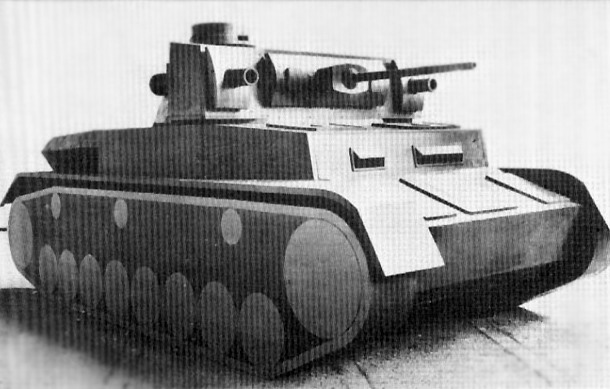
wooden model of the fighting vehicle on the Panzer IV chassis, armed with the automatic MK 103 cannon and a pair of RFK 43 recoilless guns, source: Flickr.com with permission of the publishing user, edited
A Curious Project
Not only is virtually no information available about this project, but strictly speaking it is not even clear whether it should be classified as a tank, a self-propelled gun, or a tank destroyer. In placing it, we took our cue from the primary purpose of the vehicle's armament — the RFK 43 gun — and assigned it to the tank destroyer section. In the end, however, this hardly matters much, given that the entire project never advanced beyond the wooden model stage and not a single functioning prototype was ever built. We do not know when or why the project was initiated, nor when or why it was cancelled. Practically everything we know is derived from surviving photographs of the wooden model, and even here a number of uncertainties remain.
Among those uncertainties is the question of which chassis variant the vehicle was actually to be built on. It was clearly a Panzer IV chassis — but on the wooden model, only three return rollers are visible. This would correspond only to the very late Panzer IV Ausf. J, on which the number of return rollers was reduced from four to three as late as December 1944. On the other hand, the two vision ports in the front wall of the fighting superstructure point to the early variants Panzer IV Ausf. B or Ausf. C — which makes no sense at all, since those versions were produced in 1938 and 1939, whereas the conversion project and the wooden model must certainly have originated considerably later in the war. The commander's cupola on the model also corresponds to the early design used up to 1940. Can this contradiction be explained simply as carelessness on the part of those who built the wooden model? Did they perhaps use parts left over in storage from wooden models of early tank variants?
The New Turret and Armament
These questions can perhaps be left unanswered, and we can instead focus on what the model genuinely has to offer — which is undoubtedly the design of its fighting turret and, above all, the proposed armament. The designed turret was considerably narrower than the standard Panzer IV turret. The rear section tapered to a cone shape, while the front was a flat face plate that extended significantly out to the sides. These side extensions, however, were open at the rear — something we will explain shortly. At the centre of the front plate was an external mantlet strongly resembling the one used on the Panzer III. Passing through the centre of this mantlet was the rapid-fire MK 103 cannon of 30 mm calibre — a weapon developed by Rheinmetall-Borsig and introduced into service in 1943, originally designed for installation in aircraft.
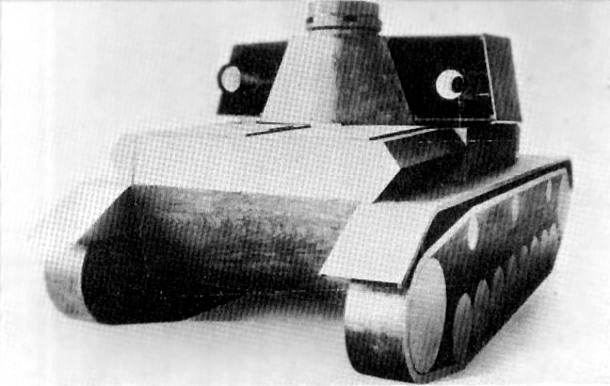
this photograph shows clearly how narrow the fighting turret actually was behind the widened front face plate; the interiors of the rear nozzles of both RFK 43 guns were painted white for some reason, source: Flickr.com with permission of the publishing user, edited
Two types of ammunition were used with the MK 103 (MK = Maschinenkanone). The high-explosive fragmentation shell, weighing 330 grams, had a muzzle velocity of 860 m/s and gave the weapon a rate of fire of 380 rounds per minute. With armour-piercing ammunition weighing 355 grams and having a muzzle velocity of 940 m/s, the rate of fire rose to up to 420 rounds per minute. The armour-piercing round had a core of ultra-hard tungsten carbide, enabling it to penetrate a remarkable 75 to 95 mm of vertical armour at a range of 300 metres. The gun was belt-fed. The armoured mantlet, which permitted vertical movement of the gun, also contained two closeable vision ports, one of which certainly housed the lens of the gun's sight.
Rückstossfreikanone 43
The widened side extensions of the turret's front plate were to house the recoilless guns designated 7.5 cm Rückstossfreikanone 43 (RFK 43), developed by Krupp. The origins of this gun lay in a requirement for an anti-tank weapon for infantry use that was light enough to be dropped by parachute without difficulty. The end result was one of the simplest artillery pieces ever to see the light of day (photographs HERE, HERE, and HERE). The weapon weighed just over 40 kilograms and could be broken down into three parts, each easily carried by a single soldier — the barrel, the perforated breech block with its nozzle, and the tripod. When the gun was to be mounted on a Panzer IV chassis, the tripod was of course not required.
The RFK 43 fired shaped-charge anti-tank rounds with a specially designed cartridge case whose base was formed by a thin plastic disc. The pressure generated inside the barrel when the round was fired broke through the disc, opening a path rearward through the nozzle — in the opposite direction to the projectile. This equalised the forces acting in both directions, and the weapon simply remained stationary after firing. The unpleasant side effect was, of course, a blast of hot propellant gases erupting from the rear nozzle. It was precisely for this reason that the guns could not be housed inside the enclosed fighting turret, but had to be located outside it — in the side extensions of the front plate.
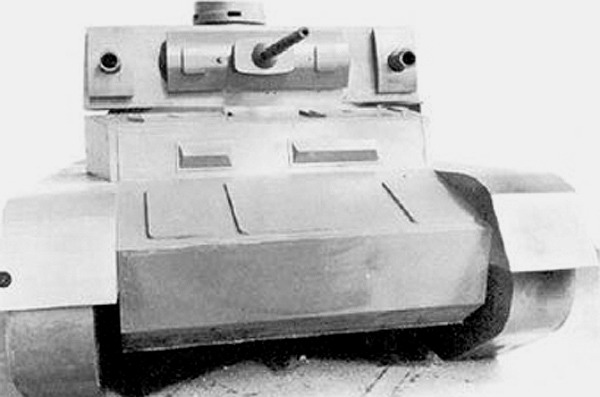
the wooden model again, in an interesting but unfortunately low-quality photograph, source: Flickr.com with permission of the publishing user, edited
The proposed method of mounting the RFK 43 guns raises several questions of its own. Since each gun was housed in its own separate mantlet, it is unclear how vertical aiming was to be achieved. Loading would also have been rather uncomfortable. Hatches would presumably have been needed in the sides of the narrow conical turret, through which the loader would lean out — or at least extend his hands — to open the breech, eject the spent cartridge case, and insert a new round. During this operation, however, he would have been exposed to enemy fire from the rear hemisphere.
End of the Project
In truth, the very concept of this fighting vehicle raises many questions. What was it actually supposed to be used for? The RFK 43 offered no exceptional range, accuracy, or destructive power. Its only advantage was its extremely low weight — and it was designed with precisely that requirement in mind. But why install a gun whose sole virtue is its light weight on a tank chassis capable of carrying a far — and truly far — heavier weapon? It is an obvious waste of the chassis's capabilities. Rather like hiring a weightlifter to pick up a box of matches. It was most likely this glaring mismatch that ultimately led to the cancellation of the entire project.
ARTICLE
CONTENTS:
Reproducing text from the Panzernet website without the written consent of the operator is prohibited.