PANZERSCHRECK BREN
a vehicle for the anti-tank squad
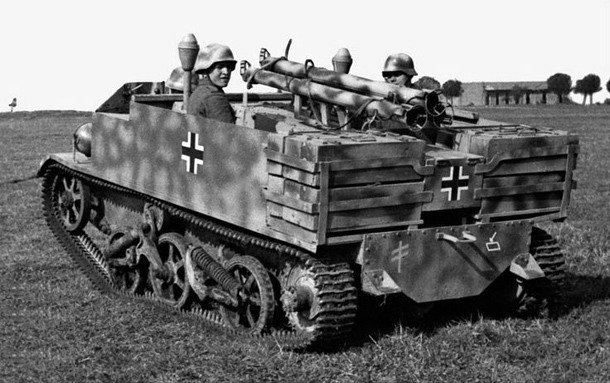
Captured Universal Carrier "armed" with three Panzerschrecks – note the ammunition crates at the rear and the insignia of the 3rd Panzergrenadier Division. Source: worldwarphotos.info, with the permission of the site operator, edited.
The vehicle described on the following pages is classified in the vast majority of sources as a tank destroyer armed with Panzerschreck rocket launchers. The German designation most commonly given – Panzerjäger Bren 731(e) – would seem to support that interpretation. In all likelihood, however, this reading is incorrect. All the available evidence points to the conclusion that this was not a tank destroyer with integral armament intended to drive directly against enemy armour, but simply a transport vehicle for an infantry anti-tank team. The three Panzerschrecks were therefore not built-in weapons but merely part of the carried "cargo." The soldiers fought on foot, after dismounting from the vehicle. But as usual – let us take things in order.
The Universal Carrier
The basis of the vehicle known as the Panzerjäger Bren 731(e) was the British Universal Carrier light tracked vehicle. The Germans captured a considerable number of these in France in 1940, left behind by the evacuated British Expeditionary Force. The German Army put them to use not only in their original role of transporting infantry and supplies, but also as the basis for several specialised conversions. The standard transport version received the German designation Gepanzerter MG-Träger Bren 731 (e). For reasons of their own, the Germans did not use the official British name Universal Carrier but based their designation on the unofficial "Bren Carrier" – a term sometimes applied to the British vehicle because its primary weapon was usually the Bren light machine gun.
The vehicle's running gear consisted of three road wheels on each side, sprung by coil springs. At the front was a spoked idler wheel and at the rear a solid toothed drive sprocket. Roughly in the middle sat a single return roller supporting the upper run of the track. Power came from a Ford V-8 air-cooled eight-cylinder petrol engine of 3.6 litres displacement, producing 85 horsepower at 3,500 rpm. The Universal Carrier had light armour of 7 to 10 mm, weighed 3.2 tonnes and had a top speed of approximately 48 km/h. As a vehicle of British origin, the driver sat on the right, with the gunner to his left, able to fire a machine gun through a port in the front armour. The Germans retained this arrangement, simply replacing the original Bren machine gun with their own MG 42. As part of the conversion of the standard transport vehicle into the anti-tank rocket launcher carrier described here, the rear cargo area was modified to accommodate up to six seated soldiers. Above the engine cover running down the centre of the cargo area, three Panzerschreck launch tubes were stowed, along with five Panzerfausts in vertical racks, and at the very rear twelve wooden crates containing a total of 24 rockets for the Panzerschrecks.
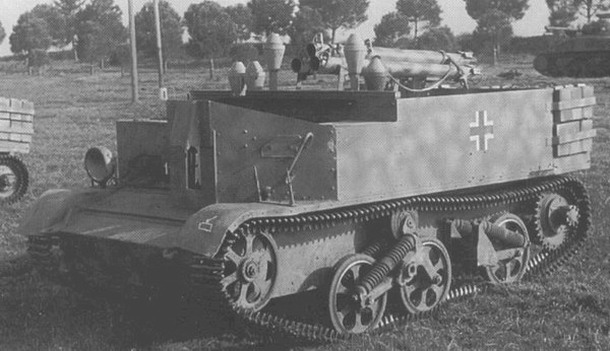
Panzerjäger Bren 731(e) – this photograph clearly shows the steel strip cradles in which the Panzerschreck launch tubes were stowed. Source: worldwarphotos.info, with the permission of the site operator, edited.
Tank Destroyer or Carrier?
What leads us to conclude that the Panzerjäger Bren 731(e) was not a tank destroyer – as most sources claim – but simply a transport vehicle for infantry anti-tank squads? First: a close look at the photographs makes clear that the three Panzerschrecks were not permanently installed in the cargo area. The launch tubes rested in cradles formed from steel strip and were secured only by leather straps (photo HERE). Firing from weapons held in place by nothing more than leather straps would certainly not have been safe – this was obviously a stowage arrangement for transport only. Second: the stowed launch tubes still had their shoulder straps for carrying on foot. This would make no sense in a "permanent" installation, as the straps would serve no purpose and would only get in the soldiers' way. Third: even if the weapons had been secured firmly enough to fire from, how would they have been aimed? Their cradles were clearly not adjustable, leaving only the option of turning the entire vehicle – which is essentially inconceivable. There was no aiming device of any kind in front of the driver's position, so accurate engagement of a target the size of a tank would have been out of the question.
Fourth: the wooden ammunition crates were stowed immediately behind the launch tubes. A rocket's exhaust flame would therefore have passed directly over them on firing. The risk involved hardly needs spelling out. Fifth: how would the soldiers on board have been protected from the exhaust of the departing rocket? Would they all have had to put on their protective gear, or dismount from the vehicle? And if they had dismounted before firing, who would have operated the weapons? No remote firing mechanism is visible in any of the photographs. And why would so many soldiers even be needed on board for this purpose? And what would have protected the Panzerfausts – whose warheads were sticking out of the cargo area – from the rocket exhaust? One possible counter-argument is that if the three Panzerschrecks were intended to be removed from the vehicle and used on foot by infantry, they ought to have had protective shields (by the summer of 1944, shields were already being fitted). This is an interesting objection but an empty one: the shields were detachable, and it is entirely plausible that they had simply been removed from the launch tubes for transport and stowed inside the cargo area.
Beyond all the "why it wouldn't work" arguments listed above, there is also one positive reason. The described use of the Universal Carrier as primarily a transport vehicle rather than a fighting vehicle fits neatly into the historical context and matches the way in which the Panzerschreck was actually employed in combat. Let us therefore take a closer look at the weapon and how it was used.
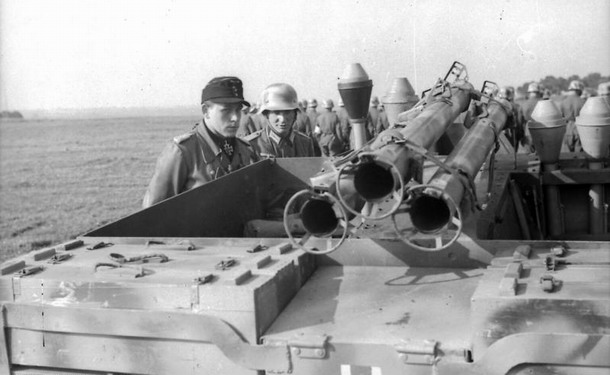
Interior view of the Panzerjäger Bren 731(e) – this photograph gives a particularly clear view of the leather straps used to secure the Panzerschrecks in their cradles. Source: Bundesarchiv Bild 101I-313-1004-19A, Wikimedia, Creative Commons, edited.
The Panzerschreck Rocket Launcher
From the opening of the invasion of the Soviet Union in June 1941, the Germans faced an enormous numerical superiority in Soviet tanks, a situation that changed little in the following years. Even though the Germans consistently destroyed many times more Russian tanks than they lost themselves, the Soviets were producing them even faster, and their absolute numbers crept steadily upward. Conventional anti-tank guns were relatively expensive and could therefore never be available in sufficient quantities. The Germans accordingly sought new anti-tank weapons that would be effective enough and cheap enough to produce in large numbers. One approach proved to be hand-held weapons using shaped-charge warheads. The first of these was the Panzerfaust, developed in 1942, which was produced in the millions thanks to its very low unit cost. It was, however, a fairly crude, inaccurate, single-shot weapon (according to US Army evaluation tests conducted with the most advanced production version, the Panzerfaust 100, the probability of hitting a tank at a range of more than 40 metres was only around 31%).
During combat with American forces in North Africa in early 1943, the Wehrmacht captured small quantities of the new M1 portable anti-tank rocket launcher, better known by its nickname "bazooka." The Germans examined the weapon and decided to produce their own version, making use of modified 88 mm rockets from the Raketenwerfer 43 "Puppchen." The result was a new infantry anti-tank weapon that went down in history as the Panzerschreck – roughly translating as "tank terror." Its official designation, however, was 8.8 cm Raketenpanzerbüchse 54, abbreviated 8.8 cm RPzB 54. Unlike the Panzerfaust, it was a reusable weapon, as the rocket was a separate round loaded into the tube rather than forming an integral part of the weapon itself.
Series production of the new weapon began in September 1943, and a month later the first 1,500 launch tubes (officially designated Ofenrohr) and 5,000 rocket-propelled rounds with shaped-charge warheads – designated Raketenpanzerbüchsegranat 4322 (RPzBGr 4322) – were sent to combat units. The early version of the Panzerschreck did not yet have the protective shield that would later become so characteristic of the weapon, and protecting the firer had to be achieved by other means. This was essential, because the rocket motor of the fired round continued to burn briefly after the projectile left the launch tube – for approximately the first two metres of flight. The firer was therefore exposed to a jet of hot gases immediately after each shot, and if the weapon was fired close to the ground (from a foxhole), the departing rocket also threw up dust, small clods of earth and grit. The firer therefore had to wear a gas mask (without the filter attached), protective gloves and ideally a hood as well – otherwise injury or burns were almost certain (the scale of the muzzle flash can be seen in the photograph HERE, source: Bergflak.com, with the permission of the site operator).
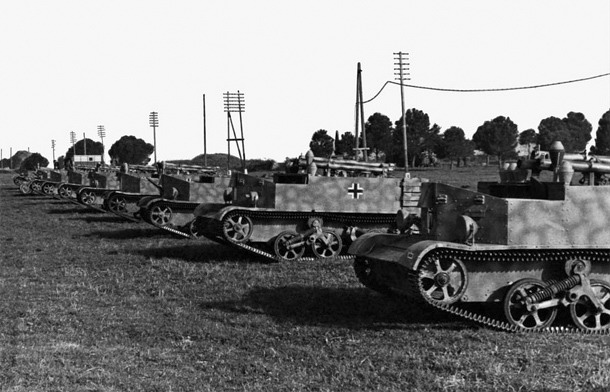
This photograph apparently shows all of the Panzerjäger Bren 731(e) vehicles built – three of the nine vehicles in the image carry no Panzerschrecks (the third and the last two). Source: Flickr.com, with the permission of the publishing user, edited.
The requirement to use all this protective equipment was naturally unpopular with the troops, who complained about it. In February 1944 the Panzerschreck was therefore fitted with a side steel shield incorporating a small aiming window. This window was filled with a glass pane, and a holder for a spare pane was provided on the inside of the shield. By the time the shield entered series production, a considerable number of launch tubes were already in service, so the shield was designed to be clipped onto existing tubes retrospectively. As photographs confirm, soldiers in the field had in the meantime occasionally improvised their own shields.
The Panzerschreck launch tube was 164 cm long and weighed 9.5 kg without the shield, or approximately 11 kg with it. The weapon's effective range was around 150 metres, and its shaped-charge warhead could burn through up to 230 mm of homogeneous armour at normal impact. Late in 1944 a newer rocket type, the Raketenpanzerbüchsegranat 4992, was introduced with an effective range of up to 200 metres. Given that the unit cost of a single launch tube was around 70 Reichsmarks, the weapon offered an undeniably impressive cost-effectiveness ratio. The Panzerschreck did, of course, have its drawbacks. It was fairly large, considerably heavier than the Panzerfaust, and required a two-man crew – one to carry and fire the weapon, the other to carry and load the rockets. As noted, the tube alone weighed 11 kg and a wooden crate containing two rockets weighed the same; carrying the weapon and its ammunition over any distance was therefore a genuine physical burden.
Anti-Tank Destruction Battalions
And who was the Panzerschreck actually intended for? Primarily, of course, for use as an infantry anti-tank weapon. From the autumn of 1943, infantry Panzerzerstörerbataillone (anti-tank destruction battalions) began to be formed, with the Panzerschreck as their principal weapon. These units were frequently assembled from the remnants of various shattered anti-tank elements of infantry divisions, or from other anti-tank formations that had lost all their guns. The Panzerschreck also found its way into Panzergrenadier units. Under organisational table KStN 1114 of November 1943, each Panzergrenadier Kompanie (company) was to have its own anti-tank squad designated Panzerzerstörertrupp. Such a "tank-killing" squad numbered nine men in total, four launch tubes and one cross-country truck. Eight soldiers formed four two-man Panzerschreck teams; the ninth served as the driver (a fully equipped and embarked Panzerzerstörertrupp from a Panzergrenadier company can be clearly seen in photographs HERE and HERE, source: Bergflak.com, with the permission of the site operator).
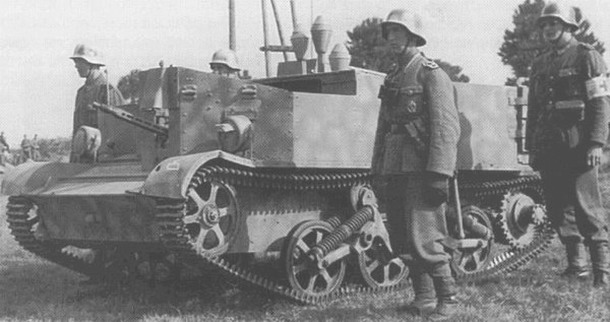
This Bren may have served the unit in a support role – it carries no Panzerschrecks, and one of the crew members has a medical armband. Source: worldwarphotos.info, with the permission of the site operator, edited.
This brings us finally to the question of how and why, in our assessment (and in the light of the historical context), the Panzerjäger Bren 731(e) came to be created. An anti-tank destruction squad of this kind carried a very substantial load: four launch tubes, 18 or more rockets, assault rifles and ammunition, water bottles, gas masks and so on. It was precisely for this reason that the squad was allocated its own truck. This was an adequate solution for longer road moves, but otherwise the truck had considerable limitations. If the chosen ambush site lay off-road or in broken terrain, the members of the Panzerzerstörertrupp had to reach it on foot, which slowed them down and tired them out. The truck could also not serve as a source of fire support in combat, which would often have been useful – especially when enemy tanks were accompanied by infantry.
The troops therefore sought a vehicle that could move cross-country and, ideally, was also armed. The half-tracked Sd.Kfz. 251 armoured personnel carrier would have been an ideal answer, but these were generally in short supply. It therefore apparently occurred to someone involved to adapt captured British Universal Carriers for this purpose. The vehicle was fully tracked, capable of handling difficult terrain, could move at a very respectable speed, had at least light armour plating and – crucially – carried a machine gun. Once the infantry had dismounted, the low vehicle could easily conceal itself nearby and contribute to the attack by firing on enemy infantry. Adapting the vehicle was not complicated at all: it simply required fitting brackets in the cargo area to hold the weapons and the rocket crates. Why the somewhat misleading name Panzerjäger Bren was chosen for the vehicle, we cannot say.
Deployment
The vast majority of surviving photographs show these vehicles drawn up in a field somewhere. The photographs show a total of nine (or more precisely, six) vehicles of this type, which – from the insignia visible on one of them – belonged to the 3rd Panzergrenadier-Division. It is quite plausible that the vehicle was built in precisely those nine (or six) examples, directly within that division. Some sources date the photographs to April 1944, which would place them in Italy, where the division was stationed at the time. It is also possible, however, that the photographs were taken in the summer of 1944, by which point the division had already moved to France. It is theoretically possible that these vehicles did see actual combat in France – perhaps even against the British, the very nation that had built them.
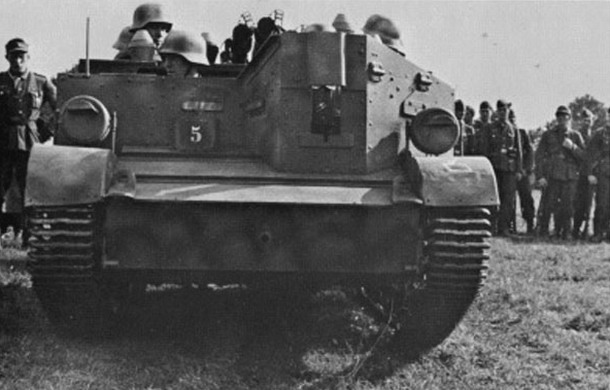
Panzerjäger Bren 731(e) with serial number 5(?). Source: worldwarphotos.info, with the permission of the site operator, edited.
Since we have essentially only those photographs from the 3rd Panzergrenadier-Division's assembly area to go on, it is worth looking at them a little more carefully. As is fairly clear, three of the nine vehicles in the line carry no Panzerschrecks – they have only Panzerfausts, or nothing at all. One of the unarmed vehicles appears to have a rod antenna, suggesting it may have served as a command vehicle for the entire group. Another photograph shows a medical orderly standing beside one of the unarmed vehicles, indicating it may have served some support function. A third unarmed Universal Carrier may have been used as an ammunition carrier or troop transport. In any case, the remaining six armed vehicles collectively carried 18 Panzerschrecks, which corresponds approximately to the total establishment strength of all Panzerzerstörertrupp within a single Panzergrenadier battalion (a battalion had four companies, each with one Panzerzerstörertrupp of four launch tubes – giving 16 Panzerschrecks in total). Some sources, however, suggest that the vehicles in the photograph did not belong to either of the Panzergrenadier battalions but were subordinate to the divisional tank battalion, Panzer Abteilung 103 – the same division but a different formation within it. This cannot be ruled out entirely, but it seems fair to say that in mid-1944 that tank battalion would still have had far more conventional equipment at its disposal than these improvised vehicles.

ARTICLE
CONTENTS:
Reproducing text from the Panzernet website without the written consent of the operator is prohibited.