TANK CREW TRAINING
how a civilian became a tank crew member
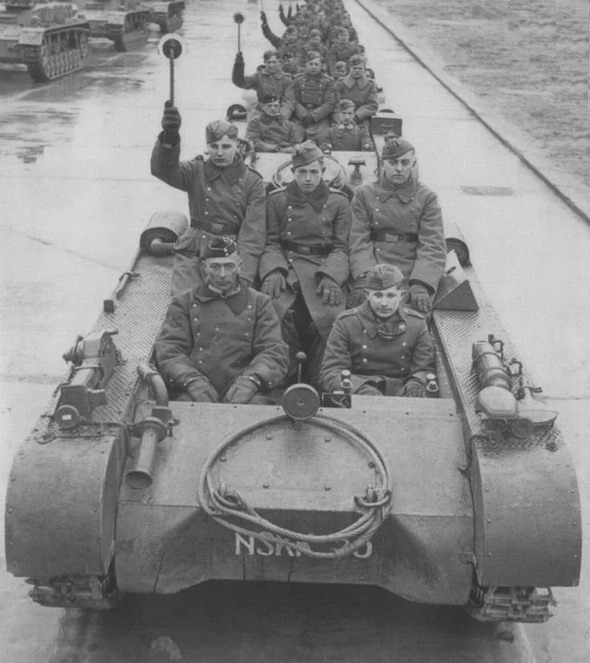
The first 150 Panzer I tanks were delivered without a hull or fighting turret and served as training vehicles for driver instruction – note the NSKK lettering on the front of the hull, source: Flickr.com with permission of the publishing user, edited
The Reichswehr
After its defeat in the First World War, the German Army – now officially designated the Reichswehr – was forced to scale back drastically in many respects. With no air force, no submarines, no tanks, no heavy artillery, and only 100,000 men in the ground forces, it was a mere shadow of its former self. Such was the price imposed for the war by the Treaty of Versailles. The German Army's senior leadership, however, was not prepared to accept this humiliation indefinitely. Some of the prohibitions were soon being directly circumvented (such as the secret development of tanks), others were countered by seeking ways to minimise their impact on combat effectiveness (such as developing new methods of waging war with a smaller force), and for others the Germans prepared thoroughly for the day when they would no longer apply. German generals believed the shameful restrictions would eventually disappear and wanted their army to be ready when that moment came – so that it would not have to start from zero when it was reborn.
The 100,000 officially permitted soldiers were therefore trained and educated so that one day, when it became possible and necessary, they would be capable of leading an army of millions. One could say the Reichswehr was not a conventional army but a great school for commanders, in which every soldier was capable of performing the duties of a significantly higher rank than his official one. Unlike many other armies, personal initiative was also highly valued in the German one. This was another way of compensating for the limited size of the Reichswehr – if the army is small, it must be all the more aggressive. This spirit of personal initiative proved so valuable that the successor Wehrmacht preserved and developed it too, even though it certainly no longer faced the problem of limited size.
In short, German soldiers were trained to understand the work of their superior as well and to have no hesitation in taking over his role on the battlefield if the commander was killed or wounded. The Germans also applied a modern command philosophy known as Auftragstaktik – mission tactics. The focal point of everything was the mission objective and achieving it as quickly as possible. Centralised decision-making and written orders were too slow and too remote from the actual situation on the battlefield. Lower-level commanders, fighting side by side with their men, were therefore given considerable authority, since they had the most up-to-date picture of the situation in their sector and could therefore make the best decisions and give necessary instructions verbally on the spot without delay. Speed was everything – speed of decision and speed of execution. The German Army, in short, produced soldiers who thought and were capable of improvising.
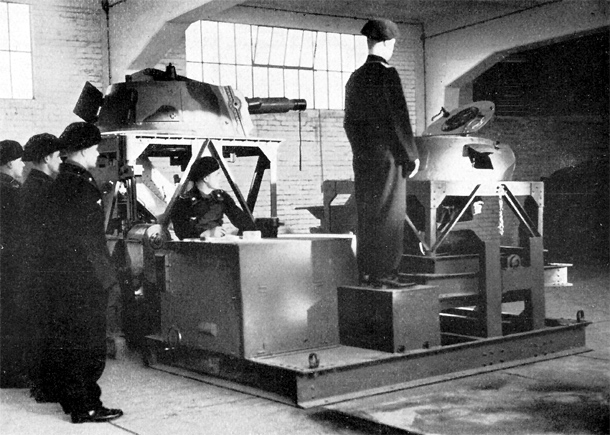
Training aids at a tank school: fighting turrets from Grosstraktor and Panzer I tanks mounted on stands, source: Flickr.com with permission of the publishing user, edited
In training their soldiers in this manner, the Germans were certainly not violating the Treaty of Versailles. Direct circumvention of some of the outright prohibitions, however, was not long in coming. In 1923, Germany found itself (yet again) in difficulty meeting its reparations payments – also part of the post-war punishment. France and Belgium reacted very sharply this time and sent their troops to occupy Germany's industrial heartland, the Ruhr. Although the French and Belgians eventually withdrew from the Ruhr in 1925, their occupation – and the dozens of German civilians killed in resisting it – left a very bitter taste. It was precisely then that the Reichswehr leadership decided that violating some prohibitions was not, in fact, such a mortal sin, and Germany finally began the secret development of its own tanks and the training of its own tank crews.
The Kama Centre
In 1925, a specification was issued for the development of Germany's first tank since the end of the Great War. For secrecy purposes it was given the cover name Grosstraktor – literally "large tractor." In 1928 the development of a second type followed, with the cover designation Leichttraktor (light tractor). At the end of 1926, the Germans signed a secret agreement with the Soviet Union to establish a tank testing and training centre deep within Soviet territory, far from the inspection bodies of the Western powers. The selection of a suitable location was handled on the German side by a Lieutenant Malbrandt, and a site was eventually found approximately 700 km east of Moscow, near the city of Kazan. The centre began operation in 1929 under the designation Kama – a portmanteau of Kazan and Malbrandt.
Kama thus became the first specialist school for a German armoured force that did not yet exist. All the secretly produced German tank prototypes were dispatched to Kazan – six Grosstraktors and four Leichttraktors – followed by soldiers, officers, mechanics, and engineers from Daimler-Benz, Krupp, and Rheinmetall-Borsig. At Kama, crew training and the testing of these first German tank prototypes took place in parallel. Various track designs were evaluated on the tanks, different turret rotation mechanisms were compared, the effectiveness of negative and positive pressure systems for extracting propellant gases from the tank interior was tested, different methods of crew communication during combat activity were trialled, and much more. All training and instruction was carried out jointly with Soviet soldiers using their own tanks.
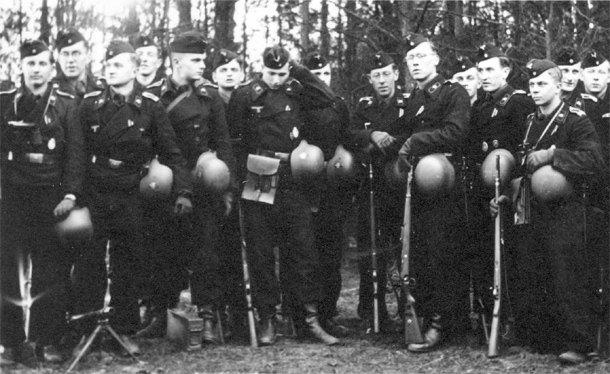
Tank crew members too had to complete basic infantry training (though the men in this photograph are clearly no raw recruits), source: Flickr.com with permission of the publishing user, edited
The tank crew members themselves trained at Kama in the operation of their vehicles, including live-fire exercises; mechanics learned how to maintain these machines; engineers from the manufacturing firms gathered invaluable information for the future improvement of their designs; and officers received instruction in commanding armoured formations. The Kama tank school was closed after the Nazis came to power in 1933, as Hitler viewed the Soviet Union not as an ally but as a potential enemy. The men who had passed through the centre, however, brought back to Germany experience that proved decisive in building a fully capable armoured force.
Preparing Civilians
Everything described so far took place at the Reichswehr level. Preparing ordinary German men for the future restoration of a large army was also necessary, however. But how to do this when conscription was also prohibited by the Treaty of Versailles? In this respect the Germans relied on various "civilian" organisations that were in reality preparing ordinary civilians for future military service. A model organisation of this type was the Reichsarbeitsdienst (RAD), the Reich Labour Service. It had originally operated under the name Freiwilliger Arbeitsdienst (FAD) since 1931, but in 1933 the Nazis took it over, placed a member of the NSDAP in its leadership, and began to militarise the entire organisation. Uniforms, drill marching, and military discipline became an inseparable part of it, with an enormous emphasis on sport and physical fitness. In 1935 service in the RAD even became compulsory and was seen as a kind of transition between school and the army.
Further examples of this preparation for the future restoration of German military strength were the party organisations NSKK and NSFK. The NSKK, or Nationalsozialistisches Kraftfahrkorps (National Socialist Motor Corps), was founded in 1930 to provide transport for SA and NSDAP members at various party events across Germany. By the end of 1931 the Corps already had some five thousand vehicles. No less important, however, was the NSKK's role in training drivers for all types of vehicles the army would need. It must be remembered that driving experience was far less widespread among ordinary people at that time than it is today, since motor vehicles were expensive and few could afford them – to say nothing of driving tracked vehicles. The army therefore needed to train drivers on a large scale. The NSFK, or Nationalsozialistisches Fliegerkorps (National Socialist Flying Corps), meanwhile looked after the training of future military pilots and other aviation personnel.
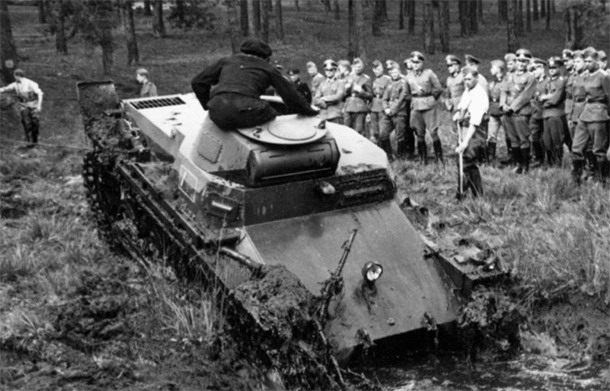
At a tank school: practising the recovery of a bogged-down Panzer I, source: Flickr.com with permission of the publishing user, edited
In 1933 Adolf Hitler became Chancellor and the rebuilding of the German Army shifted into an entirely different gear. Hitler had no patience for Versailles restrictions and for the armoured forces this was doubly true. In 1934 he ordered mass production of the light tank Panzer I to begin, and that same year the Germans launched the development of three further tank types (Panzer II, Panzer III, and Panzer IV). In 1935 the first three German tank divisions were formed (the 1st, 2nd, and 3rd Panzer Division). German tank crews no longer had to train covertly at some secret base hundreds of kilometres to the east – they now had their own official armoured forces school right in Zossen, Germany (though we will come to that in a moment).
Conscription
In 1935, compulsory military service was also restored in Germany. All men between the ages of 17 and 25 were now required to register with their relevant Wehrkreis (military district), after which they returned to their everyday lives and waited for their call-up notice. It was at this point that a considerable number of young men decided that rather than wait to be called up and assigned to a unit by the Army, they would volunteer and thereby have some influence over which branch they served in. And interest in the armoured forces was already substantial, since tanks were seen as something new, modern, and prestigious.
Armoured units operated under much the same principles as most other formations. Both professional soldiers and conscripts – who were to return to civilian life after completing their service – served side by side. Conscription to these units followed the same geographical principle as elsewhere: recruits were assigned to the unit garrisoned in their region. For example, the 1st Panzer Division, which had its home barracks in Weimar, drew its recruits primarily from Thuringia and neighbouring Saxony, while the 2nd Panzer Division, stationed in Vienna from 1938, recruited men from Austria. Being assigned to a tank division did not, of course, automatically mean being a tank crew member. Such a division had more than eleven thousand men, of whom fewer than a tenth were actual armoured vehicle crew.
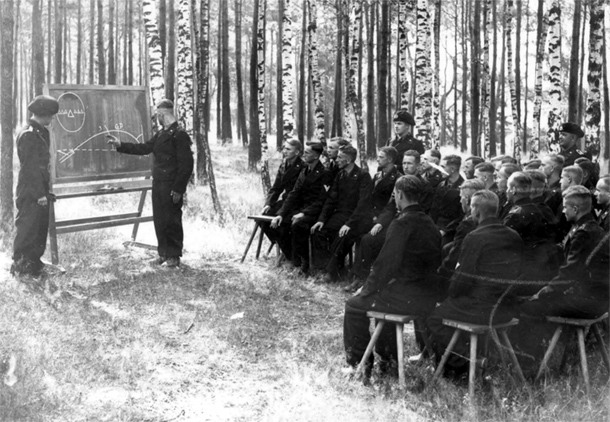
Field classroom: theoretical instruction on the use of a gun sight and the fundamentals of ballistics, source: Flickr.com with permission of the publishing user, edited
Every soldier assigned to the armoured forces first had to complete sixteen weeks of basic infantry training – and this applied even to the tank crew members themselves. This meant these men were capable of fighting temporarily as ordinary infantrymen whenever that made sense or there was simply no alternative. The great majority of new recruits had already served in the RAD before joining the Army. They were therefore accustomed to uniforms, familiar with the rank structure of the military, able to march, crawl, and handle a rifle (in the RAD this was practised with a spade – PHOTO), and generally in excellent physical condition. Their training could therefore focus much more heavily from the outset on weapons handling and combat skills. In this respect the German Army in general had a major advantage over many others, whose recruits often arrived with no military grounding at all and had to start from absolute basics.
Tank School
After completing basic infantry training, tank crew candidates continued with further specialist instruction. For this purpose, a Kraftfahrlehrkommando Zossen had been established as early as November 1933 – nothing other than a tank school located in the town of Zossen (specifically its district of Wünsdorf). The teaching staff of this school consisted, naturally, of men who had previously passed through the Kama training centre already described. Beginnings were modest, but even so it was a landmark institution. At its founding, the Kraftfahrlehrkommando Zossen was only the size of a company and had virtually no tanks at its disposal – apart from the heavily worn Grosstraktors and Leichttraktors that had returned from Kazan.
Only in January 1934 did the first production Panzer I tanks begin arriving in Zossen – and "tanks" is generous, for they were in fact bare chassis with no hull or turret (and thus no armament either). With such "study aids," the practical part of training had for the time being to be limited to driving, maintenance, and servicing. Even so, there was a great deal to learn: manoeuvring the vehicle over different terrain, recovering a bogged-down tank, towing a broken-down one, checking and topping up oil, cleaning filters, changing and tensioning tracks, adjusting and repairing engines, and so on.
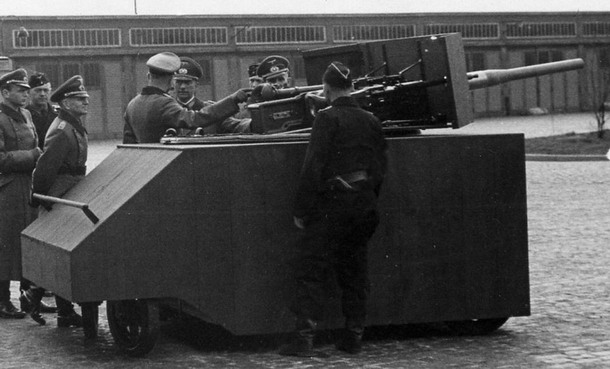
Another training aid – a wheeled mock-up vehicle with armament apparently corresponding to a Panzer III, source: Flickr.com with permission of the publishing user, edited
As far as the theoretical part of instruction was concerned, the absence of complete tanks posed essentially no problem at all. The theoretical curriculum drew, among other things, on the lessons learned during the exercises and manoeuvres that Lieutenant Colonel Heinz Guderian had conducted with his 3rd Motor Transport Battalion (3. Kraftfahrabteilung) in the early 1930s. Even though Guderian had at that time been using only wooden and cardboard tank mock-ups on ordinary car chassis – or even pedal-powered "four-wheelers" – he had been able to verify and summarise the basic principles of effective tank employment very effectively. At the tank school, cadets and career soldiers were therefore taught universally applicable golden rules such as: tanks must attack in mass, never individually, but must always maintain spacing between themselves so as not to make the enemy's aiming easier; attack at full speed and stop only to fire; pursue a fleeing enemy as far as you can, otherwise he will come back; always familiarise yourself thoroughly with the terrain of the battlefield; share all information with your crew and your subordinates; in battle spare ammunition but not blood; and so on.
Great emphasis was also placed on cooperation between tanks and supporting arms – infantry, artillery, reconnaissance, and also aviation. Soldiers had to understand that without these, tanks alone could achieve nothing. "The supporting arms must not be your servants but your guests" went another of those golden rules. In later years even old and experienced tank veterans agreed on how important the "personal relationship" with the accompanying infantry was. The foot soldiers had to know you, had to see you before the battle, to speak with you, to be aware that inside that iron box were people of flesh and blood – their comrades and fellow fighters. Only then did they truly understand that they had to support the tanks and in some situations even protect them. Both the theoretical and practical parts of training were of course supported by various study materials and manuals.
In October 1934, the first organisational structure for future German tank divisions was created. This structure envisaged two tank regiments per division, each with two tank battalions. The structure of the tank school was therefore to be adjusted in line with this proposal in order to validate the organisational scheme in practice. In November 1934, the Kraftfahrlehrkommando Zossen was therefore expanded to the level of a tank regiment (Kampfwagen-Regiment) with two battalions (Kampfwagen-Abteilung), and a second identically organised Kraftfahrlehrkommando was simultaneously established in the town of Ohrdruf. Above both schools, the equivalent of a tank brigade and tank division headquarters was then created.
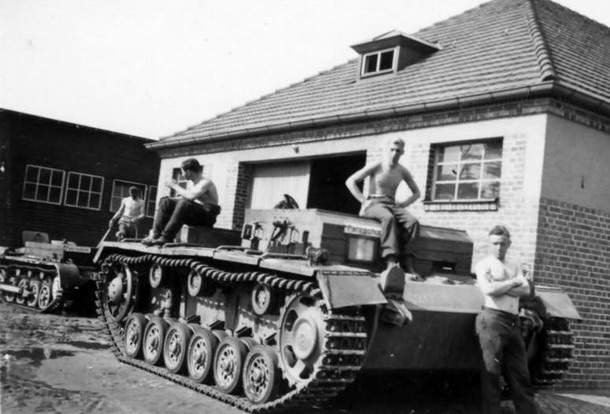
A training tank based on the Panzer III, source: Flickr.com with permission of the publishing user, edited
At the beginning of 1935 the Army began taking delivery of the first complete production Panzer I tanks, including turrets and armament, so the tank schools finally had real tanks – and in numbers that allowed mass exercises to be conducted at battalion and regimental level. Tank crew training continued nonetheless to progress from the individual to the formation. First each soldier was trained individually, then he learned to function as part of a team with the rest of the tank crew, then the crew joined exercises with the rest of their platoon, company, battalion, or regiment – and the pinnacle was manoeuvres at full divisional level.
Both Kraftfahrlehrkommandos changed their name, structure, and even location many times over the following years, eventually giving rise to the two principal tank schools of the German Army, known by their succinct and clear designations of Panzertruppenschule I (at Munster and Bergen) and Panzertruppenschule II (at Potsdam). Panzertruppenschule I specialised in training tank crews and anti-tank unit soldiers, while Panzertruppenschule II trained Panzergrenadiers and armoured car crews. These two schools were, however, far from the only ones. In 1935 a gunnery school was established at Putlos on the Baltic coast, where future tank crews conducted live-fire exercises. The training of tank force officers was handled by the Fahnenjunker-Schule der Panzertruppen at Gross-Glienicke near Berlin and the Oberfähnrich-Schule der Panzertruppen in Vyškov (in German, Wischau), near Brno. Further training centres also emerged, some of which continue to operate to this day.
Building the Tank Divisions
The German tank schools were probably busiest during three great waves of tank division formation. The first came in 1935, when the 1st, 2nd, and 3rd Panzer Divisions were founded. These were "only" three divisions, but according to the organisational scheme then in use each had two regiments, making them larger than the single-regiment divisions formed later. Moreover, everything was happening for the first time and things were still settling into a pattern. The next wave came in 1938, when the 4th and 5th Panzer Divisions were formed, along with the 1st, 2nd, 3rd, and 4th Light Divisions, which also included armoured elements and later reorganised into standard tank divisions.
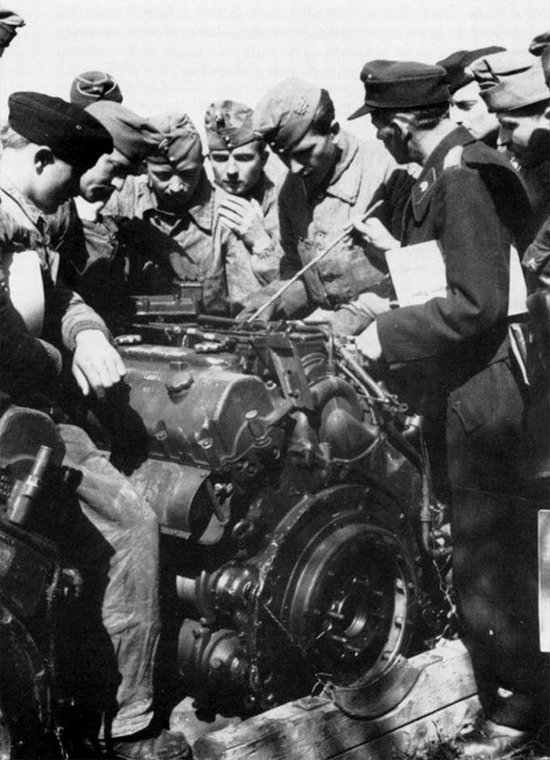
Engine instruction, most likely on a Maybach HL210 from an early version of the Tiger tank, source: Flickr.com with permission of the publishing user, edited
The third and largest wave came in 1940, when ten tank divisions were formed at once (though five of them "cannibalised" some of their men from the existing two-regiment divisions). At that point the tank schools not only had to handle the training of entirely new tank crew members but were already also making good the combat losses of existing formations. The training centres were turning out tank crew members at a furious pace; these men were then distributed to the so-called training and replacement battalions (Panzer Ersatz und Ausbildung Abteilung, though the name evolved over time and was not always thus). These battalions were then incorporated into newly forming tank divisions. A common practice was also for newcomers in a new division to be mixed with experienced veterans drawn from other units.
Following the introduction of the new Tiger and Panther tank types, specialist training centres for their crews were also established. Specifically for Tiger tank crews, a training battalion – Panzer-Ersatz-Abteilung 500 – was established at Putlos in December 1942 and moved to Paderborn in February 1943. Its primary purpose was the retraining of already-trained and experienced tank crew members in operating this new fighting machine. The Tiger was so much more complex, expensive, and capable than older German types that its crews simply could not do without special training. In addition to operating the vehicle itself, crew members also had to grasp certain characteristics of heavy tanks that were less critical in lighter types. One such golden rule specifically for Tiger crews concerned ground bearing capacity: "If you are unsure whether your tank will bog down in soft ground, put a friend on your back and stand on one leg. You will then sink into the earth at roughly the same rate as your Tiger!" To help crews acquire the necessary knowledge, highly readable illustrated manuals full of rhymes and diagrams were also produced – the celebrated Pantherfibel and Tigerfibel.
As already mentioned, the first "tanks" used for training were the turreted Panzer Is without hull or turret, simply because nothing else was available in Germany at the time. The absence of superstructures actually proved paradoxically useful in driver training, since the instructor and other students could directly observe what the driver was doing. For this reason, even in later years when various other complete tank types were available for training, school vehicles were often deliberately stripped of their turrets and hull superstructures. Period photographs show such stripped-down Panzer IIs, Panzer IIIs, and even various captured ex-French types.
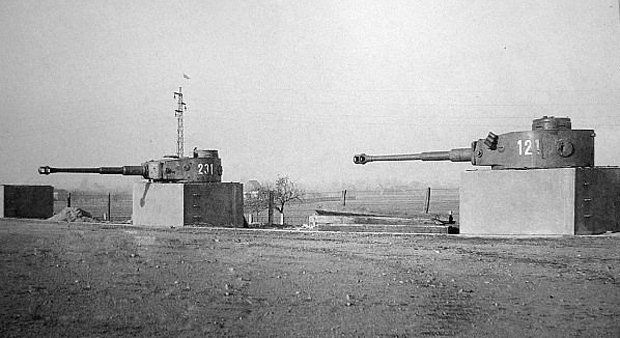
Tiger tank turrets on the gunnery range at Putlos, source: Flickr.com with permission of the publishing user, edited
As the war dragged on and raw material shortages set in, training tanks were fairly often converted to run on wood gas as an alternative fuel. Alongside actual tanks, tank schools were also equipped with various mock-ups, cut-away turret sections, and the like. For live-fire exercises at Putlos, Tiger tank turrets were even mounted on concrete plinths. Instructional films were also a very valuable intangible teaching aid, showing in real footage the various situations tanks might encounter on the battlefield and how to handle them. It should be noted that some of these were produced with real professionalism, comparing favourably with war films made many decades later.
One can readily imagine how time-consuming and expensive such tank crew training was. It comes as no surprise, therefore, that in the later months – and possibly years – of the war, training inevitably had to be cut corners. Drivers learned on whatever old vehicles were available and only switched to their actual target vehicle type towards the end of training, which was often in a completely different weight class. This led to unnecessary mechanical overloading through inexperience and avoidable breakdowns. Gunners, too, no longer had as much opportunity as before to hone their skills, and on top of everything else the overall morale of the troops was declining – an army that had long since ceased to advance and win, and was instead fighting bitter rearguard actions, worn out and exhausted.

ARTICLE
CONTENTS:
Reproducing text from the Panzernet website without the written consent of the operator is prohibited.