CAMOUFLAGE PATTERNS
how the German army ended up ahead of its time
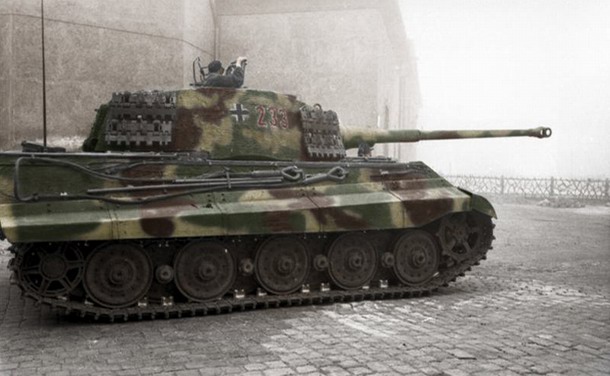
A Tiger II heavy tank in the three-colour camouflage scheme introduced in February 1943, combining dark yellow Dunkelgelb RAL 7028, olive green Olivgrün RAL 6003, and red-brown Rotbraun RAL 8017. Source: Bundesarchiv_Bild_101I-680-8282A-06, Wikimedia, Creative Commons, edited.
Camouflage, at its core, serves one of two main purposes — or a combination of both. The most obvious function is concealment: making an object blend into its surroundings so thoroughly that an observer simply fails to notice it. But camouflage can also work the other way — not by making an object invisible, but by confusing the observer's perception, making it harder to correctly identify the object, including determining its actual shape and size. The large-scale use of camouflage first emerged during the First World War. Earth-toned uniforms, camouflage nets, and a variety of painted patterns appeared on artillery pieces, trucks, tanks, ships, aircraft, and even infantry helmets. By the Second World War, camouflage had become entirely routine, employed with varying degrees of consistency and quality by all combatants. When it comes to ground forces and armoured vehicles, it was the Germans who pushed camouflage development the furthest of any nation involved — because they had no other choice. In the later stages of the war, their camouflage uniforms even featured patterns so sophisticated that they influenced the field for decades to come. But as always, let's start from the beginning.
The First World War and What Came After
Even the earliest German tanks, the A7Vs deployed in the closing stages of the Great War, commonly carried camouflage patterns combining two or three of the four standard military colours — grey, green, brown, and yellow (see a photo HERE — unfortunately in black and white, but the use of a multi-colour pattern is clearly visible). After the war ended, the Germans had no need to camouflage tanks at all, since the Versailles Treaty banned them from developing or producing armoured vehicles. That said, trucks, artillery tractors, armoured cars, and various other motorised equipment still needed attention, and for these the Reichswehr used — at least when budget allowed — a three-colour camouflage scheme in dark green, dark yellow, and dark brown, officially known as Buntfarbenanstrich.
In 1927, the Reich Committee for Delivery Conditions (Reichs-Ausschuß für Lieferbedingungen, or RAL) introduced an official colour chart defining 40 standard shades, intended to standardise colour procurement across both military and civilian sectors. Thanks to this system, we can say with confidence that from 1927 onwards, Reichswehr vehicles were given a base coat in field grey, officially designated Feldgrau-matt RAL Nr. 3, over which a camouflage pattern was applied using yellow Erdgelb-matt RAL Nr. 17, brown Braun-matt RAL Nr. 18, and green Grün-matt RAL Nr. 28. Each of the three colours was intended to cover roughly equal portions of the surface, and the pattern was to be applied differently on each vehicle, so that no two would look exactly alike — a convoy of vehicles should never form a repeating visual pattern. When the Germans decided in 1934 to set aside the restrictions of Versailles and begin serial production of the Panzer I, this same camouflage scheme was applied to those tanks as well. It is also worth noting that before any camouflage paint was applied, vehicles received a red anti-corrosion primer coat in the factory.
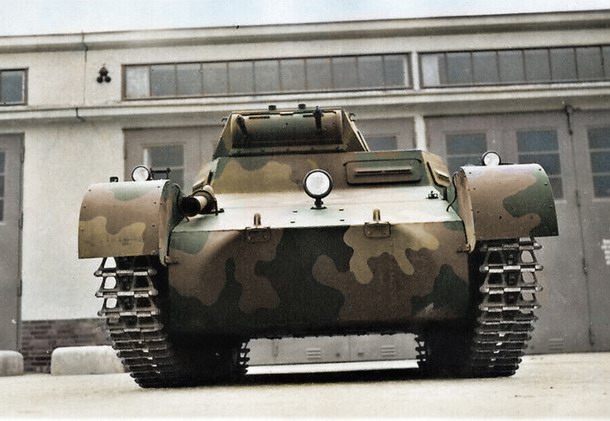
Until 1937, German tanks carried a camouflage pattern using yellow Erdgelb-matt RAL Nr. 17, brown Braun-matt RAL Nr. 18, and green Grün-matt RAL Nr. 28. On this Panzer I, however, the pattern has not been applied correctly, as the transitions between colours are too sharp. Source: Flickr.com with permission of the publishing user, edited.
The New Two-Colour Camouflage
In 1937, however, a significant change was introduced (some authors place it as early as 1935, though this seems less likely): German vehicles switched to a two-colour camouflage scheme consisting of dark grey Dunkelgrau RAL Nr. 46 and dark brown Dunkelbraun RAL Nr. 45. (The RAL numbers higher than 40 are correct — the standard colour chart had been revised and expanded in the meantime.) Grey served as the base coat covering the entire vehicle, over which large patches of brown were applied to cover approximately one third of the surface. The brown patches were not to have sharp edges; instead, they were meant to blend gradually into the underlying grey. The recommended application method was spraying rather than brushwork, as spraying produced the desired soft transitions, used less paint, and resulted in a flatter, more matte finish than a brush. According to the original order issued in July 1937, the new grey-brown scheme was to be applied only when a vehicle was due for repainting anyway — but in November 1938, a follow-up order required all vehicles to be repainted immediately regardless of their current condition.
Grey Is Cheaper
When it comes to the next change in German tank colours, the literature contains one rather significant dispute. What is certain is that, in the interest of cost savings and simplification, dark grey Dunkelgrau RAL Nr. 46 was to become the sole colour for German armoured vehicles going forward. The question is when this change actually took place. According to the monograph Panzer Colors by Bruce Culver and Bill Murphy, the switch happened just before the outbreak of the war, meaning that most German tanks deployed in Poland in September 1939 were already wearing a solid dark grey finish. According to Thomas L. Jentz's Panzer Tracts series, however, the change did not come until the summer of 1940 — which would mean that in both Poland and France, German Panzers were still fighting in the original two-colour grey-brown scheme. You might think this is clearly nonsense, since photographs from both campaigns appear to show tanks in a uniform grey finish. But there are a few things worth bearing in mind.
First, dark grey Dunkelgrau RAL Nr. 46 and dark brown Dunkelbraun RAL Nr. 45 are not entirely dissimilar colours. Second, most photographs show tanks that are heavily coated in dust and mud rather than freshly cleaned, which makes subtle colour distinctions nearly impossible to see. And third, the vast majority of period photographs are black and white, while colourised versions are often done retrospectively, which inevitably introduces further distortion. Try comparing pairs of identical images below — one in black and white, the other colourised — and you will quickly find that on the black-and-white version, the two-colour grey-brown scheme is essentially indistinguishable from a solid grey finish (Panzer I photo HERE, Panzer IV photo HERE). It is therefore quite plausible that the order to switch to solid grey did not actually arrive until after the fall of France in the summer of 1940.
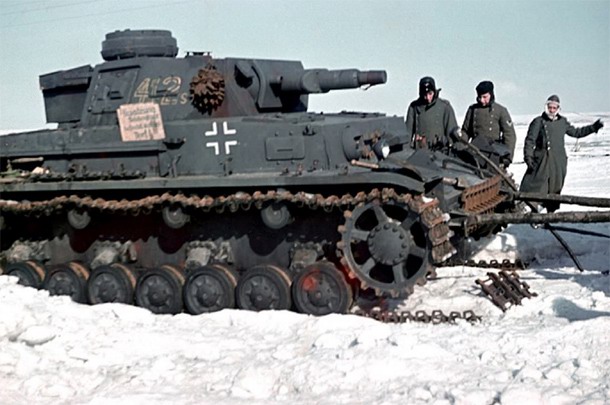
At the time of the attack on the USSR, solid dark grey RAL 7021 was the standard finish for German tanks. This photograph clearly illustrates how conspicuous that scheme looked against a winter landscape. Source: Flickr.com with permission of the publishing user, edited.
Two additional details connected to this colour change are worth mentioning. As part of the broader effort to cut costs, the way paint was procured also changed. Previously, individual units bought their grey and brown paint directly from manufacturers; with the move to a single grey finish, purchasing was centralised and paint was distributed through the standard army supply chain. The second change was a revision of the RAL numbering system itself, which also took place during 1940 — RAL numbers switched from two-digit to four-digit codes. As a result, the dark grey used on German tanks, Dunkelgrau RAL Nr. 46, received its new designation: RAL 7021.
As for the campaign into the Soviet Union in June 1941, the literature is in clear agreement: German tanks entered that operation wearing a solid coat of dark grey Dunkelgrau RAL 7021.
The Russian Winter
Operation Barbarossa did not go quite as the Germans had planned, and by November 1941 it was abundantly clear that the Wehrmacht would be fighting through a proper winter. On the 18th of November, an order was issued to distribute water-soluble white paint, which crews were instructed to apply to their vehicles in all areas with continuous or near-continuous snow cover. National markings (i.e. balkenkreuze), unit emblems, tactical numbers, and other identification painted on the hull were not to be covered with white, so that they would remain visible.
It is immediately obvious that the above order came rather late, and by the time the white paint was produced and distributed, many units simply had to improvise. That is why photographs from the first Russian winter frequently show vehicles in their standard grey finish draped with white bedsheets (photo HERE), covered in newspaper pages (photo HERE), or with a winter "camouflage" applied with ordinary chalk (photo HERE). Since the winter paint was water-soluble, crews were expected to simply scrub it off with brushes once the snow melted and return their vehicles to their standard grey appearance. By spring 1942, Wehrmacht and Waffen-SS vehicles on the Eastern Front had thus reverted to a uniform grey once again. Before long, however, it became clear that troops in the field were not particularly happy with this single-colour finish — and that they were now doing deliberately what had previously happened by accident on dusty Russian roads: smearing their grey vehicles with mud. Command responded by permitting units to requisition additional colours, particularly dark green and dark brown, and to apply them to grey-painted vehicles largely at their own discretion. This was essentially a preview of what was coming in 1943 — but more on that in a moment.
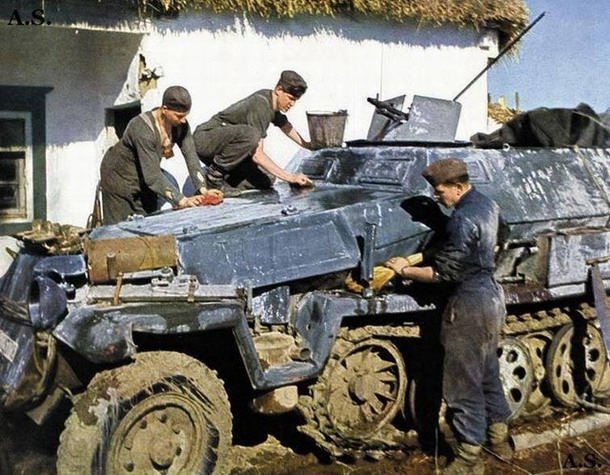
Spring 1942 on the Eastern Front: soldiers stripping the temporary winter whitewash from a Sd.Kfz. 251 half-track, revealing the standard grey RAL 7021 underneath. Source: Flickr.com with permission of the publishing user, edited.
Under the African Sun
Let us, however, briefly leave the Soviet Union and step into the heat of the African sun. Germany's involvement on the continent began unexpectedly as a rescue mission for the collapsing Italians in February 1941. Because the deployment was largely unplanned, many things had to be worked out on the fly — including vehicle colours. The first German tanks to arrive in Libya therefore came wearing their standard "European" finish of dark grey Dunkelgrau RAL 7021. This colour proved poorly suited for concealment in the African terrain, and soldiers consequently smeared their vehicles with as much mud as possible, mixing it with water in whatever containers were available (photo HERE). Photographs also show that on some tanks dispatched to Africa, the black rubber rims of the road wheels were painted white to reflect sunlight and reduce the heat absorbed, thereby slowing their deterioration (photo HERE).
It was not until mid-March 1941 that an official camouflage scheme for the African theatre was approved. The base coat was to be a yellowish-brown Gelbbraun RAL 8000 applied across the entire vehicle, over which irregular patches of grey-green Graugrün RAL 7008 were to be applied, covering approximately one third of the surface with gradual, soft transitions between the two colours. A special paint was also supplied for waterproof tarpaulins and the fabric roofs of passenger vehicles. The African campaign brought a number of specific challenges that directly affected camouflage. The most obvious was the climate: scorching sun and sand-laden wind could strip and abrade any paint finish with remarkable speed. Supply lines from Germany to North Africa were enormously long, and since ammunition and fuel naturally took priority, the Afrikakorps frequently suffered from paint shortages. As a result, German soldiers regularly made do with captured British paints.
A new colour scheme for vehicles fighting in Africa was formally introduced in March 1942. The previous yellowish-brown RAL 8000 base was to be replaced by a sandy brown RAL 8020, with patches in grey RAL 7027 covering roughly one third of the surface. In practice, however, supply problems meant that most vehicles ended up painted in nothing but the sandy brown base. The timing of this change also proved unfortunate. At the turn of 1942 and 1943, the Afrikakorps retreated from Libya into Tunisia — a region with considerably more vegetation. A solid sandy-brown finish offered little concealment in that environment. As the African campaign moved into its final phase, German troops increasingly turned to a different solution: draping their vehicles with branches and foliage.
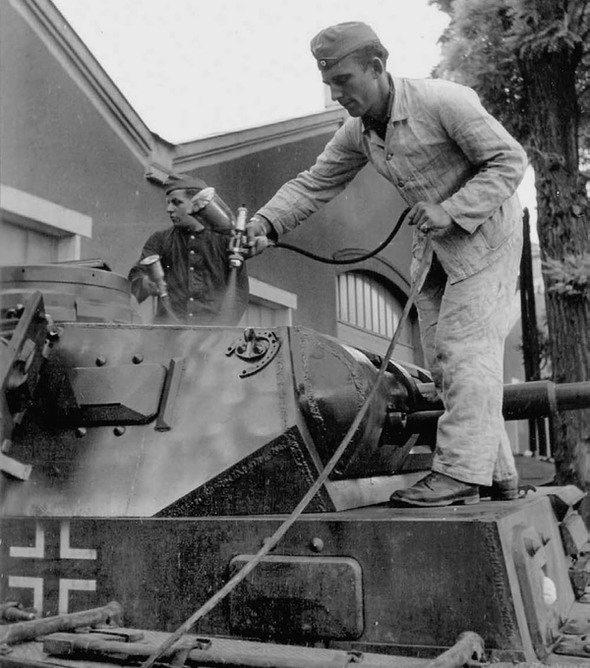
This was the prescribed method of applying camouflage paint — using a spray gun ensured smooth transitions between colours, economical use of paint, and a flatter, more matte finish on the final result. Source: Flickr.com with permission of the publishing user, edited.
By early 1943 the fighting in Africa was clearly drawing to a close, so let us now return to the Eastern Front, where events were very much still in full swing.
The Legendary Three-Colour Scheme
Growing dissatisfaction with the grey-based camouflage system led, in February 1943, to an order that amounted to a genuine revolution. From that point on, three colours were to be used for all German fighting vehicles: dark yellow Dunkelgelb RAL 7028, olive green Olivgrün RAL 6003, and red-brown Rotbraun RAL 8017. Dark yellow was to serve as the base coat; everything else was left entirely to the discretion of individual unit commanders. The idea was brilliantly simple. After all, the commander of a given unit knows best what terrain his men are fighting in and has the strongest possible motivation to make his vehicles as well-concealed as possible. Given the right materials, the results could only be good — and indeed they were. This decision gave rise to an almost limitless variety of combinations of the three prescribed colours, with varying degrees of emphasis on any one of them, rendered in patches, clouds, stripes, dots, dashes, crosshatching, and every other shape that commanders saw fit to use.
New fighting vehicles left the factories painted only in dark yellow Dunkelgelb RAL 7028. All three approved colours were then distributed to units in the form of a thick paste, packaged in 2 kg and 20 kg containers. Tables were also issued giving at least a rough indication of how much paint was needed for each type of vehicle — for instance, roughly 1.5 kg for a passenger car, around 4.5 kg for a heavy truck, and about 6 kg for a tank. Before application, the paste was of course to be thinned to the appropriate consistency, preferably with petrol, though thinning with plain water was also permitted. The recommended method of application was, naturally, a spray gun powered by a compressor connected to the vehicle's engine.
It soon became apparent, however, that paint thinned with water was quite unstable and would dissolve even in ordinary rain. An order was therefore issued requiring petrol to be used exclusively. Unfortunately, petrol became an increasingly scarce commodity as the war continued, and crews were understandably reluctant to use it for painting. Mixtures of oil and petrol were sometimes used instead, which ultimately altered the final shades and added yet another layer of variation to the finished camouflage. Similarly, spray guns were not always available, so crews often applied paint with brushes, rags, sponges, brooms, and whatever else came to hand.
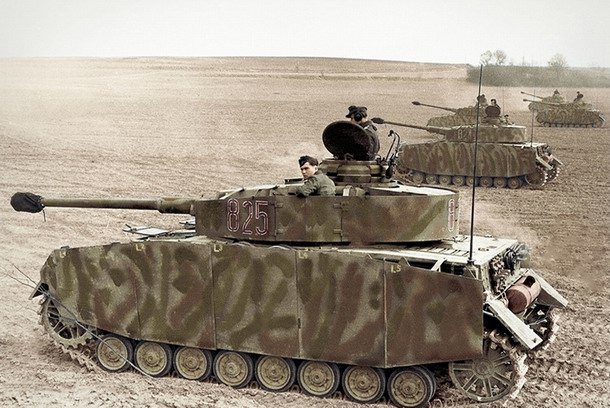
From February 1943, unit commanders had a free hand in deciding what their vehicles' camouflage would look like — only the three prescribed colours were specified: dark yellow, olive green, and red-brown. Source: Bundesarchiv_Bild_101I-298-1759-25, Wikimedia, Creative Commons, edited.
Ambush Camouflage
The apparent disorder that reigned in vehicle camouflage evidently irritated certain orderly-minded officials or officers, and so in August 1944 an optional standard pattern for the three-colour scheme was issued, known as Hinterhalt-Tarnung — roughly translatable as ambush camouflage or ambush pattern. The scheme called for the three standard colours to be applied in irregular stripes, over which small dots, circles, or dashes were then painted in whichever of the three colours was different from the one underneath. According to its creators, this pattern was ideally suited for vehicles parked in forested terrain.
Since it was a fairly complex pattern, it was recommended — whenever possible — to have it applied by skilled workers in the factory before the vehicle was dispatched to the front. In practice, however, this was far from the norm, and new armoured vehicles continued to leave factories most commonly wearing only the Dunkelgelb RAL 7028 base coat. Between September 1944 and the end of the war, two or possibly three further amendments relating to vehicle colour schemes were issued. Given the general collapse of supply and logistics by that stage, these changes can be considered entirely inconsequential.
A chapter of its own is the use of natural foliage — branches and other vegetation — as camouflage. The significance of this practice for German tanks and other armoured vehicles grew in proportion to the decline of the Luftwaffe and the enemy's steadily increasing air superiority. Foliage camouflage is particularly effective when viewed from above — provided, of course, that the crew spots an approaching aircraft in time to pull off the road and bring the vehicle to a halt. On the newly opened Western Front it was almost indispensable, given the Allies' near-absolute air superiority. Branches were typically attached to armoured vehicles using wire, or simply tucked into any gap where there was a reasonable chance they would stay put. In larger quantities, foliage was really only used during movement and when vehicles were parked in one place for extended periods — in actual combat, the vegetation could easily obscure the crew's vision and get in the way.
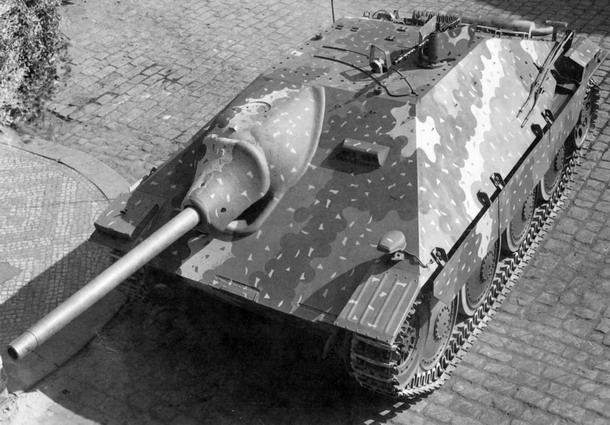
The pinnacle of the evolution of German armoured vehicle camouflage was arguably the so-called ambush pattern (Hinterhalt-Tarnung), introduced in August 1944 — seen here on a Hetzer tank destroyer. Source: Flickr.com with permission of the publishing user, edited.
Interior Colours
To wrap things up, let us take at least a brief look at the colours used inside German armoured vehicles. In vehicles with open fighting compartments — such as self-propelled guns, early tank destroyers, and half-track personnel carriers — the interior was painted in the same colour as the exterior base coat. The reason was straightforward: the interior of such vehicles was visible to enemy aircraft and therefore needed at least a degree of camouflage. In vehicles with a fully enclosed crew compartment, most notably tanks, the interior was standardly painted in ivory, designated Elfenbein RAL 1001. The advantage of this colour was that it optically brightened an otherwise quite dark enclosed space. Hatch covers, however, were painted on their inner face in the same colour as the exterior base coat, so that when open they would blend as much as possible with the outside of the vehicle — though this was by no means a universal rule, as numerous photographs confirm (example HERE). Towards the end of the war, the ivory interior finish began to be abandoned as a cost-cutting measure, and tanks were delivered to the army with interiors painted only in the red anti-corrosion primer.
ARTICLE
CONTENTS:
Reproducing text from the Panzernet website without the written consent of the operator is prohibited.