PANZERWERFER 42
self-propelled rocket launcher on the Opel Maultier chassis
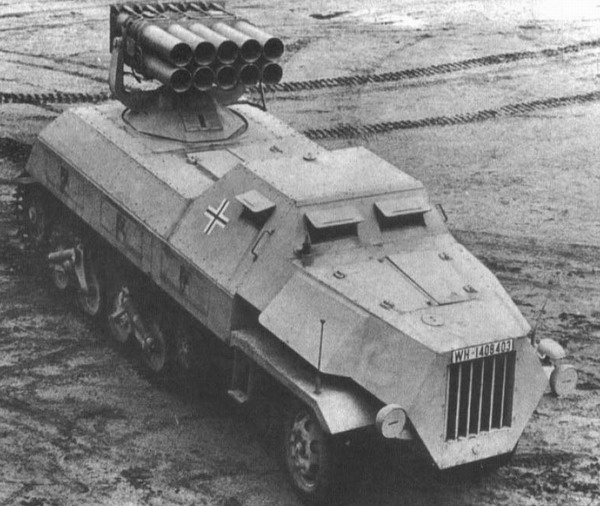
15cm Panzerwerfer 42 auf Selbstfahrlafette Sd.Kfz. 4/1, source: Flickr.com with permission, edited
The German army made use of enormous numbers of trucks of many different types during the Second World War. Among these, the Opel Blitz stood out — thousands of them were delivered to the armed forces. Wheeled vehicles, however, had very limited cross-country capability, and particularly in Russia during the spring rains the Germans felt this shortcoming keenly. Experience on the Eastern Front led German engineers to develop half-track trucks derived from existing wheeled vehicles. It was in this way that the Opel Maultier (Maultier = mule) came into being.
This vehicle later served as the basis for the self-propelled rocket launcher Panzerwerfer 42. The cab and cargo body were removed entirely from the chassis and replaced by a fully enclosed armoured superstructure welded from steel plates 10 mm thick at the front and 8 mm on the sides and rear. The front steerable axle was identical to that of the wheeled truck, as the Maultier had already retained it unchanged. The rear track assembly, also carried over from the Maultier, consisted on each side of four road wheels suspended and sprung in pairs, along with a drive sprocket and an idler wheel. The powertrain was a six-cylinder Opel engine producing 68 horsepower, capable of propelling the vehicle to a maximum road speed of 38 km/h.
Behind the engine bonnet was the cab for the driver and commander. Visibility was provided by windows in the front and side walls, fitted with hinged covers incorporating narrow observation slits. When moving in the rear areas, the crew could open the windows fully, while in areas where enemy fire was a risk they used only the observation slits.
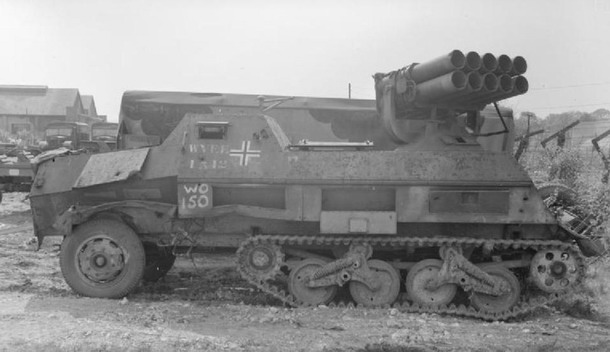
Panzerwerfer 42 captured by the Allies, source: internet, Public domain, edited
Behind the crew cab was an equally enclosed cargo compartment. On its roof, mounted on a rotating base, sat a ten-barrel rocket launcher of 150 mm calibre. The barrels were arranged in two rows of five, one above the other. The first set of rockets was carried already loaded in the launcher; additional ammunition was stored in the cargo compartment, accessed through double doors in the angled rear wall of the superstructure. Each rocket weighed 34.7 kg, of which 10 kg was the warhead's explosive charge. The maximum range of the rockets was 6,700 metres.
Additional storage space for tools and equipment was provided by six lockable stowage boxes on the sides of the rear section of the superstructure, identical in design to those on the Sd.Kfz. 251 Ausf. D. At the rear edge of the crew cab, a swivel mount was fitted for an MG 34 machine gun, which served as supplementary armament for close-range ground and anti-aircraft defence. Since the on-board rocket supply was quite limited, dedicated ammunition carriers were also produced to resupply the launchers. These were identical vehicles but without the rocket launcher fitted, their only armament being the machine gun.
In an exact number of examples that is not precisely known, a second type of self-propelled rocket launcher was also built on the Opel Maultier chassis. Its basic construction was the same as described above, but the armament was changed. This vehicle carried a 24-barrel rocket launcher of 80 mm calibre — a weapon the Germans also experimentally fitted to some captured French half-tracks. "Barrel" is not quite the right term here, as the launchers were simply open guide rails 186 cm in length.
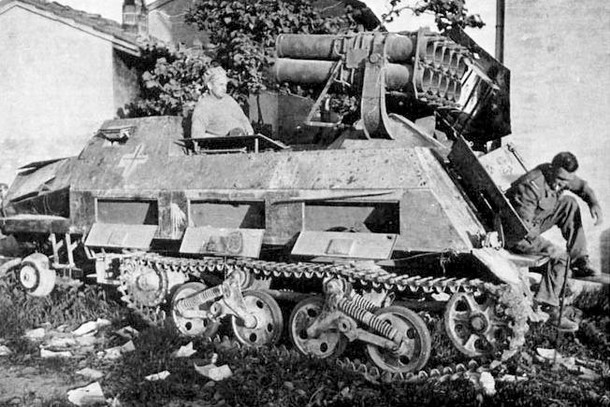
Panzerwerfer 42 captured by the Allies, source: internet, Public domain, edited
The launch rails were arranged in two rows of twelve, one above the other. Two rockets were clipped to each rail — one on top and one underneath — giving the launcher the ability to fire 48 rockets in a single salvo. The rockets were 80 mm in calibre and came in either high-explosive or smoke variants. This vehicle carried the designation 8cm Vielfachwerfer auf Maultier 40 and was most likely built only in a very small number of experimental examples.
A total of 300 self-propelled rocket launchers were produced during the production run, and they went on to serve with the German army right through to the very end of the war.
Reproducing text from the Panzernet website without the written consent of the operator is prohibited.