Sd.Kfz. 6
self-propelled guns on the half-track tractor chassis
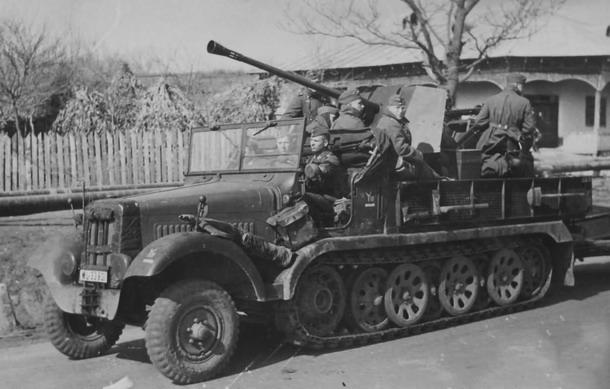
Sd.Kfz. 6/2 with a 37 mm Flak 36 cannon, in this case fitted with the gun shield; source: worldwarphotos.info, used with permission of the operator, edited
Origins of the Half-track
The Sd.Kfz. 6 (Sd.Kfz. = Sonderkraftfahrzeug = special purpose vehicle) emerged from an extensive half-track tractor development programme launched by the German Army in the early 1930s. The programme covered vehicles in six payload categories, with towing capacities ranging from 1 to 18 tonnes. Among the vehicles required was one capable of towing weapons and loads of up to 5 tonnes, the development of which was contracted to the firm Büssing NAG.
The project carried the unwieldy designation leichte geländegängige Zugkraftwagen — literally "light cross-country tractor." In 1934, the first development version appeared under the designation BN l 4, which still had little in common with the later production vehicle. Büssing NAG probably built a total of eight pre-production prototypes of the BN l 4. In addition to the parent company, the firm Krauss-Maffei evidently also participated in development, producing its own prototype variant in the same year, designated KM l 4. It is not clear from the available literature, however, whether the two manufacturers collaborated as partners or competed as rivals. Either way, Krauss-Maffei's involvement ended with the construction of that single prototype.
In 1935, Büssing NAG introduced the next development generation, designated BN l 5. This version featured a more powerful engine and a substantially redesigned track system extended by a fourth road wheel. It apparently entered series production, in which Daimler Benz also participated (under the designation DB l 5), and several hundred vehicles of this version were built in total. In 1936, yet another generation appeared — the BN l 7 — with an even more powerful engine; Büssing NAG and Daimler Benz (the latter under the designation DB l 7) again jointly produced several hundred units.
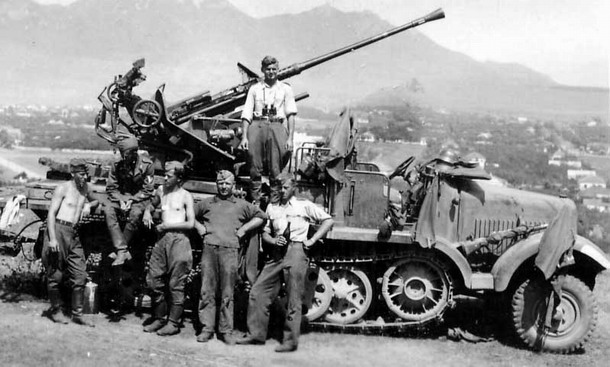
Sd.Kfz. 6/2 with a 37 mm Flak 36 cannon, in this case fitted without the gun shield; source: Flickr.com, used with permission of the publishing user, edited
In 1937 the Army officially renamed the vehicle mittlerer Zugkraftwagen 5t (Sd.Kfz. 6), and a further production generation entered service under the factory designation BN l 8. The track unit of this version was redesigned and extended by an additional two road wheels, bringing the total to six. The BN l 9 followed in 1939 and was essentially the definitive variant. In 1941 only minor engineering modifications were made, after which the factory designation was changed to BN l 9b. Series production of the tractor continued until November 1943.
The powerplant of the definitive Sd.Kfz. 6 was the Maybach HL54 TUKRM six-cylinder engine with a displacement of 5.42 litres and a maximum output of 115 horsepower at 2,600 rpm. The gearbox offered four forward speeds and one reverse, but the vehicle was also equipped with a two-speed reduction gearbox, giving the driver a total of eight forward gears and two reverse. Fuel capacity was 190 litres. The driver steered using a conventional steering wheel: gentle turns moved only the front wheels, while larger steering inputs additionally applied braking to the track on the inside of the turn.
Vehicle Description
The chassis consisted of a front axle with conventional wheels and a rear track unit. The track assembly comprised a front drive sprocket, a rear idler, and six road wheels. The road wheels were sprung by torsion bars and fitted with rubber tyres to improve ride characteristics. Each wheel was in fact a double unit, made up of two steel discs — so the half-track effectively had twelve road wheel discs, arranged on six axles. The wheels were arranged in interleaved rows overlapping one another, a configuration typical of German half-tracks and, later, tanks as well. The discs of the even-numbered wheels were mounted further apart on their axles, with the odd-numbered wheels — whose discs sat close together — fitting into the gap between them. Viewed from the side, only the even-numbered wheels were fully visible, specifically their outer discs.
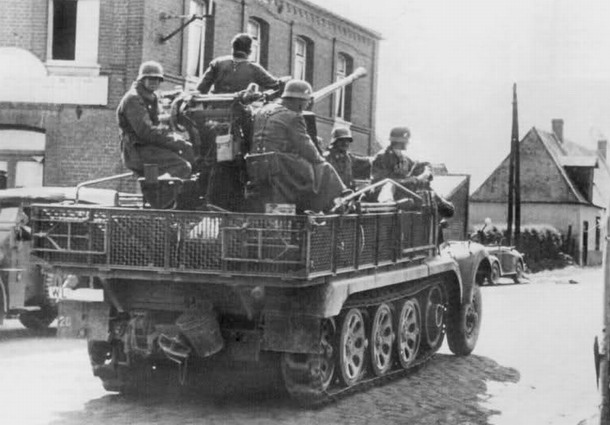
Rear view of the Sd.Kfz. 6/2; source: Flickr.com, used with permission of the publishing user, edited
The front of the vehicle housed the engine compartment, followed by the driver and commander's cab, with the main cargo area at the rear. The overwhelming majority of Sd.Kfz. 6 vehicles were built in the configuration for engineer units, where the cargo area featured three rows of seats and the vehicle was used to tow trailers carrying bridging equipment or assault boats. An artillery variant also existed, with two rows of seats and a cargo area to the rear, intended for towing guns such as the 105 mm leFH 18, the 100 mm sK 18, or the 150 mm sFH 18. This variant was designated Sd.Kfz. 6/1.
Sd.Kfz. 6/2
For those interested in combat vehicles, however, it is two quite different variants that are of particular interest. The first of these carried the ordnance code Sd.Kfz. 6/2. Its full official designation appears in at least three different forms in the sources, though this is of secondary importance. The variant was intended for anti-aircraft defence and was armed with a 37 mm Flak 36 cannon. The area behind the driver and commander's cab was converted into a flat fighting platform, in the centre of which the gun was mounted. It was installed on its standard pedestal mount, which allowed full 360-degree horizontal traverse. Vertical elevation ranged from -8 to +85 degrees.
The theoretical rate of fire of the Flak 36 was 160 rounds per minute, though the practical rate was only 80 to 100 rounds. The gun was fed from six-round clips. Maximum ceiling was around 4,800 metres, though effective engagement altitude was approximately 3,500 metres. The weapon was also very well suited to engaging ground targets, including enemy armour. At a range of 600 metres, it could penetrate up to 27 mm of armour plate angled at 30 degrees. Maximum theoretical horizontal range was around 6,500 metres, though effective range was of course considerably less.
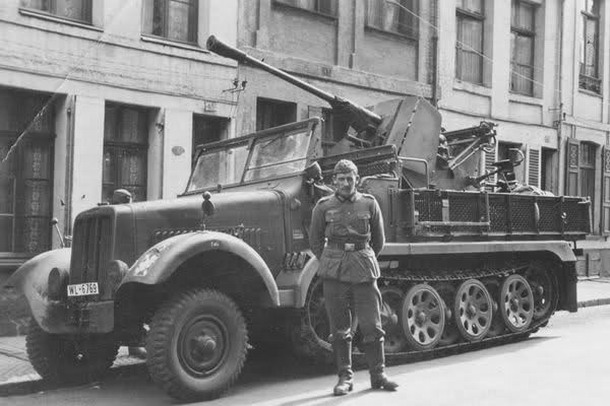
Sd.Kfz. 6/2; source: Flickr.com, used with permission of the publishing user, edited
The fighting platform was essentially completely open. It was enclosed on the sides and rear by only a low railing of heavy-gauge wire mesh. Before engaging targets, sections of this railing were folded down — which both cleared the arc of traverse and enlarged the working area (the folded sections did not drop all the way down, but locked horizontally, extending the floor of the platform), making it easier for the gun crew to operate. The only protection available to the crew in this open fighting compartment was the gun's own shield, which was rather small and therefore offered only token cover. A significant number of vehicles, moreover, were not fitted with the shield at all, leaving the crew entirely exposed in combat.
The crew of the Sd.Kfz. 6/2 numbered seven men. The driver and commander sat in the forward cab, as on the standard tractor. The remaining five soldiers made up the gun crew and were stationed at the weapon. Only an immediate-use ammunition supply appears to have been carried on the vehicle itself; further ammunition was transported in the Sonderanhänger 57 trailer. The Sd.Kfz. 6/2 weighed 10.4 tonnes (compared to approximately 9 tonnes for the standard tractor) and had a top speed of around 50 km/h. Road range was approximately 300 km, cross-country range roughly 120 km.
The first 63 Sd.Kfz. 6/2 vehicles were built in 1939. A follow-on order for a further 135 was placed, delivered during 1940 and 1941. According to some sources, the gun platforms were supplied by the firm Gottfried Lindner of Ammendorf.
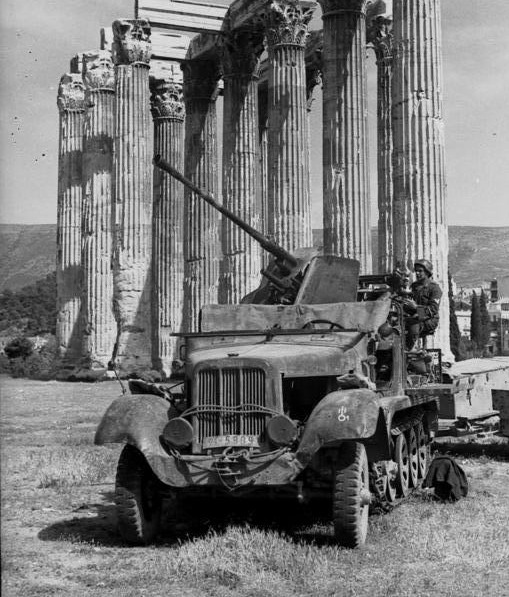
Sd.Kfz. 6/2 ready for action; source: Bundesarchiv_Bild_101I-165-0432-17A, Wikimedia, Creative Commons, edited
Sd.Kfz. 6/3
The second armed variant of the Sd.Kfz. 6 tractor was designed for destroying enemy armoured vehicles. Its official designation was 7,62 cm F.K.296(r) auf gepanzerter Selbstfahrlafette (Sd.Kfz. 6/3). The name makes clear that the vehicle's main weapon was the captured Soviet 76.2 mm F-22 field gun, which the Germans designated Feldkanone 296(r). During the opening phase of Operation Barbarossa, the Germans captured enormous quantities of these guns along with their ammunition. It is worth noting that the Sd.Kfz. 6/3 carried the original Soviet weapon firing original Soviet ammunition, not the modified German variant designated PaK 36(r). Although the F-22 was not primarily designed as an anti-tank gun, it outperformed the available German alternatives in that role — production of the German 75 mm PaK 40 was only just getting under way.
The decision to produce such a vehicle was apparently taken in August 1941. The self-propelled gun was built for the African theatre, where it was intended to help the German Afrikakorps deal with the Allies' heavily armoured vehicles, such as the infantry tank Matilda. The firm Alkett was tasked with adapting the half-track tractor to carry the Soviet weapon. The result strongly suggests that the Army's specification placed a premium on speed and low cost. The designers evidently did not trouble themselves with a sophisticated solution: they simply placed the gun in the space behind the driver and commander's cab, complete with its wheels, shield and shortened trail legs.
The fighting compartment was then enclosed by a rudimentary armoured box of flat plates. The armour thickness most commonly cited is 10 mm, though figures of 4.5 mm also appear in some sources. The top of the armoured box was left completely open. The front plate had a large cutout through which the barrel protruded, with the gap filled by the gun's own shield. The gun could be traversed horizontally 30 degrees to either side and elevated vertically from -7 to +20 degrees.
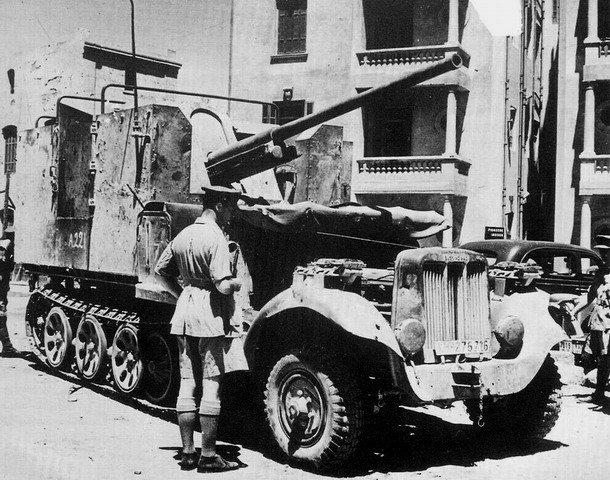
Sd.Kfz. 6/3 with the Soviet F-22 cannon, captured by the Allies in Africa; source: Flickr.com, Public Domain, edited
Each side plate featured a large access door for the gun crew. Sources disagree on crew size — some give three men, others four. The gun certainly required two men for aiming, as its elevation and traverse controls were on opposite sides of the weapon (an unfortunate design feature that the Soviets themselves had complained about). At least one more man was needed as loader. What a fourth crew member would have been responsible for is unclear. The gun crew was complemented by the driver and commander in the open forward cab, bringing the total on board to five or six men. Spanning the open roof of the fighting compartment were two tubular beams over which a waterproof canvas cover could be stretched to provide shelter from the elements. A smaller door in the rear wall of the fighting compartment apparently served for ammunition loading.
The Sd.Kfz. 6/3 had no integral anti-infantry weapon. The crew's only defence against close-range attack was fire from their personal weapons, or perhaps a machine gun that the soldiers may have carried aboard. The armoured superstructure substantially increased the vehicle's silhouette and thus its visibility (the half-track stood 2.98 metres tall). One might argue that the sheer height of the armour provided excellent coverage for the gun crew — and that is true — but only in terms of coverage. At a mere 10 mm (and possibly less), the armour offered protection only against small-arms fire and light splinters. The vehicle's weight, due to the gun and armour, rose to 11.2 tonnes (some sources cite 10.5 tonnes, which seems too low).
By the end of 1941, a total of nine of these self-propelled guns had been completed on the Sd.Kfz. 6 chassis and were promptly dispatched to Africa. The first six arrived in January 1942, with the remaining three following in February. They were assigned to the 3rd Company of Panzerjäger-Abteilung 605 and took part in several major engagements, including the battles of Bir Hakeim, Gazala and El Alamein. It was at El Alamein that one of these vehicles was captured by the British. The remaining eight were lost in combat one by one.
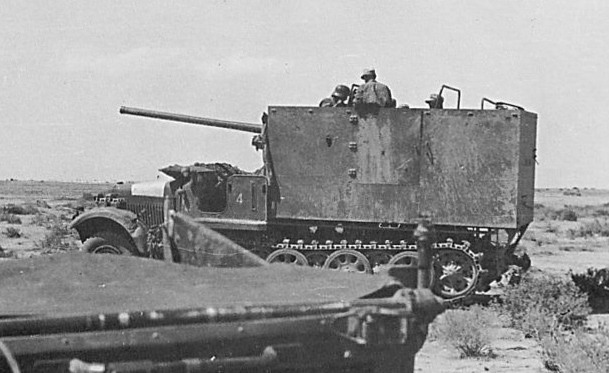
Sd.Kfz. 6/3 with the Soviet F-22 cannon in Africa; source: Flickr.com, used with permission of the publishing user, edited
The improvised tank destroyer described above is very frequently referred to in the literature by the nickname Diana — but this is a mistake. The name Diana (after the ancient goddess of the hunt) was intended for a different, if closely related, vehicle. Diana was to be a purpose-built tank destroyer, again based on the Sd.Kfz. 6 chassis, but instead of the original Soviet F-22 cannon it was to carry the modified variant designated PaK 36(r).
That weapon was the result of modifications carried out on the F-22 by Rheinmetall Borsig for the German Army. The conversion included a new chamber allowing the use of more powerful German 75 mm ammunition — otherwise intended for the PaK 40 anti-tank gun. The German cartridge had a case approximately twice as long and slightly wider, and consequently a propellant charge nearly two-and-a-half times larger. The gun's recoil mechanism was also strengthened, the controls relocated to one side, and several further changes made. Most of the converted guns also received a muzzle brake. Diana was to have received better-designed armour protection as well. The entire project, however, either never progressed beyond the drawing board or, according to some sources, resulted in the construction of a single prototype.
ARTICLE
CONTENTS:
Reproducing text from the Panzernet website without the written consent of the operator is prohibited.