Sd.Kfz. 11
self-propelled guns on the half-track tractor chassis
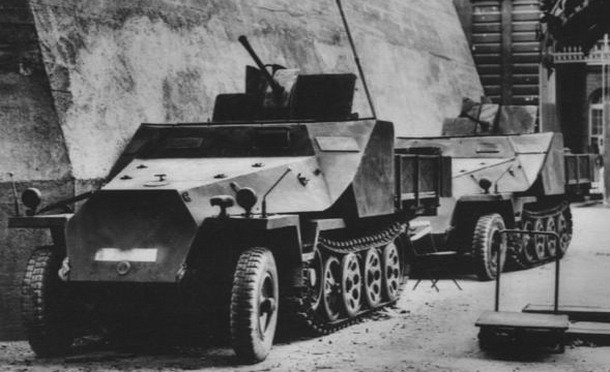
a pair of self-propelled Flak 38 guns on Sd.Kfz. 11 chassis; source: Flickr.com, used with permission of the publishing user, edited
Origins of the Half-track
In the early 1930s the German Army established a comprehensive half-track tractor development programme covering vehicles across six weight categories. Among them was a light vehicle intended for towing weapons and loads of up to three tonnes. Its development was entrusted in 1933 to Hansa-Lloyd, a subsidiary of Borgward. The first prototype, designated Hl Kl 2, appeared in 1934, followed a year later by the improved Hl Kl 3 and then the Hl Kl 4 (H) with a rear-mounted engine. By 1936 the project had matured into the Hl Kl 5 chassis variant, of which a small series was produced. In 1938 the project passed to Hanomag, which developed it into the definitive Hl Kl 6 (sometimes written Hl Kl 6) variant. Hanomag replaced the previous Hansa-Lloyd engines with Maybach units — first the NL 38 TUKR and ultimately the HL 42 TUKRM. In the meantime, the vehicle had in 1937 received its official designation: leichter Zugkraftwagen 3t (Sd.Kfz. 11).
Vehicle Description
The chassis consisted of a front steered axle and a rear track unit. The front axle was sprung by a single large transversely mounted leaf spring. Some sources indicate that the front wheels were not fitted with brakes at all. The track unit on each side comprised seven pressed-steel road wheels with circular lightening holes. Each wheel consisted of two discs: the odd-numbered wheels had their discs mounted close together on the axle, while the second, fourth and sixth wheels had their discs set further apart — allowing the odd wheels to nest into the space between the two halves of the adjacent even wheels. When viewed from the side, the even-numbered wheels therefore partially obscured the odd ones. The last road wheel was raised slightly above the level of the others and doubled as the idler wheel; at the front was the toothed drive sprocket, which was of an entirely different design.
The road wheels were sprung by torsion bars, which meant that the wheels on opposite sides of the chassis could not be positioned directly opposite one another. The left-side wheels were offset further rearward, so the gap between the first road wheel and the drive sprocket on that side was approximately 14 cm wider than on the right. As a result, the left track was one link longer than the right — 56 links on the left versus 55 on the right. The 280 mm wide tracks were fitted with rubber pads for more comfortable running on hard roads. Some sources indicate that on the final production batches these rubber pads were replaced by metal ones, but apparently this proved such a trial that it noticeably worsened road performance, and the idea was quietly abandoned.
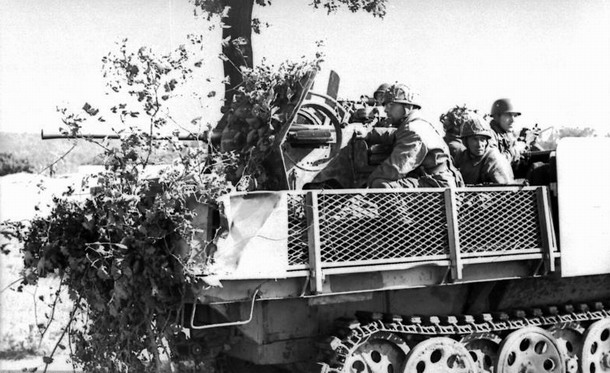
2cm Flak 38 auf Selbstfahrlafette Zugkraftwagen 3t (Sd.Kfz. 11); source: Bundesarchiv_Bild_101I-590-2333-23A, Wikimedia, Creative Commons, edited
The production Sd.Kfz. 11 was powered by the Maybach HL42 TUKRM already mentioned — a petrol-fuelled six-cylinder engine of 4.2 litres (4,199 cc) displacement, developing a maximum of 100 hp at 2,800 rpm. The gearbox was of the Hanomag 021 32785 U50 type, with four forward speeds and one reverse. The engine was mounted at the front of the vehicle, with the gearbox beneath the cab floor. Behind the gearbox were the battery and fuel tank, and the exhaust silencer sat right at the rear. In addition to the main gearbox, the Sd.Kfz. 11 was also equipped with a two-speed reduction gearbox, giving the driver a total of eight forward speeds and two in reverse in practice. It is worth noting that a considerable number of sources make no mention of this reduction gearbox at all.
The driver controlled the vehicle with a steering wheel, the standard set of three pedals, and two gear levers — the second belonging to the reduction gearbox — with the handbrake lever to his right. Due to the considerable length of the track contact patch, the Sd.Kfz. 11 used a steering system typical of fully tracked vehicles. Conventional automotive steering by turning the front wheels was only effective for gentle curves; once the driver turned the wheel more than 15 degrees, braking was applied to the track on the inside of the turn. The relative complexity of this steering system was amply repaid by the excellent cross-country performance that the large track area provided.
In its basic tractor configuration, the Sd.Kfz. 11 was intended primarily to tow the 105 mm le FH 18 light howitzer, though in practice it was frequently used with 75 mm anti-tank guns and other weapons as well. A number of further variants were also produced, intended for example to tow the Nebelwerfer 40 (100 mm), Nebelwerfer 41 (150 mm) and Nebelwerfer 42 (210 mm) rocket launchers. A version for transporting 280 mm and 320 mm rockets for the Schweres Wurfgerät 40 was also built, as were chemical decontamination and spraying vehicles and several other variants. However, only one — or strictly speaking two — of all the variants built can properly be described as a self-propelled gun, and it is that variant which will be discussed below.
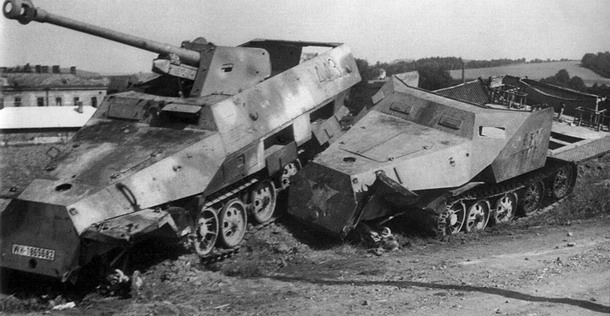
in the foreground an Sd.Kfz. 251/22 Ausf. D, with a 2cm Flak 38 auf Selbstfahrlafette Zugkraftwagen 3t (Sd.Kfz. 11) without its weapon behind it; this photograph offers an excellent opportunity to compare the armour details of these two related vehicles; source: Flickr.com, Public Domain, edited
The self-propelled variant was not, however, based on the standard Sd.Kfz. 11 chassis (designated H Kl 6), but on its modified version developed for the armoured personnel carrier Sd.Kfz. 251 — the H Kl 6p chassis. This is why a large number of authors do not list the vehicle as a variant of the Sd.Kfz. 11 tractor at all, but instead classify it as a variant of the Sd.Kfz. 251, or even assign it the separate ordnance code Sd.Kfz. 261/17. The vehicle's full official designation, however, was 2cm Flak 38 auf Selbstfahrlafette Zugkraftwagen 3t (Sd.Kfz. 11), which unambiguously identifies it as a variant of the half-track tractor.
Note 1: An alternative wording of the full official designation also appears in some sources — "Selbstfahrlafette (Sd.Kfz. 11) für 2cm Flak 38 auf Zugkraftwagen 3t mit Panzerschutz" — which likewise confirms the vehicle's identity as a variant of the Sd.Kfz. 11 tractor.
Note 2: The use of the H Kl 6p chassis does not in itself make the vehicle a sub-variant of the Sd.Kfz. 251. After all, the last production examples of the standard Sd.Kfz. 11 tractor were also built on the H Kl 6p chassis, as a production rationalisation measure.
It is true, however, that the vehicle looked more like the Sd.Kfz. 251 armoured personnel carrier than the standard Sd.Kfz. 11 tractor — and little wonder, since the front grille and engine bonnet were genuinely borrowed from the Sd.Kfz. 251... but more on that shortly.
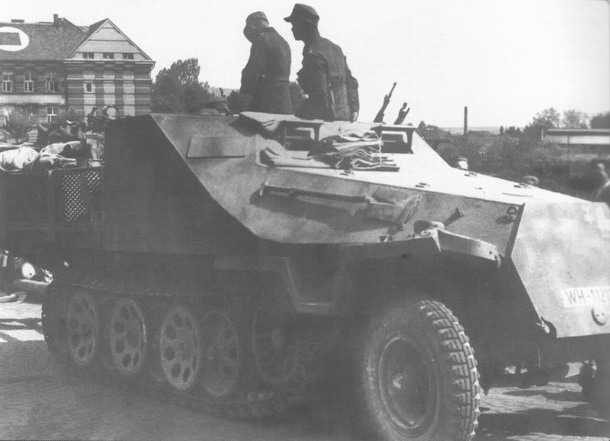
2cm Flak 38 auf Selbstfahrlafette Zugkraftwagen 3t (Sd.Kfz. 11) without its weapon, used as a cargo carrier; source: Flickr.com, Public Domain, edited
The Armed Variants
Development of the vehicle was commissioned at the turn of 1943–44 from the Auto Union A.G. consortium of automotive companies. The order reportedly called for as many as 2,400 armoured superstructures to be produced for fitting to the half-track chassis described above. Final assembly of the vehicles was to take place in the workshops of Horch, one of the Auto Union member companies. The first five prototypes were completed in March 1944.
As already noted, the front grille and armoured engine bonnet were borrowed from the Sd.Kfz. 251 armoured personnel carrier — from the Ausf. C version for the early prototypes, and exclusively from the Ausf. D for the series production vehicles. The armour for the driver and commander's cab, however, was entirely original and differed from the Sd.Kfz. 251 armour in several respects, including the design of the vision ports and the transition from the front to the side panels. The side walls themselves were also arranged differently from the personnel carrier: they were vertical rather than angled, and extended down to approximately the midpoint of the track unit, protecting not only the driver and commander but apparently also the crew seats positioned there. Behind the armoured forward section was an open platform, protected at the sides only by low side panels filled with wire mesh, which could be folded outward to allow the gun to traverse freely. The rear wall of the platform was solid but again very low, affording the crew standing there virtually no protection. Ammunition stowage was likely located adjacent to the rear wall.
In the centre of this platform was mounted the 20 mm Flak 38 automatic anti-aircraft cannon, complete with its gun shield — which represented practically the only protection available to the crew. The mounting allowed full 360-degree traverse. The gun's theoretical rate of fire was up to 480 rounds per minute, though in practice only around 220 rounds per minute was achievable. Effective engagement ceiling was 2,200 metres. The fighting platform extended quite noticeably rearward beyond the track unit, which allowed the gun to be positioned far enough back that seats for the gun crew could be accommodated ahead of it, within the armoured section.
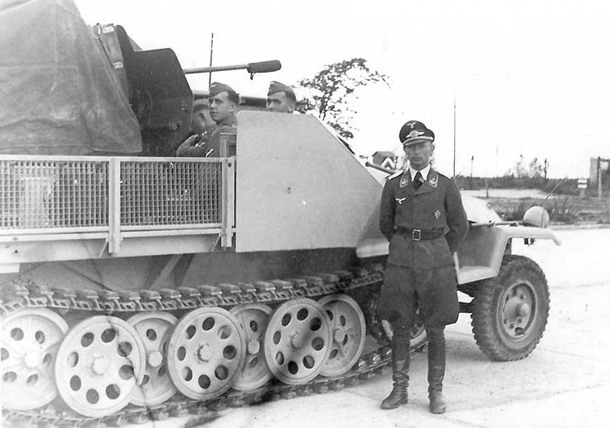
2cm Flak 38 auf Selbstfahrlafette Zugkraftwagen 3t (Sd.Kfz. 11); source: Flickr.com, used with permission of the publishing user, edited
Production of this variant continued until March 1945. Total production figures of 604 and 644 appear in different sources, though given the rarity of photographs of these vehicles both numbers seem rather high. A proportion of the vehicles were deployed without their guns and served apparently as ammunition carriers for the armed vehicles, with the guns presumably capable of being fitted fairly quickly if the need arose — for instance if another armed vehicle in the unit suffered a catastrophic breakdown. Photographs clearly confirm that this variant of the Sd.Kfz. 11 saw service on both the Eastern and Western Fronts, with images of vehicles captured by both Soviet and American forces.
What appears to have been a field conversion saw at least one example of this half-track fitted with a triple mount of 15 mm MG 151/15 anti-aircraft machine guns. Large numbers of these originally aircraft-mounted weapons became available to other branches of the armed forces as the Luftwaffe replaced them with more powerful aircraft cannon. The German Navy had developed a mount for three of these weapons linked together, known as the Flakdrilling Sockellafette. A single MG 151/15 was certainly no more effective than the standard Flak 38, but combining three of them produced a quite extraordinary rate of fire: each of the three barrels fired at approximately 700 rounds per minute, giving the entire triple mount a theoretical output of up to 2,100 rounds per minute — literally burying the enemy in lead. This made the assembly highly effective not only against low-flying aircraft but against ground targets as well.
The entire mount stood on a tall rotating conical pedestal, requiring the gunner to operate the weapon standing up. A large armour plate was fixed to the front of the mount to afford the standing soldier at least some protection. Large belt-feed ammunition boxes were suspended from the front and sides of the pedestal.
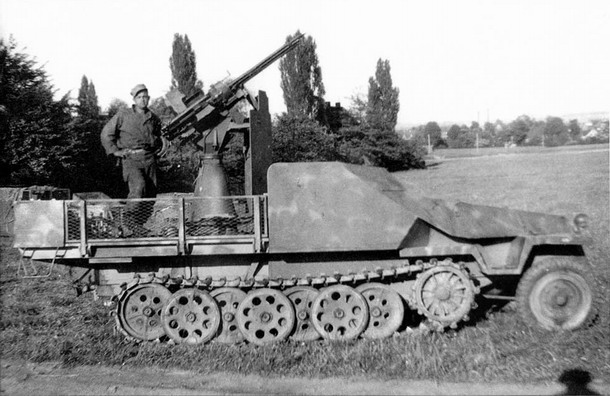
what appears to be a field conversion rearmed with a triple mount of MG 151/15 anti-aircraft machine guns; source: Flickr.com, Public Domain, edited
In closing, I must admit that I find it somewhat puzzling what led the Germans to develop a self-propelled Flak 38 on the Sd.Kfz. 11 chassis. By the time the project was launched, the Army already had the Sd.Kfz. 251/17 — a vehicle virtually identical in combat value. The only advantage the Sd.Kfz. 11-based vehicle may have offered was a lower unit cost, achieved through only partial armour coverage of the hull.
ARTICLE
CONTENTS:
Reproducing text from the Panzernet website without the written consent of the operator is prohibited.