FLAMMPANZER I
a fiery improvisation from field workshops
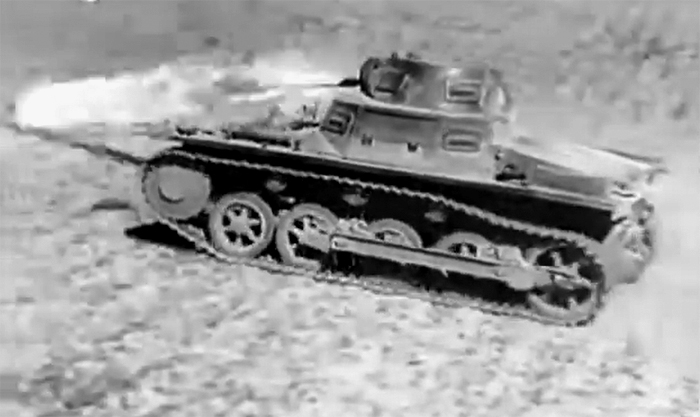
flamethrower conversion of a Panzer I Ausf. A carried out by Spanish Nationalists during the Civil War against the Republicans, seen here during exercises in 1937, source: Flickr.com, edited
Let us state from the outset that no official flamethrower tank based on the light Panzer I ever existed. However, three unofficial flamethrower conversions were produced. Two of them were the work of Nationalist forces fighting under General Franco in the Spanish Civil War, while the third was born in one of the German Afrikakorps' field workshops. Independently of one another, soldiers of two different nations, on two different continents, in two different decades and two different wars, arrived at the idea of converting the Panzer I into a flamethrower tank. Let us take it chronologically and begin in Spain.
The Spanish Flammpanzer
In the Spanish Civil War, which lasted from 1936 to 1939, the Nationalists – supported by Hitler's Germany – faced the Republicans, who were backed in turn by Stalin's USSR. Among other military aid, the Germans sent to Spain a total of more than a hundred light Panzer I tanks, both the Ausf. A and Ausf. B variants. Beyond this, the Spanish received from their German allies a range of aircraft, artillery and other materiel, including the Flammenwerfer 35 portable flamethrower.
In an effort to obtain a fighting vehicle capable of destroying enemy fortifications, the Spanish soldiers decided to experimentally fit two of these flamethrowers into Panzer I tanks in place of their standard armament. The standard Panzer I was armed only with machine guns, which were of course of limited use against fortified positions. Very little is known about the conversions that were carried out. In one case the flamethrower was fitted into an Ausf. A, and in the other into an Ausf. B.
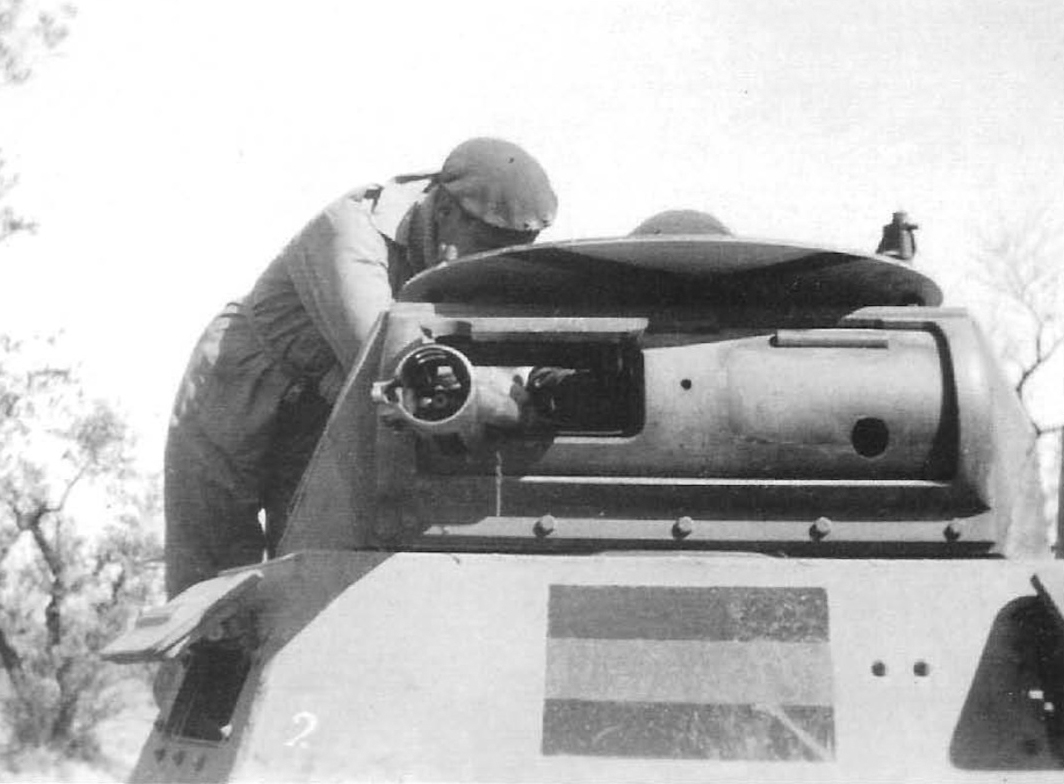
Spain again, but this time a flamethrower conversion of a Panzer I Ausf. B, source: Flickr.com, edited
The conversion of a standard tank into a flamethrower vehicle was fairly straightforward. The portable Flammenwerfer 35 was simply secured inside the hull and its lance (the flame projector barrel) routed through an opening in the front face of the turret in place of the original machine gun. In both cases the flamethrower replaced the right-hand gun of the twin machine gun installation, which makes logical sense. The driver sat on the left side of the hull, so the flamethrower had to be stowed on the right to avoid obstructing him. The flamethrower fitted in the Ausf. A received a long, narrow lance, and the left-hand machine gun beside it was retained. The flamethrower in the Ausf. B, by contrast, had a short barrel protected by a wide perforated tube, and the left-hand machine gun appears to have been removed entirely.
The Flammenwerfer 35 was most likely installed in the vehicle's interior without any major modifications, meaning its basic performance characteristics remained unchanged. The Flammenwerfer 35 consisted of two containers. The larger one held 11.8 litres of an incendiary substance called Flammöl – a mixture of petrol and tar. The smaller container held highly pressurised nitrogen, which served as the propellant for the incendiary mixture. The standard Flammenwerfer 35 weighed more than 35 kg, making it portable in principle, though carrying it was genuinely hard work. The fuel supply was sufficient for one long burst of 10 seconds or up to 15 short one-second bursts. The effective range of the flamethrower was between 25 and 30 metres.
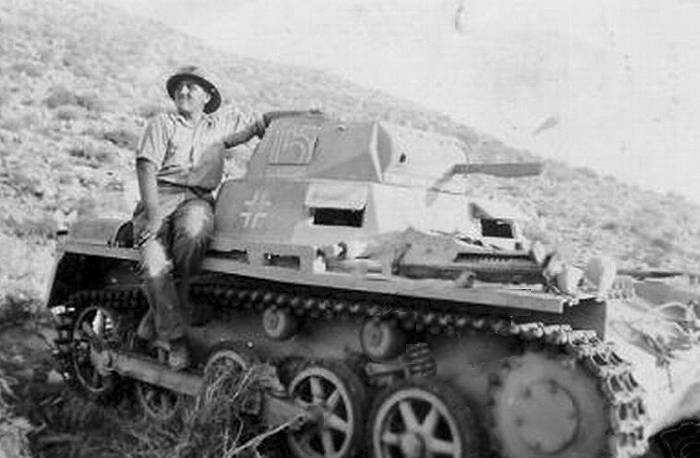
Panzer I Ausf. A converted into a flamethrower carrier by Afrikakorps units; the shape of the lance suggests a portable Flammenwerfer 40 was installed in the vehicle, source: Flickr.com, edited
The Spanish apparently used the designation Panzer I Lanzallamas (Spanish for flamethrower) for these vehicles. The exact date of their construction is not known, but according to some authors at least the Ausf. A-based vehicle is captured in film footage dated to November 1937. Most sources agree that the Nationalists never actually committed these flamethrower tanks to combat, and that the project was more of an experiment intended to test their practical viability.
The experimental installation of a flamethrower in a Panzer I was also mentioned in a report on lessons learned from the Spanish Civil War, prepared for the German General Staff at the end of March 1939. The report noted that fitting the lance of a portable flamethrower in place of a standard machine gun had been technically very straightforward and trouble-free. At the same time, however, it identified the vehicle's very limited effective range as a fundamental shortcoming.
Flammpanzer for the Afrikakorps
An almost identical conversion of the Panzer I was carried out again several years later, this time in North Africa in the workshops of the 5th Tank Regiment. The Ausf. A was used as the basis. Only two surviving photographs of this vehicle are known to exist. From these it is clear that the vehicle bore the turret number R15, suggesting it was most likely originally a regimental headquarters tank (see the article on turret numbers). Just as the Spanish had done years earlier, the Germans were trying to obtain a fighting vehicle capable of destroying enemy fortifications – or more precisely, the occupants inside them. Their specific intention was apparently to use the flamethrower tank against the concrete bunkers around Tobruk.
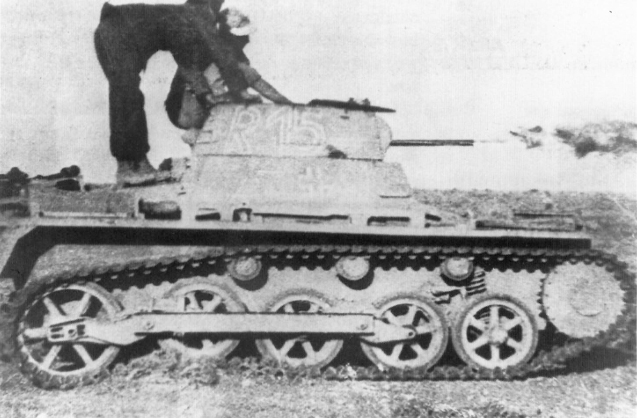
the flamethrower Panzer I Ausf. A in North Africa again; in this photograph the lance looks different from the previous image – was the flamethrower perhaps replaced with a newer Flammenwerfer 41 type? source: Flickr.com, edited
Sources generally state that a Flammenwerfer 40 portable flamethrower was installed in the tank. This weapon was developed as a modernisation of the German flamethrower from the First World War, but owing to negative operational experience it saw only limited adoption. It is true that the shape of the lance in one of the two available photographs of the flamethrower Panzer I matches the shape of the Flammenwerfer 40's lance (i.e. widening towards the bottom). The second photograph of the vehicle, however, shows a lance without this widening. It is therefore possible that the soldiers experimented with a different type of flamethrower, or replaced the original Flammenwerfer 40 lance with some other tube. Also worth noting is the fact that in the North African Flammpanzer the flamethrower was installed in place of the left-hand machine gun – the opposite of both Spanish versions.
Whatever type of portable flamethrower was installed – Flammenwerfer 35, Flammenwerfer 40, or even Flammenwerfer 41 – its effective range remained around 25 to 30 metres. Whether the Germans ever actually committed this vehicle to combat is not clear from the available literature.

ARTICLE
CONTENTS:
Reproducing text from the Panzernet website without the written consent of the operator is prohibited.