PANZER B2 (FLAMM)
flame conversion of a French tank
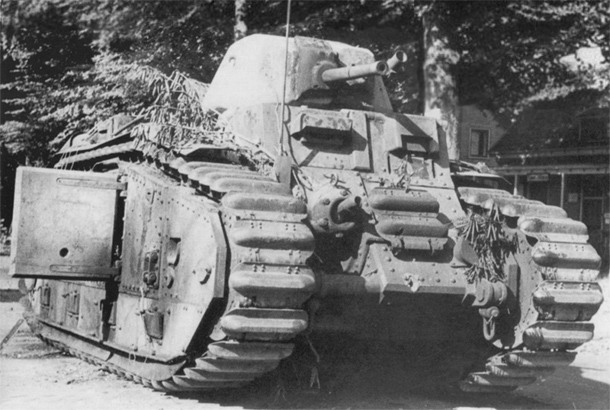
a production-series PzKpfw B2 (Flamm) flame tank, knocked out somewhere in the vicinity of Arnhem in September 1944; source: Flickr.com, Public domain, edited
The French Char B1 bis
Among the equipment that fell into German hands following the French capitulation were 161 heavy tanks of the Char B1 bis type. This design had been in development since the 1920s, first as the Char B1 and later in the improved Char B1 bis variant. The tank carried two guns: the more powerful one, a 75 mm weapon, was mounted in the hull and was intended to destroy enemy fortifications, while a 47 mm gun in the rotating turret dealt with enemy armour. The designers also provided for strong frontal armour – 40 mm on the original Char B1 and a full 60 mm on the Char B1 bis. Overall, however, it was a highly complex and extremely expensive vehicle to produce. Nevertheless, before the Second World War the French embarked on what can only be described as mass production: an astonishing 1,144 were ordered, and 369 had been delivered to the army by the time of the German invasion in May 1940.
For German tanks, this heavily armoured vehicle was a genuinely tough opponent, yet the French lost enormous numbers of them through entirely avoidable mistakes – above all through poor logistics. French crews frequently abandoned their vehicles or blew them up simply because they had run out of fuel or ammunition. The Germans did press the captured serviceable tanks into their own use, under the designation Panzerkampfwagen B2 740(f), but were not particularly enthusiastic about them and used them primarily for training rather than with front-line units. The Char B1 bis had almost nothing that the Germans valued in a tank: it was rather slow, its turret had room for only one man, and the hull-mounted 75 mm gun could traverse just one degree to either side, which severely limited its practical usefulness. The 47 mm gun in the rotating turret was not especially powerful either. The only feature the Germans considered an asset was the already-mentioned strong frontal armour, and they decided to make use of it.
Conversion Proposal
In March 1941, Hitler ordered the ordnance office to analyse the possibility of converting the Panzerkampfwagen B2 740(f) into a self-propelled flamethrower capable of "clearing" enemy bunkers and fortifications. For such a role the strong frontal armour was very well suited, since a flame tank had to approach its target to within a matter of tens of metres. The ordnance office commissioned Daimler-Benz to study two possible solutions. In the first, the flamethrower would be installed in place of the hull 75 mm gun while the turret 47 mm gun was retained. In the second, the flamethrower would be placed in the turret instead, and the hull 75 mm gun would be replaced by a German weapon of the same calibre but with a greater arc of traverse.
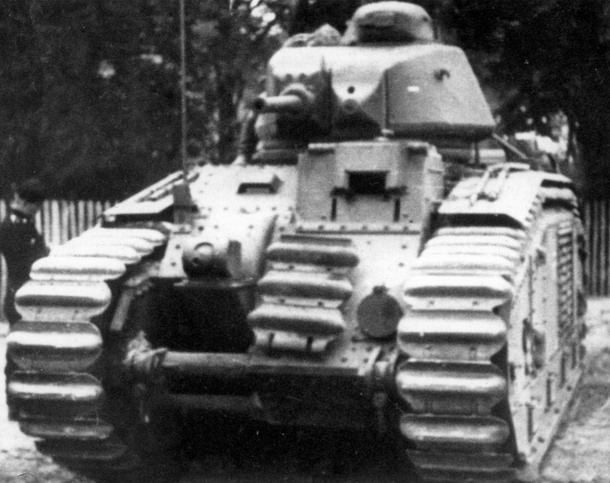
PzKpfw B2 (Flamm) in the interim version produced by Wegmann, fitted with the small flame turret taken from the Flammpanzer II tank; source: Flickr.com with permission of the publishing user, edited
The analysis, completed in early April 1941, concluded that it was technically impossible to fit the flamethrower in the turret – it could only go in the hull – and the decision was made accordingly. Daimler-Benz also declared, however, that it was unable to carry out the conversion of the French tanks without disrupting work on other projects for the German army. The ordnance office therefore transferred further work to the Wegmann company in Kassel, though Daimler-Benz was to complete the design drawings for the new armoured components. These new components consisted primarily of a ball mount for the flamethrower barrel, a raised fighting compartment front plate with a vision port for the operator, and an armoured cover for the fuel tank to be mounted at the rear of the hull.
Interim Solution
Further detailed negotiations between Daimler-Benz and the ordnance office meant the drawings for the new components were not finalised until 19 May 1941. It soon became clear, however, that Deutsche Edelstahl Werke (D.E.W.), the firm tasked with manufacturing the new parts, would be unable to meet the required delivery schedule. Hitler had demanded that the first flame tanks be completed by early June 1941, in time to take part in the attack on the USSR. D.E.W. informed the ordnance office representatives that after receiving the drawings it would need several weeks to set up its production equipment.
The only way to meet the deadline was to come up with a simpler interim technical solution – a Zwischenlösung – as quickly as possible. The ordnance office therefore turned immediately to Wegmann and Koebe (who was to supply the flamethrower itself) and asked for their proposals. The Koebe firm from Luckenwalde put forward a design that placed simplicity and speed firmly above everything else: a fixed flamethrower barrel would simply be inserted into the aperture left by the original French 75 mm gun, with aiming handled by the driver steering the whole tank. Inside the vehicle, two tanks holding a combined total of 500 litres of fuel, a centrifugal pump, and a small petrol engine to drive it would be installed. The proposal promised up to 200 bursts with a range of 40 to 45 metres.
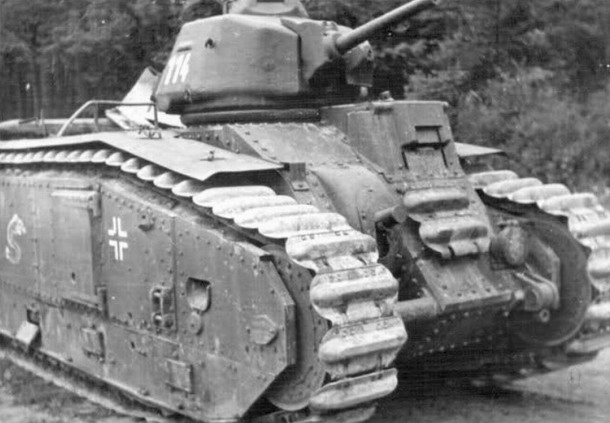
PzKpfw B2 (Flamm) in the interim version by Koebe; in this variant the flamethrower barrel could not be traversed independently; source: Flickr.com with permission of the publishing user, edited
The second interim solution, proposed by Wegmann, involved using existing components from the PzKpfw II (Flamm) flame tank. In place of the original gun, a small rotating sub-turret with a flamethrower nozzle would be fitted, meaning the gunner could aim by traversing the sub-turret rather than having to steer the entire tank. The gunner would use a simple vision port cut into the front armour plate. The internal flamethrower system was also to be taken from the PzKpfw II (Flamm) and comprised a 160-litre tank of Flammöl fuel mixture, two nitrogen pressure cylinders used as the propellant, and an acetylene cylinder for ignition. This arrangement allowed 80 bursts to a range of 30 metres.
Each of these solutions had its advantages and drawbacks, but for the ordnance office the overriding priority was time, so it decided to accept both proposals and tasked each firm with producing 12 flame tanks. The first 24 vehicles – designated PzKpfw B2 (Flamm) – were completed as so-called Zwischenlösung vehicles at the turn of May and June 1941, in both configurations described above. The sources do not make clear exactly where the conversions took place, but in all likelihood it was at the workshops of both firms involved – Wegmann in Kassel and Koebe in Luckenwalde (and it really is Koebe, not Köbe – see the firm's own sign for yourself; the company otherwise manufactured motorised fire pumps). In any case, each tank underwent a full overhaul before conversion, carried out by the so-called "Instandsetzung-Kommando Daimler-Benz Paris" at the Renault factory in Boulogne-Billancourt.
Production Series
The original Daimler-Benz design nonetheless remained the target solution, and D.E.W. had in the meantime been working on manufacturing the new armoured components it required. The first five production-series flame tanks were finally accepted by the army in November 1941, with deliveries continuing in relatively small numbers throughout 1942. A total of 60 production-series PzKpfw B2 (Flamm) were eventually built. On these vehicles the flamethrower barrel was installed in a ball mount, protected on the outside by a bolted cast flange. The operator's fighting compartment received a new, raised front plate with a vision port fitted with an armoured shutter (all three installation methods can be compared in the photograph HERE). The fuel tank was located in the rear of the hull, protected by a new section of armour plate. The flamethrower continued to be supplied by Koebe of Luckenwalde. As with the interim Koebe solution described above, the fuel was pumped by a high-capacity centrifugal pump driven by a twin-cylinder petrol engine, the J10.
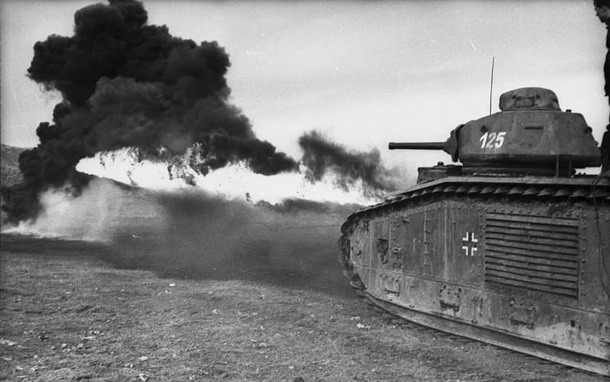
PzKpfw B2 (Flamm) in action; source: Bundesarchiv Bild 101I-708-0293-14, Wikimedia, Creative Commons, edited
Vehicle Description
The basic technical specifications of the PzKpfw B2 (Flamm) were almost certainly very similar to those of the original French Char B1 bis. In the case of weight, however, some sources suggest the conversion added 3 tonnes – which apparently also contributed to the vehicle's later mechanical troubles in service. The original Char B1 bis weighed approximately 31.5 tonnes, so if this increase is correct the resulting weight would have been around 34.5 tonnes. If we assume that removing the 75 mm gun together with its ammunition and installing the flamethrower together with its fuel tank was more or less a weight-neutral operation, then the increase would be accounted for by the additional armour fitted to the front and, above all, the rear of the hull – which would mean the weight gain applied only to the production-series vehicles.
Whatever the exact weight, the overall dimensions of the vehicle were almost certainly very close to those of the original Char B1 bis (save perhaps for a minor increase in length due to the fuel tank and its armoured cover added at the rear of the hull). That means a length of approximately 6.37 m, a width of 2.46 m, and a height of 2.79 m. As is clear, this was a truly enormous machine, and one glance was enough to confirm that its design had begun back in 1921 – the long tracks running around the full length of the hull sides, the complex running gear made up of a large number of small wheels, riveted rather than welded construction, and so on. The vehicle was powered by a Renault petrol engine producing 309 horsepower, connected to a gearbox with five forward gears and one reverse. Maximum speed on a road was 25 km/h, though the typical cross-country speed was considerably lower.
Organisation and Deployment
The first 24 flame tanks, built as the interim solution, were concentrated into the newly formed Panzer Abteilung (F) 102. The battalion was not fully equipped until 20 June 1941 – just two days before the launch of Operation Barbarossa. It was immediately dispatched to south-eastern Poland to join the 24th Infantry Division, which was part of the German 17th Army. Together with that division, the battalion was to advance roughly in the direction of Tomaszów Lubelski in Poland towards the Soviet (today Ukrainian) city of Rava-Ruska. Along this axis the Germans had to break through the fortifications of the so-called Molotov defensive line, and it was precisely for this purpose that the PzKpfw B2 (Flamm) was called upon. On the first day the flame tanks did succeed in destroying one Soviet bunker – but that was effectively the end of their achievements.
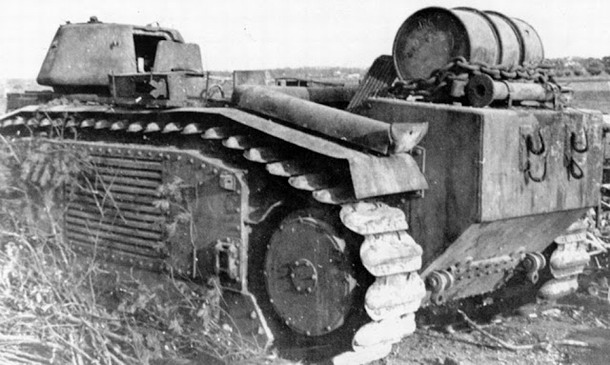
the production-series PzKpfw B2 (Flamm) had its fuel tank housed in the rear of the hull beneath additional armour plating (we are not referring to the barrel in the photograph, but to the angular "box" beneath it); source: Flickr.com with permission of the publishing user, edited
The following day the battalion was transferred to the 296th Infantry Division to help it break through a belt of bunkers around Wielki Dział hill – a task that proved beyond its capability. After several days of unsuccessful attempts to destroy the Soviet fortifications, mechanical breakdowns began to appear with increasing frequency among the flame tanks, and two of them may even have been destroyed by the enemy. The Soviet fortifications were ultimately taken with the help of artillery, and the remaining PzKpfw B2 (Flamm) vehicles were able to continue eastward with the rest of the 17th Army's formations. They appear to have played no further part in the fighting. As the kilometres accumulated, so did the technical problems and breakdowns, until at the end of July 1941 a decision was made to withdraw the battalion from combat and disband it entirely. The tanks were subsequently sent to the Renault factory in Boulogne-Billancourt, where they most likely spent the remainder of the war in France.
The later-produced 60 "series" PzKpfw B2 (Flamm) vehicles were distributed among several different units serving on both the Eastern and Western Fronts. Twelve of them, with Panzer Kompanie 223, even made it to the Crimea, where they took an active part in the siege of Sevastopol. Once again, however, they proved to be unreliable fighting machines requiring constant maintenance. Some PzKpfw B2 (Flamm) vehicles also certainly saw action against the Allies in the summer and autumn of 1944.
ARTICLE
CONTENTS:
Reproducing text from the Panzernet website without the written consent of the operator is prohibited.