FLAKWAGEN VOMAG
an anti-aircraft gun on a bus chassis
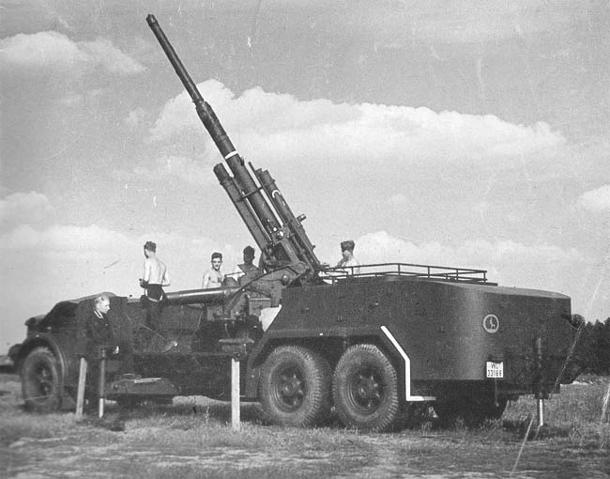
self-propelled anti-aircraft gun on the VOMAG 7 OR 660 bus chassis, source: Flickr.com with the permission of the publishing user, edited
The VOMAG company
What could lace-making, a bus and an 88 mm anti-aircraft gun possibly have in common? That is precisely what the following lines will tell you. The combat vehicle we are about to describe bore the official designation Selbstfahrlafette auf Fahrgestell VOMAG 7 OR 660 mit 8,8 cm Flak. Among other things, this name reveals that the vehicle's origins lay with the VOMAG company from the Saxon town of Plauen. At the turn of the nineteenth and twentieth centuries, Plauen was a centre of lace and embroidery production — Plauen lace was a byword for quality at the time — and it was this regional tradition that gave rise to the firm Vogtländische Maschinenfabrik AG, or VOMAG for short. The company manufactured and repaired the knitting and embroidery machines on which its customers created their lace and needlework.
During the First World War, VOMAG became significantly involved in military supply contracts, including the manufacture of lorries. After the war the company continued in this field and expanded its production to include buses as well, and the business flourished — until the Great Depression swept fully across Europe from the United States and VOMAG effectively went bankrupt in 1932. The rise of the Nazis to power and their massive investment in transport, infrastructure and the armed forces literally resuscitated the company, enabling it to resume production of both lorries and buses.
The VOMAG 7 OR 660 bus
One of the highlights of the company's production programme became, in 1935, the high-capacity VOMAG 7 OR 660 bus. Three axles, a weight of 7.15 tonnes, a payload of around 9 tonnes, a passenger capacity of 40 to 60, a diesel engine developing 150 horsepower and a maximum speed of up to 90 km/h. Over the following years VOMAG built just over 50 of these buses for various intercity transport operators, but above all for the Reichspost — the German national postal service. And it was the Reichspost that, after the outbreak of the Second World War, handed a number of these buses over to the army for use in transporting troops away from combat areas.
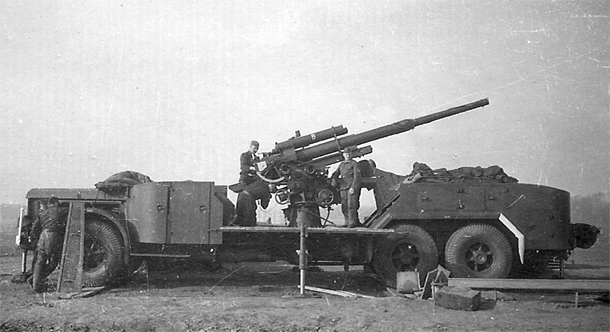
Selbstfahrlafette auf Fahrgestell VOMAG 7 OR 660 mit 8,8 cm Flak ready for action, source: panzerserra.blogspot.com, edited
Conversion to a Flakwagen
VOMAG began work on converting the bus described above into a carrier for the 88 mm anti-aircraft gun at the beginning of 1940. According to most sources, this was done on the order of Hitler's escort battalion, the Führer-Begleit-Bataillon. The vehicles were reportedly intended to provide air defence for the Führer's convoy during his travels. Given the armament chosen, it was clearly not intended as conventional close-range convoy protection against low-flying enemy ground-attack aircraft. Anti-aircraft guns of 88 mm calibre were designed to destroy high-flying targets — and the time required to deploy them, prepare for action and aim them reflected this. It can therefore be assumed that the vehicles were intended primarily to protect Hitler's temporary field headquarters during overland movements — in short, whenever the Führer's convoy stopped for an extended period, the vehicles were to be deployed nearby to screen the location against possible high-altitude air attack.
Vehicle description
As part of the conversion the vehicle was shortened. The exact extent of the shortening is unfortunately not stated in the literature, but a comparison of photographs of the original bus and the converted vehicle suggests something in the region of 2 to 3 metres. The original bus's diesel engine was apparently retained during the conversion, though the literature does not state this explicitly — nor does it specify where the engine was located, whether at the rear or at the front.
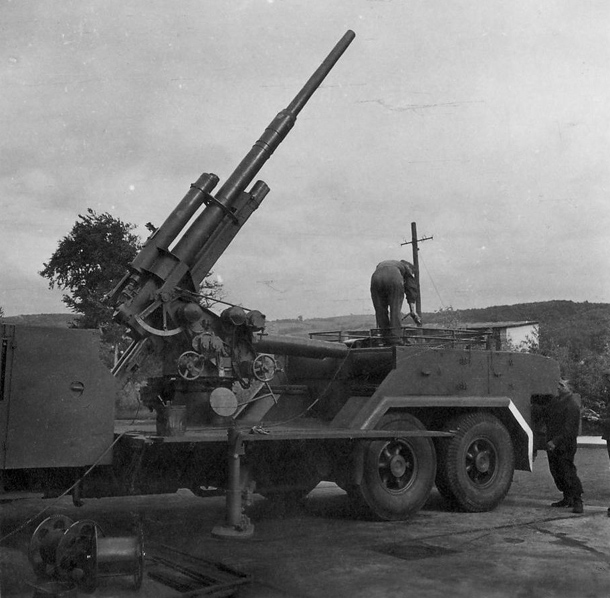
a fine view of the 88 mm Flak gun on board the VOMAG Flakwagen; note the reels of communication cable lying at the lower left, source: Flickr.com with the permission of the publishing user, edited
The rest of the vehicle, however, was changed quite fundamentally. The original bus body was effectively removed entirely and replaced by a new one that was open at the top — with the exception of the rear section. The front driver's cab received new folding windscreens and new side entry doors fitted with removable mica windows. The driver did not have his own seat but a bench, on which one or two additional men could sit beside him. Behind the backrest of this bench was a second similar bench facing rearward. On either side of this bench, additional entry doors were provided in both sides of the cab.
Further rearward came an open cargo platform with folding side walls made of wire mesh. In the centre of this platform, a Flak 36 gun of 88 mm calibre was mounted on a rotating pedestal — some sources suggest a Flak 18 barrel fitted to a Flak 36 mount was used, which is also possible. The Flak 36 (and the Flak 18 similarly) had a barrel length of 493 cm and could send a 9.4 kg shell to a maximum altitude of 9,900 metres, with an effective ceiling of 8,000 metres. When engaging aerial targets, shells with time fuzes were used so that the shell would detonate at the calculated altitude without needing to physically strike the target. The pedestal allowed full 360-degree traverse and elevation up to +85°. The gun was installed without a shield, though a shield was later added to at least some vehicles — as can be seen for example HERE and HERE.
Behind the gun, the fighting space was closed off by another bench seating three soldiers, beyond which came the enclosed rear cargo section. This contained stowage for 72 rounds of artillery ammunition and, at the very back, space for tools and various other necessary equipment including the crew's personal belongings. This rear section of the body was the only part that was fully enclosed. Despite what it may look like at first glance, the side walls of this section were certainly not carried over from the original bus body — one need only recall the shortening mentioned above, or look at the rear wheel mudguards, which are completely different from those of the original bus. According to some authors, 10 mm armour plate was used in the construction of this enclosed rear section.
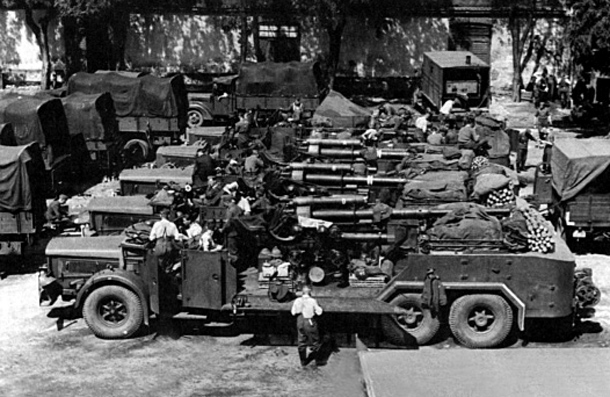
an almost complete battery of VOMAG Flakwagens; note the bundles of fascines and tarpaulins stowed at the rear, source: Flickr.com with the permission of the publishing user, edited
The roof of the ammunition compartment also served as a stowage area for various items — typically bundles of fascines used to help extract a bogged-down vehicle, and a large waterproof tarpaulin with which the entire open cab and gun could be covered in bad weather. Two reels of communication cable could be hung on the rear wall of the vehicle, providing the connection between the gun and the fire-control computer (more on that shortly). With its armament, 72 rounds of ammunition, 400 litres of diesel and all other cargo on board, the vehicle weighed approximately 19 tonnes.
Before opening fire, the crew folded down the wire-mesh side walls alongside the gun to the horizontal position, substantially increasing the working area around the weapon. Preparation for firing also involved deploying four stabilising outriggers — one at the front, one at the rear and one on each side of the vehicle. If the ground was soft, the crew would also place wooden boards under the wheels. If the gun battery was preparing for coordinated fire, the two communication cables were connected to the fire-control and directing vehicle.
Fire-control variant
As mentioned above, some of the original buses were converted not into combat vehicles but into fire-control vehicles known as Flakmesstruppkraftwagen. Instead of a gun, these vehicles carried the sophisticated equipment known as the Kommandogerät 40 — a combination of the Em4mR40 stereoscopic rangefinder with its 4-metre tube and an analogue computer that processed target observations into firing instructions for the individual guns in the battery. The complete equipment weighed 1,600 kg and required a crew of five specially trained soldiers. In return, it was capable of transmitting reasonably accurate aiming instructions to each gun via communication cable, for targets flying at altitudes of up to 12 kilometres — though the 88 mm Flak could not actually reach that high 😊.
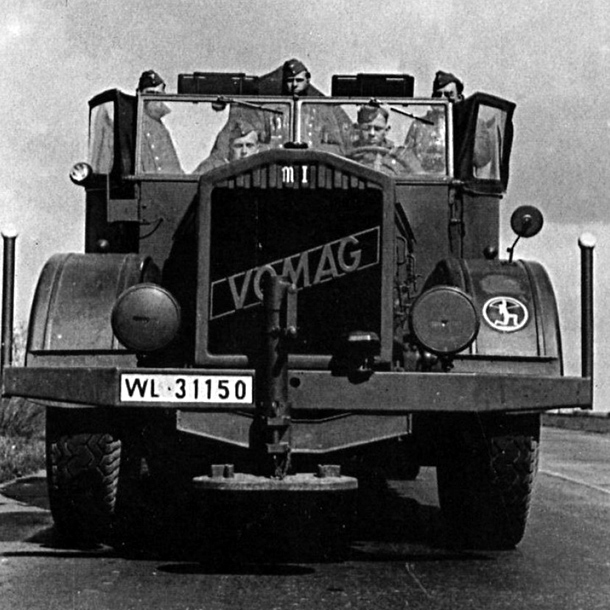
a fine front view of the VOMAG Flakwagen; the badge of the 1st Battalion of Flak-Regiment 42 is clearly visible on the left mudguard — a kneeling archer shooting skyward; note also the front stabilising outrigger, source: Flickr.com with the permission of the publishing user, edited
Three sets of data were transmitted: the direction of fire, the barrel elevation angle and the time-fuze delay for the shells. The required vertical and horizontal barrel position was displayed on each gun by what we might call a forerunner of the display screen — the so-called Lampenempfänger (photo HERE). The crew of each gun then simply adjusted the weapon to the indicated position. The required fuze delay was set automatically when the round was inserted into a dedicated device that was part of every gun (photo HERE). After that, the crew simply loaded and fired. The entire battery of guns would then engage the same target simultaneously. For even more precise location of aerial targets, the battery was equipped with a small mobile Würzburg radar (photo HERE). For completeness, it should be added that the fire-control Flakmesstruppkraftwagen did not have an enclosed ammunition and cargo section at the rear, but only an open loading platform.
Organisation and deployment
As noted above, the 88 mm Flak guns on the VOMAG 7 OR 660 chassis were originally ordered as air defence for Hitler's escort battalion, the Führer-Begleit-Bataillon. By the time these self-propelled weapons were ready, however, much had changed. In the intervening period the Germans had conquered the Benelux countries and France in a lightning campaign, and there was now no adversary left in Europe close enough for the Führer to travel to by land to be with his troops. All future objectives of German military operations were simply too far away for overland travel — Greece, Great Britain, the USSR, North Africa. If Hitler were to go anywhere in future, it would in all likelihood be by air, making the mobile escort battery of self-propelled anti-aircraft guns suddenly redundant.
All the combat vehicles of this type that had been built were therefore taken over in April 1941 by the newly formed anti-aircraft regiment Flak-Regiment 42 (mot.) from Berlin — mot. standing for motorisiert (motorised). More precisely, they were taken over by the 1st Battalion (Abteilung) of this regiment, as no further battalions existed at that time — they were added considerably later. The unit was effectively tasked with testing the new weapon in operational conditions, and for this reason was also sometimes referred to as Versuchsabteilung für 8,8 cm Flak (Sf.) — the trials battalion for self-propelled 88 mm anti-aircraft guns.
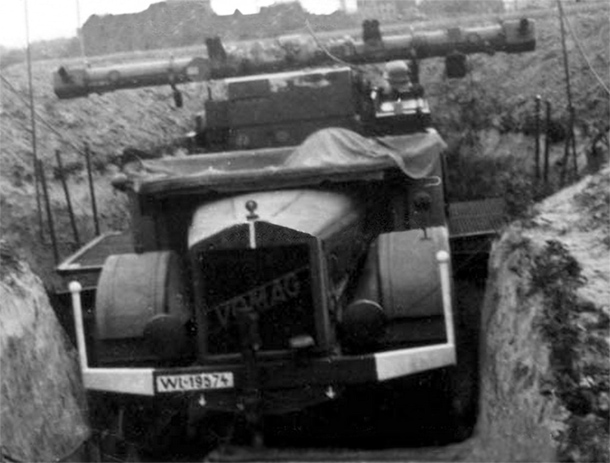
the fire-control vehicle Flakmesstruppkraftwagen "armed" with the Kommandogerät 40, which combined a large coincidence rangefinder with a complex analogue computer, source: panzerserra.blogspot.com, edited
The battalion comprised three batteries. Each received 4 combat vehicles, 2 fire-control and command vehicles and 2 reserve unarmed vehicles — 24 vehicles in total. At some point in 1943, the 6 reserve vehicles from all three batteries were combined to form a new fourth battery. The battalion subsequently travelled the length and breadth of Germany, helping to reinforce air defences wherever Allied bombing raids posed the greatest threat. According to some sources, the battalion was to be sent to Budapest in May 1944. Other sources place it in Romania from August 1944, with the move to Budapest following thereafter. And it was in Budapest that the entire battalion was apparently destroyed — as documented by photographs of several wrecks amid the city's buildings. So now you know what lace-making, a bus and an anti-aircraft gun have in common.

ARTICLE
CONTENTS:
Reproducing text from the Panzernet website without the written consent of the operator is prohibited.