KUGELBLITZ
an unfinished project for an advanced Flakpanzer
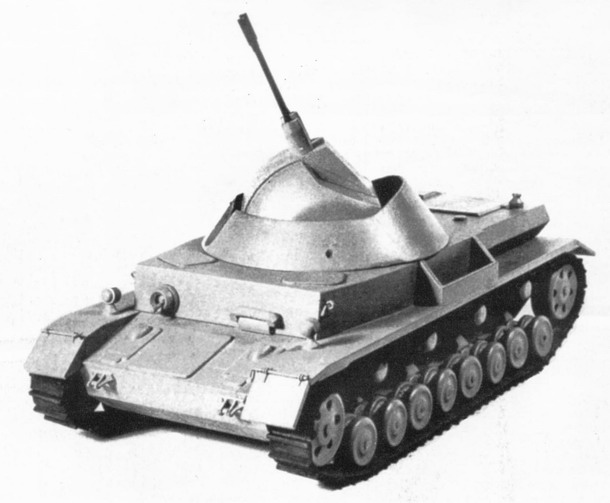
model of the Kugelblitz anti-aircraft tank, source: topwar.ru, edited
The intensive development of self-propelled anti-aircraft guns based on the proven PzKpfw IV chassis — which got under way from roughly mid-1943 and progressively gave rise to the Möbelwagen, the Wirbelwind, and the Ostwind — culminated in the creation of a highly advanced vehicle named the Kugelblitz, meaning "ball lightning".
The core idea behind this new approach to the anti-aircraft tank was a radical reduction in the vehicle's silhouette combined with a significant improvement in passive crew protection. Development was led by Daimler-Benz, which came up with a highly original turret design. Unlike all previous vehicles of this type, the turret was fully enclosed. In shape it closely resembled a large sphere — though the portion that protruded above the hull gave little impression of this. The turret was encircled by a ring that allowed it to traverse, cut away at the front to accommodate the gun barrels in the travel position and raised at the rear. The ring was made of sloped armour 25 mm thick.
The walls of the spherical turret itself were likewise 25 mm thick. In its upper surface were hatches for the vehicle commander and the two-man gun crew — the gunner and the loader. The commander sat behind the gun on its axis, the gunner to the left and the loader to the right of the weapon, each with their own hatch above them. The turret was power-traversed via a hydraulic system at a rate of 60° per second.
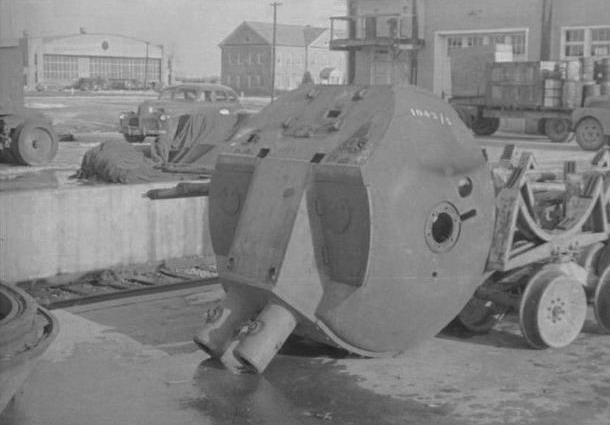
the Kugelblitz turret as the Allies found it in a factory yard; on the ground to the left what appears to be a section of the turret ring is visible, source: internet, Public domain, edited
The vehicle's main armament consisted of two automatic aircraft cannons, the Mk 103, calibre 30 mm, originally developed for Luftwaffe fighter aircraft. For the Kugelblitz the guns were modified by Rheinmetall, with the barrel extended to 2.3 metres, among other changes. This modified version received the designation 3cm Flak 103/38 Jaboschreck — meaning "the terror of fighter-bombers". The vehicle carried two guns mounted side by side in a single plane. The cannons had a rate of fire of 650 rounds per minute, and the ammunition supply of 1,200 rounds was carried in belts. The weapon's maximum range was 5,700 metres, with an elevation arc from -7° to +80°.
The prototype of the new Flakpanzer was completed in November 1944. Hitler, shown photographs of it, was enthusiastic and demanded immediate series production — which by that point was far from straightforward. In the end, only seven vehicles were completed in January and February 1945 before further production collapsed entirely.
The completed vehicles were handed over to a test unit at Ohrdruf, which in all likelihood actually used them in combat during the final weeks of the war. It was a considerable stroke of luck for the Allied air forces that the Germans had not developed this vehicle earlier, or managed to produce it in greater numbers — it was a genuinely effective weapon that would certainly have inflicted serious losses on the enemy.
Reproducing text from the Panzernet website without the written consent of the operator is prohibited.