ERNST BARKMANN
SS-Oberscharführer, 25. 8. 1919 – 27. 6. 2009
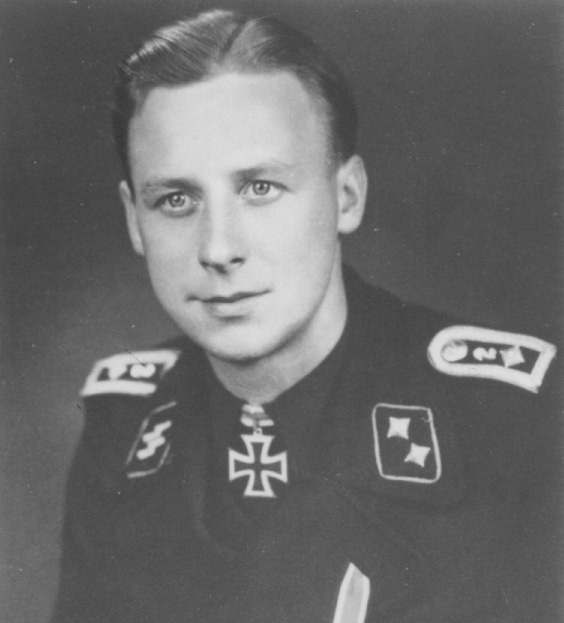
Ernst Barkmann, here holding the rank of SS-Oberscharführer; source: Tumblr.com, edited
Joining the Waffen-SS
Ernst Barkmann was born on 25 August 1919 into a farming family in the town of Kisdorf, some 30 km north of Hamburg. After completing his schooling in 1935, young Ernst joined his father in working the farm. Like many other young Germans he soon became a supporter of the new politics that Hitler's rise to power had brought, and it was no surprise that he applied to join the Waffen-SS.
On 1 April 1939 Barkmann was accepted for training with the SS-Standarte Germania regiment (some sources give April 1936 as the date of Barkmann's admission to the Waffen-SS, but as he would have been only sixteen at that time, this date is most likely incorrect). After three months of training he was posted, with the rank of SS-Mann, to the 3rd Battalion of the regiment at Radolfzell in southern Germany.
Poland, France and the Soviet Union
Before the attack on Poland, Barkmann's unit was transferred to East Prussia and assigned to the 14th Army under General Wilhelm List. He was in action from the first day of the war as a machine gunner in the 9th Company, 3rd Battalion. During the Polish campaign he was wounded and received the Wound Badge in Black. For his combat service he was promoted to SS-Rottenführer (lance corporal). In October 1939 Barkmann's regiment, SS-Standarte Germania, became part of the newly formed SS-Division Verfügungstruppe, a division built around three previously independent regiments: SS-Standarte Deutschland, Germania, and Der Führer.
In 1940 Barkmann took part in the campaign against France, which earned him the Infantry Assault Badge. From late 1940 the Verfügungstruppe division underwent reorganisation, in the course of which it was renamed first to Division Deutschland and then, in January 1941, to Division Reich. Under that name the division took part in fighting in Yugoslavia in the first half of 1941.
Still with Division Reich and as part of Army Group Centre, Barkmann joined the attack on the Soviet Union that same year. In July he was seriously wounded during fighting near Dnepropetrovsk, receiving the Silver Wound Badge and the Iron Cross Second Class. He spent the remainder of 1941 recovering. In early 1942 he was transferred to the Netherlands, where he served as an instructor for European volunteers of the Waffen-SS.
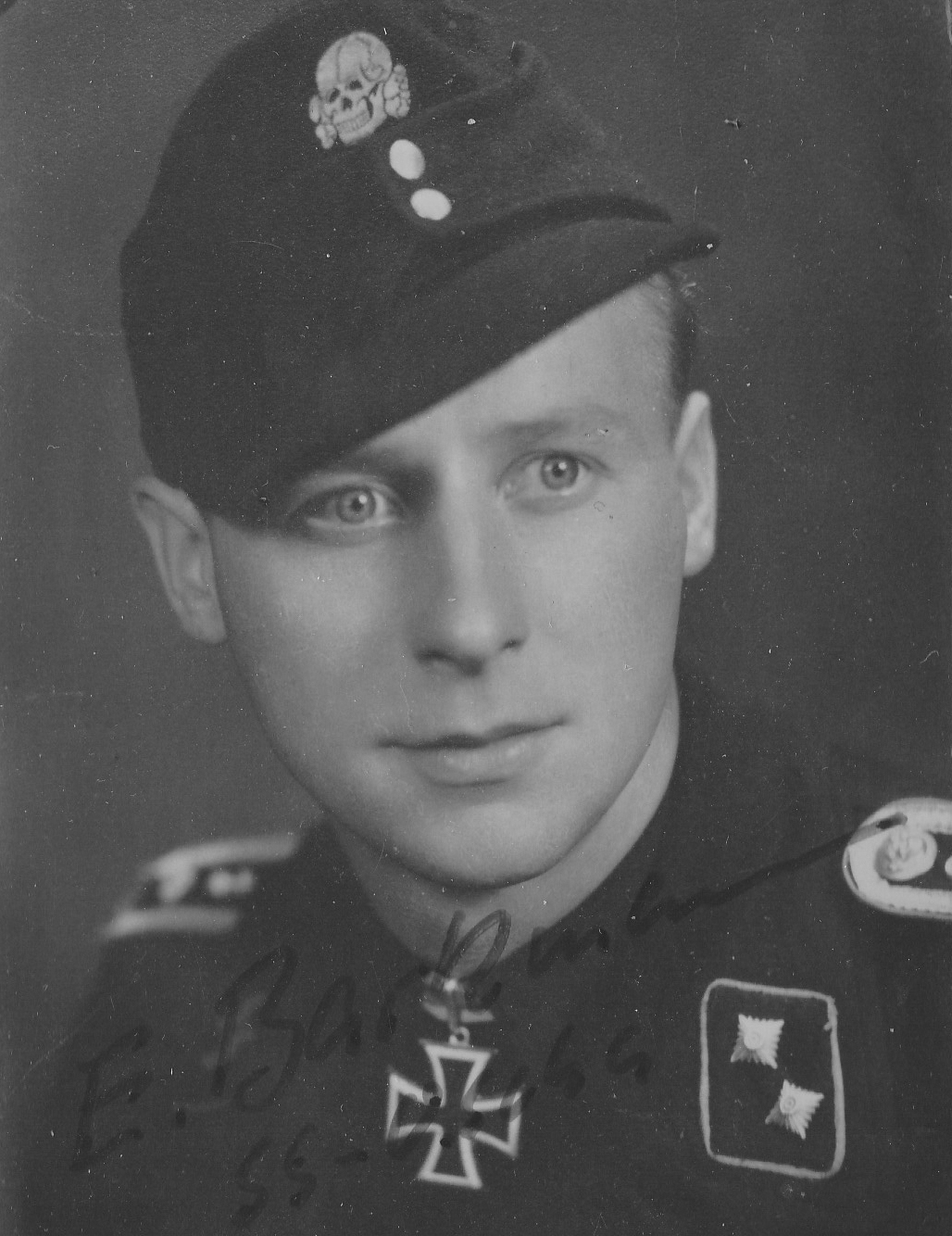
Ernst Barkmann in a portrait photograph; source: Flickr.com, edited
In the winter of 1942/43, however, he was called back to the Eastern Front to rejoin his division, which had in the meantime been reorganised again, now as the 2. SS-Panzer-Grenadier-Division Das Reich. Barkmann was assigned as a gunner in a Panzer III commanded by SS-Rottenführer Alfred Hargesheimer, serving in the 2nd Company of the division's 2nd Panzer Regiment (SS Panzer Regiment 2).
Das Reich was then assigned to the SS-Panzerkorps under Paul Hausser to support the defence of Kharkov. During the fighting in southern Russia Barkmann distinguished himself as an outstanding gunner, and on the strength of this was promoted to SS-Unterscharführer (corporal) and given command of his own Panzer III, tactical number 221. During the fighting for Kharkov he also received the Iron Cross First Class (though some sources state that this decoration came only in August 1944).
In July 1943 Barkmann and his unit took part in the gigantic operation Zitadelle, the attack on the Kursk salient. Despite every effort the operation ended in failure for the Germans, and their divisions – including Das Reich – had to withdraw. After the losses suffered at Kursk, the division was reinforced and reorganised as a full panzer division, and from November 1943 bore the name 2. SS-Panzer-Division Das Reich. Before that, in August 1943, Barkmann had been transferred to the 4th Company of the 2nd Panzer Regiment, which was now equipped with the new Panther Ausf. D tanks. Barkmann received tank number 424.
To the Western Front
Das Reich remained on the Eastern Front until January 1944. Only in early February of that year was it sent to France for rest, replenishment, and above all assignment to the so-called Panzergruppe West – a formation being assembled as a defensive reserve against the expected Allied invasion of France. Das Reich was stationed in the Bordeaux area, considerably further south than where the invasion eventually took place. Apart from minor clashes with partisans, the men enjoyed relative quiet and were able to recover from the long campaigns in the East.
On D-Day, 6 June 1944, Das Reich was ordered to remain in its area and await a possible second wave of landings. When it became clear that the main invasion was in Normandy, Das Reich received orders to move north immediately towards the newly opened front.
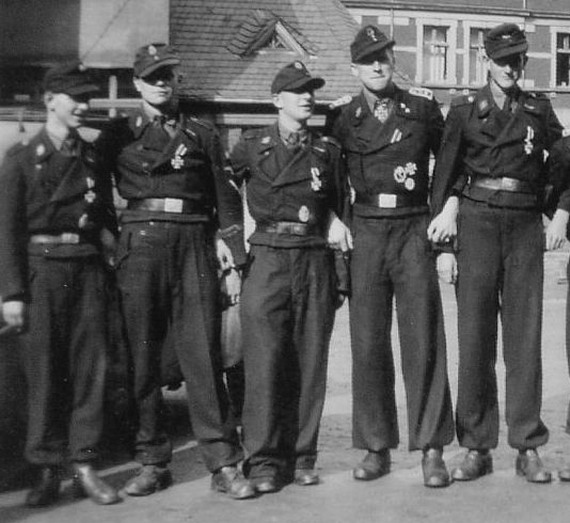
Barkmann (second from right) with his crew in France, summer 1944; source: forum.worldoftanks.ru, edited
In early July Das Reich finally arrived in the St. Lô area, where it was to engage the American 9th and 30th Infantry Divisions and the 3rd Armored Division. The Germans attacked on 8 July west of St. Lô, near the village of Saint-Sébastien. Barkmann's 4th Company led the attack with its tanks. That day Barkmann encountered American Sherman tanks for the first time and immediately succeeded in destroying one. He also had his first experience of the style of combat on the Western Front. This was not fighting across open ground at long range with enormous numbers of tanks on each side. It was fighting in confusing terrain full of woodlands, hedgerows, and villages – combat in which far fewer vehicles were engaged, giving a single tank a far greater role in the outcome of a battle.
On 12 July Barkmann's Panther destroyed two more Shermans and damaged a third. On 13 July, concealed in a camouflaged position, he destroyed two American tanks and forced four others to withdraw. Shortly afterwards he received word that the Americans had broken through at another sector and were now advancing behind the German positions. Barkmann turned his tank and set off to assess the situation. He soon encountered a group of American tanks, half-tracks, and anti-tank guns.
In the engagement that followed, Barkmann destroyed three more tanks. His tank was then hit, setting the engine on fire. The crew managed to extinguish the flames, restart the engine, and drive to safety. Barkmann's tank ended up in the repair workshop. On 14 July he was allocated a replacement vehicle and given orders to rescue four Panther tanks that had become stranded behind enemy lines. Barkmann completed the mission without loss, destroying three enemy tanks in the process.
That same day he received orders from the regimental commander, SS-Obersturmbannführer Christian Tychsen, to rescue German prisoners of war being held by the Allies approximately 800 metres behind the front line. This operation was also a complete success and the prisoners were freed – with no German losses, as the enemy fled the moment they saw Panther tanks bearing down on them at full speed over the hill.
During the fighting on 20 and 21 July Barkmann added four more American tanks to his personal tally. In the meantime his original Panther number 424 had been returned from the workshop. With the Allies' inexorable advance it was clear that Das Reich could not hold its sector, and the division was ordered to move. Barkmann was to relocate with his company to the town of Coutances.
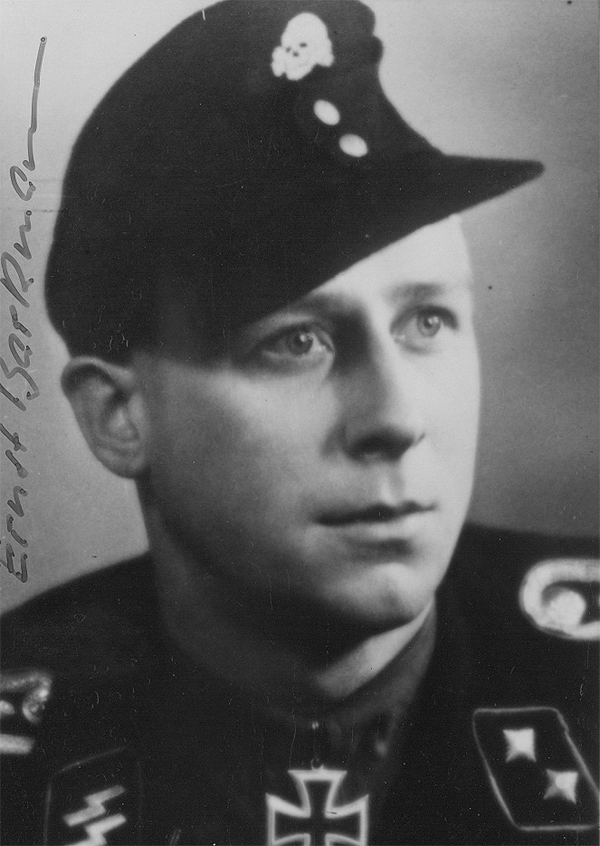
Ernst Barkmann, again holding the rank of SS-Oberscharführer; source: Tumblr.com, edited
Alone Against the Shermans
On 26 July, however, Barkmann's tank was struck in the engine by an Allied aircraft during the move and was left immobilised. The mechanics worked through the night and by the following morning had managed to get the tank running again. By then, though, Barkmann had fallen far behind the rest of his company. On the road to rejoin it, a German infantryman stopped him at the village of Le Lorey and told him that the Allies had already taken the town of Marigny and were advancing towards Coutances, cutting off his route.
Barkmann sent two members of his crew to check the situation. They returned with word of approximately 15 American Sherman tanks, along with other vehicles, moving along the St. Lô–Coutances road. Barkmann immediately found a suitable firing position some hundred metres from the road's junction, concealing his tank behind a rise in the ground and trees. When the enemy column approached he opened fire. He first knocked out the two leading tanks, then an fuel bowser truck that was following behind them, completely blocking the road for the rest of the column. Two Shermans attempted to bypass the burning wrecks but Barkmann destroyed those as well. The Panther continued to fire on the vehicles in the column as they began to reverse hastily away.
Two Sherman tanks left the road, circled around Barkmann, and attempted to attack him from the left. He spotted them, however, and destroyed both with unerring accuracy. One of the Shermans managed to fire twice at the Panther and, while it did not miss, caused no serious damage to the German vehicle.
The surprised and retreating Americans immediately called for air support. Within minutes American fighter-bombers appeared over the scene and began attacking the lone German tank. Simultaneously the Shermans pushed forward again. The aircraft's fire was initially off-target, allowing Barkmann to destroy two more Shermans. Then, however, his tank took several serious hits from the air that damaged the tracks and steering mechanism and knocked out the vehicle's internal ventilation. At that point Barkmann concluded he could hold on no longer and gave the order to withdraw. Despite its many wounds, the tank was able to move off and even destroyed one more Sherman on the way out.
Barkmann drove as far as the nearby village of Neufbourg, where he sheltered and carried out makeshift repairs to some of the damage before continuing towards Coutances. This engagement, in which Barkmann's lone Panther knocked out nine American Sherman tanks and several other vehicles, became known as "Barkmann's Corner".
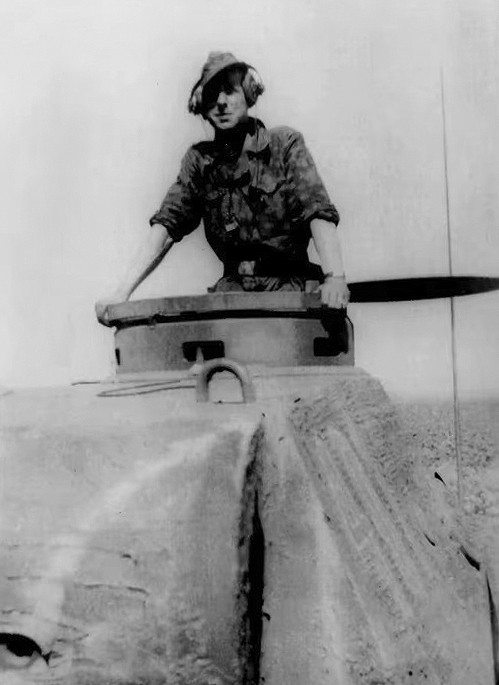
Ernst Barkmann in the commander's cupola of his Panther number 401; source: Tumblr.com, edited
Barkmann reached Coutances on 28 July, but the Americans had got there first, so he had to continue towards Avranches. He took with him another damaged Panther in tow. After some distance it became clear that both tanks could not continue like this, and the crew decided to leave the damaged vehicle behind – but first they wanted to destroy it to prevent the Allies from repairing and using it. The crew set the tank on fire. Unfortunately Barkmann's own tank also caught alight in the process, and both crews were left to continue on foot.
Barkmann thus arrived in Avranches on foot on 5 August, where he was given a tumultuous welcome by his comrades, who had already heard of his exploits. For his bravery he was recommended for the Knight's Cross, which was officially awarded on 27 August and physically presented on 5 September.
The Village of Manhay
In December 1944 Barkmann and his new tank number 401 also took part in the Ardennes offensive. On the night of 23 December, during the advance on the Belgian village of Manhay, the tanks of the 4th Company came under enemy fire and were forced to split up. Barkmann found himself alone on enemy territory once again and once again showed his nerve in such a situation. He pressed on in the assigned direction of advance, scanning for the other tanks of his unit. In the darkness of the forest he came dangerously close to mistaking an enemy Sherman for one of his own, nearly closing to a very dangerous range. Before reaching the village of Manhay he destroyed three American tanks in the forest.
Barkmann's Panther number 401 arrived in Manhay while it was still dark, to find the village full of American soldiers and tanks. Turning around to retreat or opening fire would have been suicidal, so Barkmann simply drove straight through the village as if nothing were out of the ordinary. In the darkened village, crowded with their own tanks, none of the Americans noticed one foreign machine rolling calmly along right past them.
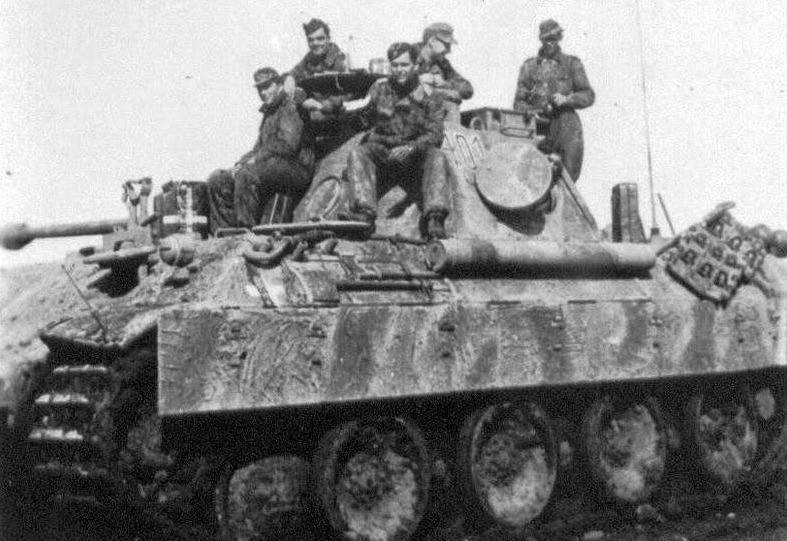
the crew of Panther number 401 – Ernst Barkmann is in the commander's cupola; source: Tumblr.com, edited
When Barkmann reached the crossroads where he was supposed to turn left and continue through Grandménil to Érezée – the 4th Company's objective – American tanks blocked the turn and he was forced to continue straight ahead. At that moment, however, this was probably the least of the crew's worries. Their main concern was to get out of the village as quickly as possible, which by Barkmann's rough estimate contained around eighty American tanks and other vehicles. The German vehicle had unwittingly found itself right in the middle of the assembly point of the American 2nd Armored Division.
Barkmann therefore continued through the village in the direction of Werbomont. When they were almost clear, a jeep appeared ahead signalling the tank to stop. The Germans could not allow this, so they drove straight at the vehicle until a collision occurred. The impact knocked the Panther off the road and into a stationary Sherman, where it became wedged with its tracks caught on the American vehicle – and to make matters worse, the engine cut out.
By now the soldiers nearby had realised an intruder was among them and opened fire with small arms. Fortunately the driver managed to restart the engine quickly, ease the tank free, and the 401 drove out of the village. Only one American crew reacted fast enough and a single Sherman set off in pursuit. The Germans knocked it out with one shot and then drove at full speed away from the village, now in uproar and confusion behind them.
A few hundred metres out, Barkmann found a suitable defensive position, stopped, and waited for the American tanks that would surely come after him. Instead, after a short while he heard the sound of fighting from the village itself, and from radio intercepts he realised that the rest of his unit was at that moment taking Manhay by storm. After the battle Barkmann was reunited with his company in the captured village, which held some twenty destroyed or abandoned American tanks. The Ardennes operation Wacht am Rhein ultimately failed, however, and the Das Reich units were forced to withdraw eastward in roughly mid-January 1945.
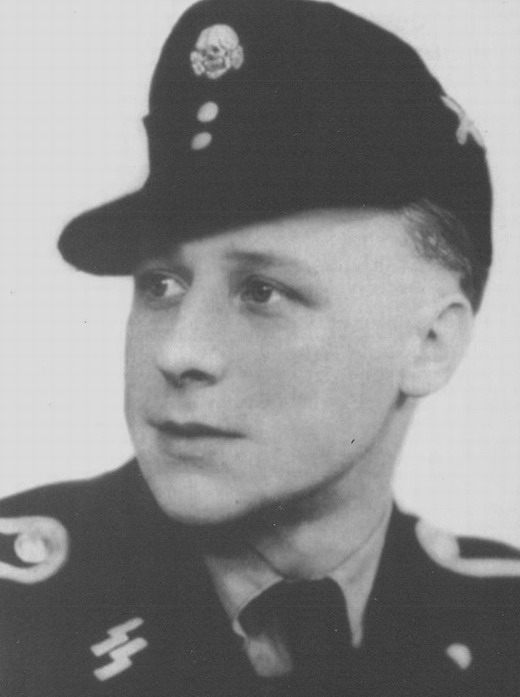
Ernst Barkmann; source: Tumblr.com, edited
In March 1945 Das Reich was fighting on the Eastern Front again, this time in Hungary as part of Operation Spring Awakening. Barkmann was specifically engaged in fighting near the town of Székesfehérvár (Stuhlweissenburg in German). With a general shortage of fuel and spare parts, the number of combat-ready tanks dwindled relentlessly. Barkmann's company was forced to merge with tanks of the 1st SS Division Leibstandarte under the command of Jochen Peiper.
The situation was untenable, the German army was in retreat, and Barkmann's 4th Company was among the units covering the withdrawal. This put it in the thickest of the fighting against overwhelming numbers of Soviet T-34 and IS tanks. Barkmann fell back with the others all the way to Vienna, where he was still in action in April. He and most of his crew were wounded during this fighting when his Panther was accidentally hit by another German unit. Barkmann finally lost his tank not in battle but in an accident, when he drove into a large bomb crater and badly damaged one of the tracks and several road wheels. The tank could not be recovered or repaired, so the crew destroyed it themselves.
The End of the War
When Ernst Barkmann surrendered to Allied soldiers on 8 May 1945 he was 25 years old, and to his credit stood 82 enemy tanks destroyed, 43 anti-tank guns, and large quantities of other equipment. Barkmann survived the war and returned to his hometown of Kisdorf, where he later even served as mayor. He died of natural causes in 2009 at the age of 89.

ARTICLE
CONTENTS:
Reproducing text from the Panzernet website without the written consent of the operator is prohibited.