INTELLIGENCE BULLETIN
American military intelligence monthly
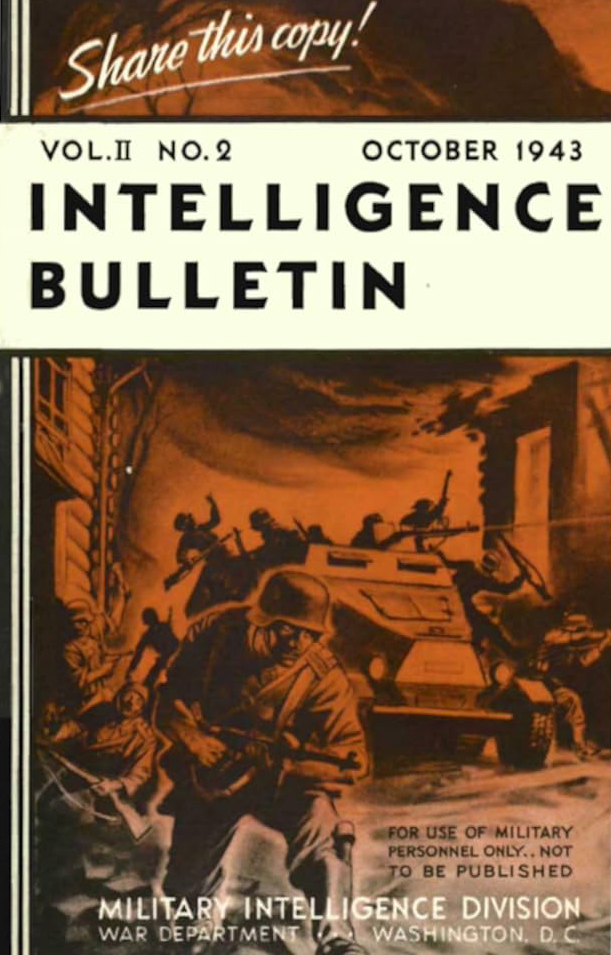
cover of the American military intelligence monthly Intelligence Bulletin (shown here purely as an example — the October 1943 issue)
The Intelligence Bulletin monthly was published during and after the Second World War by the American military intelligence service. It was intended for Allied officers and other military personnel, keeping them informed about the latest developments in both friendly and enemy tactics, weapons, and related matters.
In the issue of 10 June 1943 — a full nine months after the Tiger's actual first deployment on the Eastern Front — readers of the bulletin learned about the new German tank PzKpfw VI – Tiger.
SELECTED CONTENTS:
June 1943 Cover
The cover of the June 1943 issue, which contained the information about the German tank described below. For a long time the monthly's covers were this plain and no-frills — the comic-book style cover design did not arrive until later.
Page 19
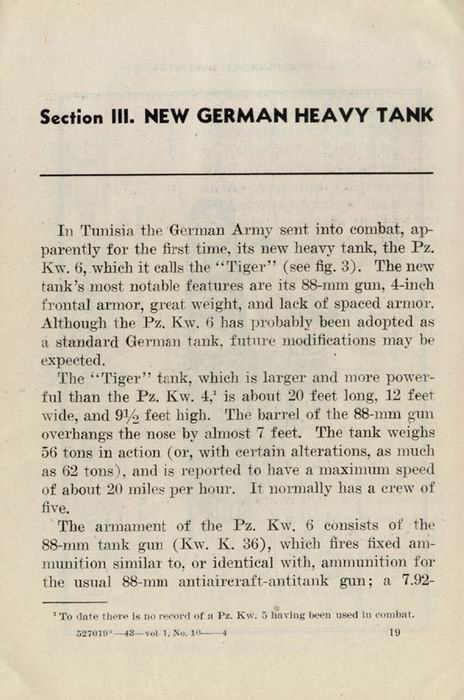
The new heavy German tank "Pz.Kw. 6," also known as the Tiger, has been deployed in Tunisia for the first time. The vehicle is armed with an 88 mm gun, weighs 56 tonnes, has a crew of five, and is capable of reaching speeds of up to 20 miles per hour. A footnote reveals that the Allies were evidently somewhat taken aback by the gap in the German numbering sequence: "we have no record of any Pz.Kw. 5 being used."
Page 20
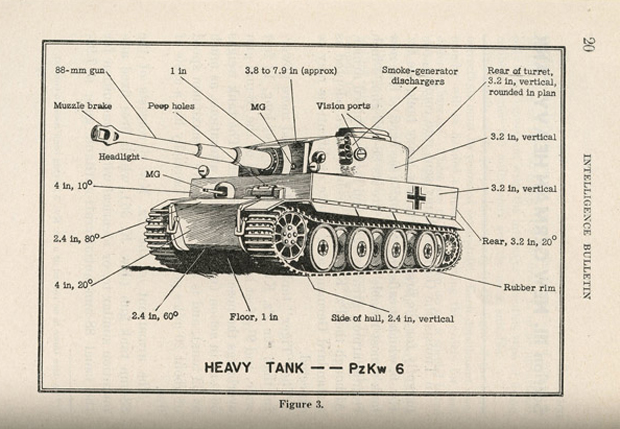
A diagram of the Tiger tank showing the angle and thickness of the armour on each face of the hull and turret. Note that the Allies persistently referred to German tanks by the incorrect abbreviations Pz.Kw. or PzKW.
Page 21
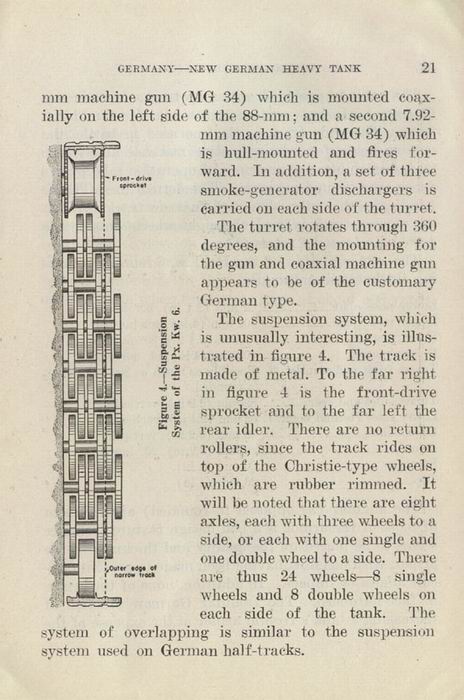
On this page the authors devote considerable attention to the running gear of the new tank, informing readers that each side features 24 road wheels arranged on eight axles. The wheels overlap in a similar fashion to the already-familiar older German half-tracks.
Page 22
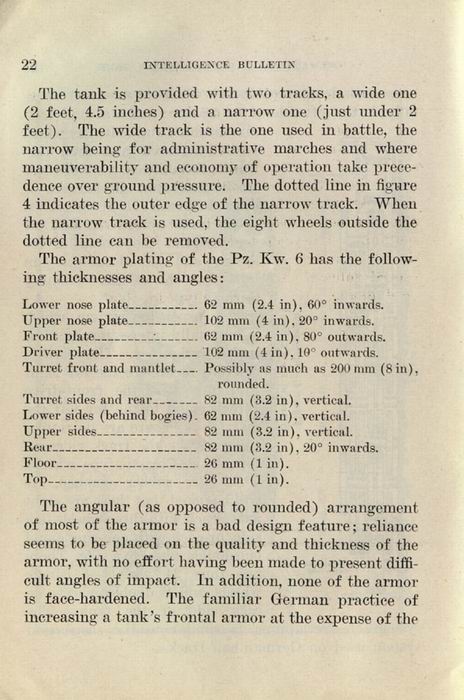
The Allies evidently had information about the existence of two track types for the Tiger — wider combat tracks and narrower transport tracks — and about the necessity of removing the outer row of road wheels when changing between them. The page also summarises once more the thickness and angle of the tank's armour.
Page 23
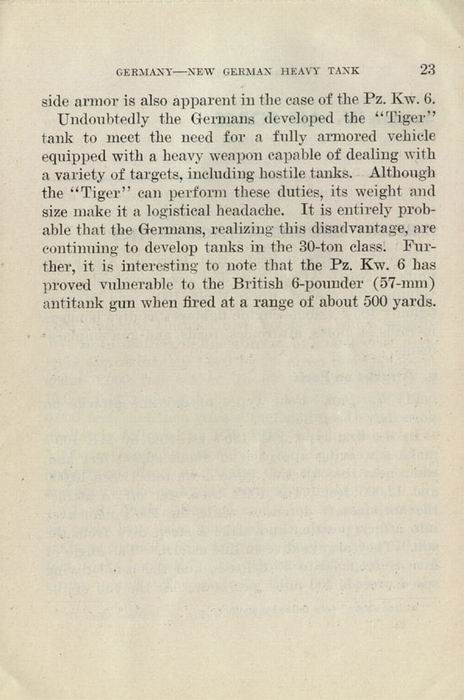
While the Allies acknowledge that the Tiger will presumably carry out its combat tasks very effectively, they also recognise what a rod the Germans have made for their own backs — and how much effort it will cost them to logistically support the operations of these armoured monsters.

Reproducing text from the Panzernet website without the written consent of the operator is prohibited.