KASSERINE PASS
the last surge of German forces in Africa
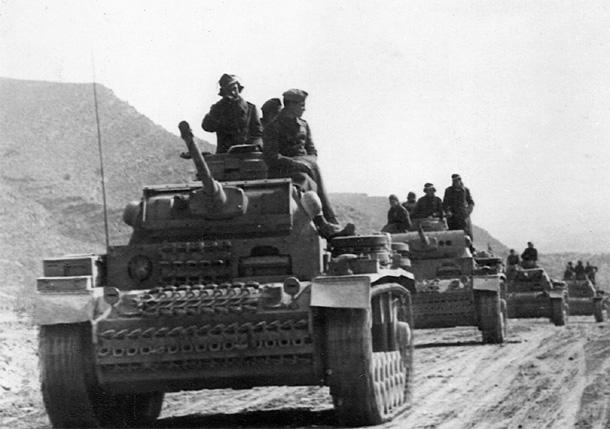
Panzer III tanks of the 10th Panzer Division advancing along road No. 17 from Kasserine Pass toward the town of Thala, source: flickr.com with permission of the publishing user, edited
Introduction
The term "Battle of Kasserine Pass" is generally used as an umbrella label for a series of three combat operations codenamed Frühlingswind, Morgenluft and Sturmflut, which took place in late January and throughout February 1943 in central Tunisia. It was one of the last offensive actions of German and Italian forces in North Africa before their final defeat, and at the same time it was the first major clash of armoured units of the German Wehrmacht and the American Army. The entire offensive was marked by quarrels between two commanders — Rommel and von Arnim — who were moreover both subordinated in Africa not to German but to Italian supreme command. While the German-Italian forces achieved several impressive tactical victories in Tunisia, from a strategic perspective they were still heading toward their inevitable end.
The Situation
At the beginning of 1943 the situation of the German forces in Africa was far from rosy. It had been nearly two years since the Wehrmacht first set foot on the dark continent — two years of fighting the British, characterised by alternating advances and retreats depending on which side managed to accumulate enough reinforcements and supplies (for the Germans, the African war was a logistical nightmare from start to finish). The successes of the Afrikakorps reached their peak at the turn of June and July 1942, when Rommel pushed from Libya into Egypt and stood at the gates of El Alamein. There, however, his advance was halted by tough British resistance and above all by crippling shortages of fuel and ammunition.
In October 1942 the British launched their counteroffensive and forced Rommel into a long retreat westward from El Alamein. In the first phase the Germans fell back out of Egypt deep into Libya to the area of El Agheila. In December, however, Rommel was forced to abandon even that position and withdraw across the rest of Libya all the way into Tunisia, to the so-called Mareth Line — a system of fortifications built by the French before the Second World War. There the Germans established defensive positions and halted the pursuing British Eighth Army (which was also running out of steam as it moved further and further from its supply depots in Egypt). During the retreat between 23 October and 2 December 1942, however, the Afrikakorps lost an astonishing 229 tanks. The 21st Panzer Division, once the battering ram of Rommel's offensives, had just 4 tanks on 7 November 1942 — it had ceased to exist as a division in any meaningful sense and was reduced to two improvised battle groups. Rommel's catastrophic retreat from Egypt and Libya was not the only bad news for the German command. In November 1942 the Allies launched Operation Torch, during which Anglo-American forces landed at three points west of Tunisia — at Casablanca (Morocco), Oran and Algiers (Algeria). Their aim was to press on the Germans in Tunisia from the west and encircle them.
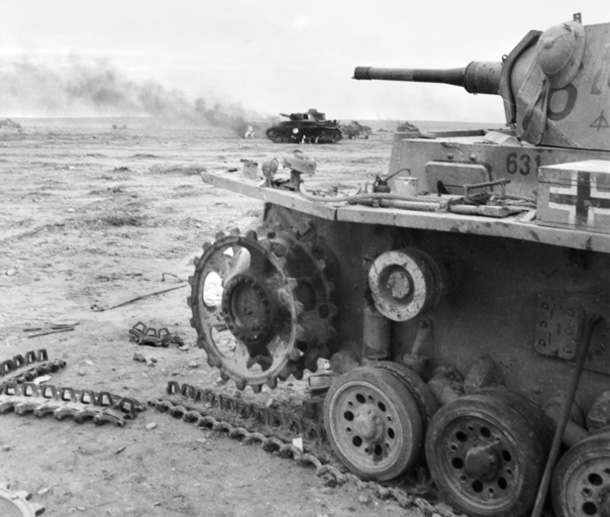
During the retreat across Libya, Rommel's Afrikakorps suffered enormous losses, source: flickr.com, Public Domain, edited
Hitler and his generals realised that Africa was now a fight for survival and that Rommel with his decimated forces had no chance on his own. The straight-line distance from Algiers to the Tunisian border is roughly 480 kilometres, and from the border to Tunis — now the main supply port for the German forces — was only 150 kilometres. Time was not on their side. All available units therefore began streaming from Italy into Tunisia almost immediately, primarily the 190th Panzer Regiment, elements of the 10th Panzer Division, paratroopers of the 5th Parachute Regiment, and also the 501st Heavy Tank Battalion with its Tiger tanks (sPzAbt 501). An improvised battle group was formed on the spot from the arriving units and immediately dispatched westward to halt the approaching Allies.
Von Arnim Arrives
The units designated for the defence of Tunisia (whether already in Africa or still on their way to and from Italy) were in early December 1942 organisationally consolidated under the newly formed 5th Panzer Army (5. Panzerarmee), with the experienced General der Panzertruppen Hans-Jürgen von Arnim appointed to command it. Hitler had made a deliberate decision not to simply reinforce Rommel directly but to send an entirely separate contingent under a different commander. By this point Rommel's star had faded considerably and Hitler no longer trusted him as he once had. In von Arnim, by contrast, he placed great hopes.
By the end of 1942 the Germans had managed to halt the Allied advance from the west and stabilise the front. It was not a particularly dazzling victory, however, as the front line ran from north to south, in places only 60 kilometres from the Mediterranean coast. The Germans were holding literally just a narrow strip of land along Tunisia's eastern coastline, leaving them with no strategic depth and no room to manoeuvre. The flow of units from Italy to Tunis continued through January nevertheless, by both sea and air, and represented an enormous logistical undertaking. Over November, December and January, more than 110,000 German and Italian soldiers passed through the port of Tunis (and probably Bizerte as well), along with 428 tanks, 729 guns, 5,688 wheeled and half-track vehicles, and hundreds of thousands of tons of supplies. By the end of January 1943 von Arnim had around 100,000 soldiers at his disposal in northern Tunisia (74,000 German and 26,000 Italian), while Rommel in the south had a further roughly 78,000 men (30,000 German and 48,000 Italian). In early January the remainder of the already-mentioned 501st Heavy Tank Battalion Tiger (sPzAbt 501) also arrived in Tunis. It should be noted, however, that this was still a mixed battalion which at full establishment had "only" 20 Tiger tanks; the remaining 25 tanks of the battalion were of the PzKpfw III Ausf. N type.
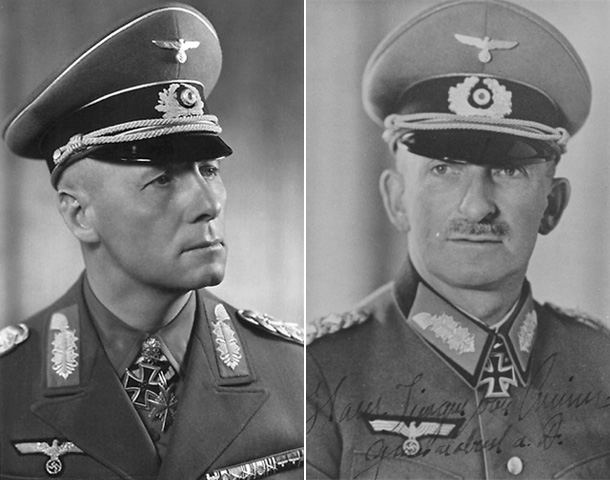
Rommel and von Arnim — two roosters on one dunghill, whose disputes had to be refereed by Field Marshal Kesselring, source: flickr.com, edited
The consequence of Hitler's decision to reinforce Africa with a second independent contingent rather than simply sending more troops to Rommel was, predictably, the splitting of the German forces in Tunisia into two parts. In the north stood von Arnim with his 5. Panzerarmee, which included the 10th Panzer Division and the 501st Heavy Tank Battalion with its Tiger tanks (sPzAbt 501). In the south stood Rommel with his Panzerarmee Afrika, now officially renamed the German-Italian Panzer Army (Deutsch-Italienische Panzerarmee), which included among others the German 15th and 21st Panzer Divisions and the Italian 131st Armoured Division. At the end of January 1943, however, the 21st Panzer Division was transferred from Rommel to von Arnim's command and became part of the 5. Panzerarmee.
Securing the German Positions
The German forces were thus concentrated in the north and south, while the central area between the two contingents was relatively thinly held — a fact that gave von Arnim considerable concern. He identified the main risk as a potential Allied attack in precisely this central sector, directed toward the town of Sfax. Such an attack would drive a wedge between the German forces in the north and south, cutting the southern forces off from their supply ports. Von Arnim therefore decided that his first offensive action in Africa would be to secure the western approach routes to Sfax.
The terrain in the area in question is largely shaped by the Dorsale mountain massif (the eastern spur of the Lesser Atlas range). Roads and tracks here follow the passes between the individual ridges, and whoever controls a pass controls the ability to move through the mountains. This applied equally to the main road running westward toward Sfax, which passed through — among other places — the pass near the settlement of Faid. At 4 a.m. on 30 January 1943 two German battle groups composed primarily of troops from the 21st Panzer Division moved out. The defence of Faid Pass at the time was provided solely by soldiers of French colonial units. Although their guns managed to inflict some losses on the attacking Germans and Italians, by noon both the pass and the settlement of Faid were effectively taken, as was the neighbouring pass near Rebaou, situated roughly 7 kilometres to the south. Encouraged by this success, von Arnim dispatched another battle group on 31 January — this time drawn from the 10th Panzer Division — to seize the pass near Pichon (today's Haffouz), located roughly 60 kilometres further north on the main approach route to another important town, Sousse.
After losing the Faid and Rebaou passes, the Americans tried to organise a counterattack as quickly as possible. Battle Group Stark (commander Alexander Stark) was sent toward Faid Pass, while Battle Group Kern (commander William Kern) headed for the Rebaou Pass. The Germans, however, had managed to dig in quickly on the newly captured ground and prepare solid defences, including several concealed 88 mm guns. It is therefore no surprise that the American counterattack attempts, carried out on 31 January and 1 February 1943, failed.
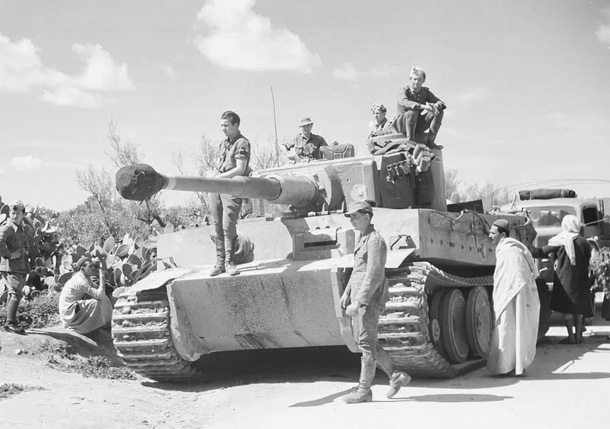
Among the reinforcements sent to Tunisia were the heavy Tiger tanks of sPzAbt 501, source: flickr.com with permission of the publishing user, edited
Von Arnim's offensive operation had thus gone better than expected. Based on this experience, the Germans concluded that the Allies were in much the same position as themselves — meaning the central sector of the front was also weakly defended on their side. It appeared that the American units in this sector posed no threat, but rather an opportunity, and so the Germans immediately began planning a further offensive. At this point the divided command structure made itself fully felt, as von Arnim and Rommel each submitted their own plan to their superiors — and it hardly needs pointing out that the two plans were very different from each other.
Von Arnim's thinking ran roughly as follows: in the far south, the German-Italian forces on the Mareth Line were reasonably well prepared to defend against the British Eighth Army, which was in any case exhausted after having chased the Germans all the way from Egypt across Libya, and would need some time to rebuild its strength for a major assault. In the central sector the enemy had proven weak, as the easy capture of the Faid, Rebaou and Pichon passes had shown. Von Arnim therefore proposed shifting attention to the northern sector and attacking from Pichon toward El Kef. Rommel, on the other hand, proposed continuing the offensive in the weakly held central sector, capturing Kasserine Pass, and pushing through it toward the Allies' major supply hub at Tebessa in Algeria (or, if the situation favoured it, the somewhat closer town of Thala).
Frühlingswind and Morgenluft
While both men's nominal superior was Field Marshal Albert Kesselring (commander-in-chief of German forces in Africa), formal command over all Axis forces on the continent rested with the Italian Comando Supremo. Kesselring was more drawn to Rommel's proposal, because it was more ambitious and held out the possibility of a major victory that would help Germany forget the recent catastrophe at Stalingrad. Rommel, however, did not have sufficient forces for his plan and would need cooperation from von Arnim's units — something von Arnim loudly and vigorously refused. On 9 February 1943 a conference took place between Rommel, von Arnim, Kesselring and the Italian general Giovanni Messe. The outcome was a plan for two parallel offensive operations. The first was given the codename Frühlingswind (Spring Wind) and was assigned to von Arnim, using the forces of the 21st and 10th Panzer Divisions, though tactical command of the operation was delegated by von Arnim to General Heinz Ziegler. The primary objective of the operation was the capture of the town of Sidi Bou Zid. After that, Ziegler was to send the tanks of the 21st Panzer Division south to Rommel (effectively returning the division to him), enabling Rommel to launch the second offensive operation, codenamed Morgenluft — Morning Air. For Morgenluft, Rommel assembled from his own men a battle group named simply Kampfgruppe DAK (DAK = Deutsches Afrikakorps), placing Colonel Kurt von Liebenstein in command. This group, reinforced by the 21st Panzer Division tanks, was to attack from the southeast via El Guettar and capture the town of Gafsa. Frühlingswind was to be launched first, sometime between 12 and 14 February (the exact date left to von Arnim's discretion). If all went smoothly, the attack on both axes could continue further west — but more on that later.
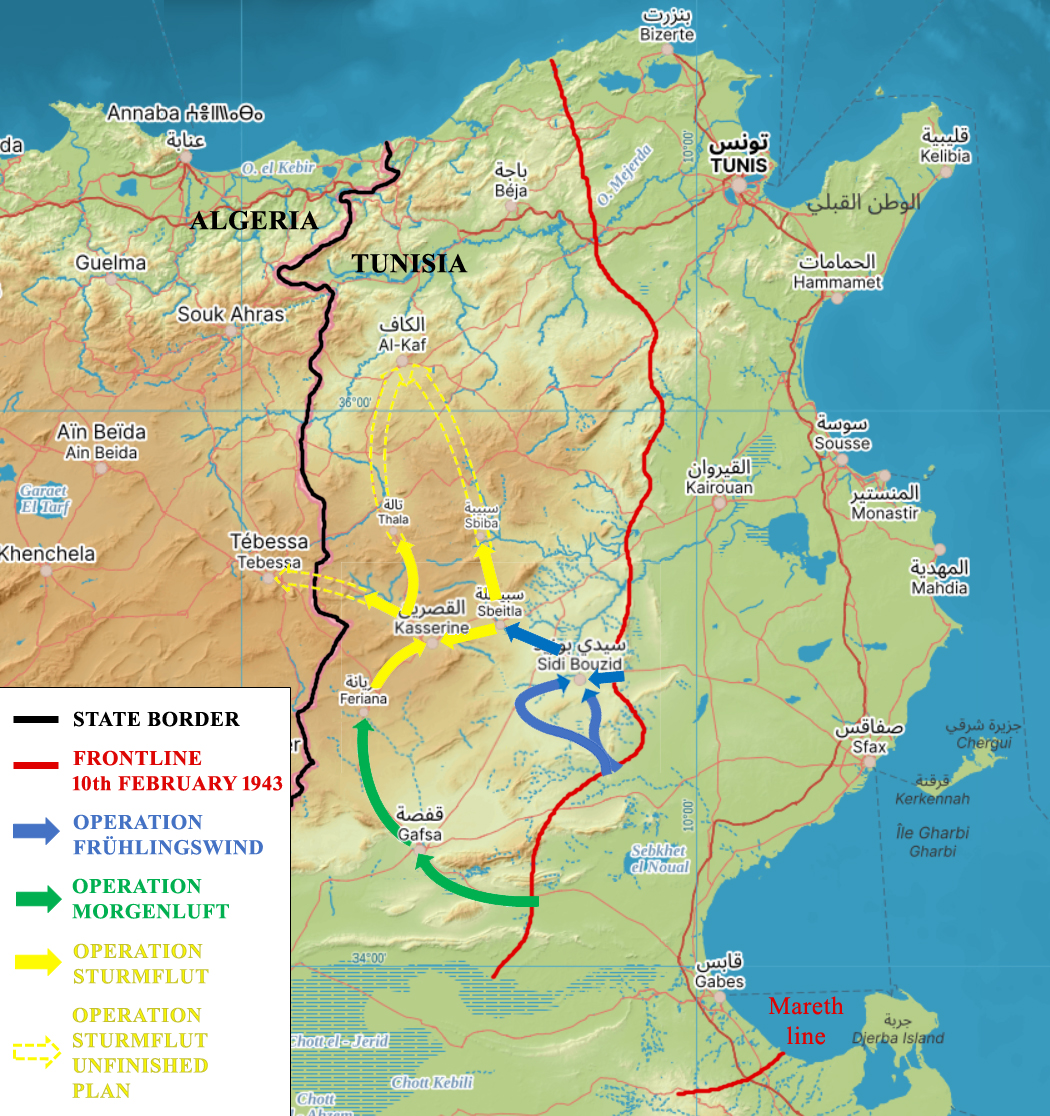
Map of the German advance during operations Frühlingswind, Morgenluft and Sturmflut; note: the map shows town and village names in their original (non-Czech) form (CLICK ON THE IMAGE FOR FULL SIZE), source: Panzernet
American Forces
The German assessment of the Allied situation in the central sector of the front was essentially correct. The main Allied force in this area was the American II Corps (Major General Lloyd Fredendall), which was indeed stretched along a 180-kilometre front and therefore represented no concentrated fighting force at all. The II Corps' main striking arm was the 1st Armored Division (Major General Orlando Ward), which in early February 1943 had a total of 85 (or up to 92) light Stuart tanks and 202 medium Lee and Sherman tanks. The division was split into four operational groups (Combat Commands), each deployed in a different location at the time the German offensive began. Combat Command A held the area roughly between the towns of Sbeitla and Sidi Bou Zid (Sidi Bou Zid being the target of Frühlingswind); Combat Command D was positioned in the town of Gafsa (the target of Morgenluft). Combat Command C was located near the town of Hadjeb El Aioun (roughly 40 kilometres north of Sidi Bou Zid), and finally Combat Command B was stationed some 90 kilometres north of Sidi Bou Zid in the Ousseltia area. Of all the division's operational groups, Combat Command B alone had any combat experience — the rest of the American tankers were complete novices.
The Allied Supreme Commander Dwight D. Eisenhower had already ordered on 20 January 1943 that the units of the 1st Armored Division be more concentrated in one place, but his subordinates — including II Corps commander Fredendall — had paid insufficient attention to this order. When Eisenhower arrived for a personal inspection on 13 February 1943, he was taken aback by the thin defensive line formed by the dispersed Combat Commands and immediately issued orders to finally rectify the situation — but it was already too late. The German Operation Frühlingswind was only hours away from beginning.
The Attack on Sidi Bou Zid
On Sunday 14 February 1943, still in the deep of night, the German units began to move. As already noted, the objective of Operation Frühlingswind was the capture of Sidi Bou Zid, and the task was entrusted to the 10th and 21st Panzer Divisions. The first of these had 110 tanks of the Panzer III and Panzer IV types available for the operation, plus the heavy Tiger tanks from schwere Panzer Abteilung 501. The second division could commit 91 tanks of the Panzer III and Panzer IV types. The 10th Panzer Division was to attack through the previously captured Faid Pass, while the 21st Panzer Division was to cross the front line roughly 30 kilometres further south, through the pass beneath the hill of Djebel Maizila (sometimes written Mu'ayzilah). For the attack, each of the two panzer divisions was split into two battle groups. From the soldiers of the 10th Panzer Division, Kampfgruppe Reimann and Kampfgruppe Gerhardt were formed; the 21st Panzer Division was divided into Kampfgruppe Schütte and Kampfgruppe Stenkhoff.
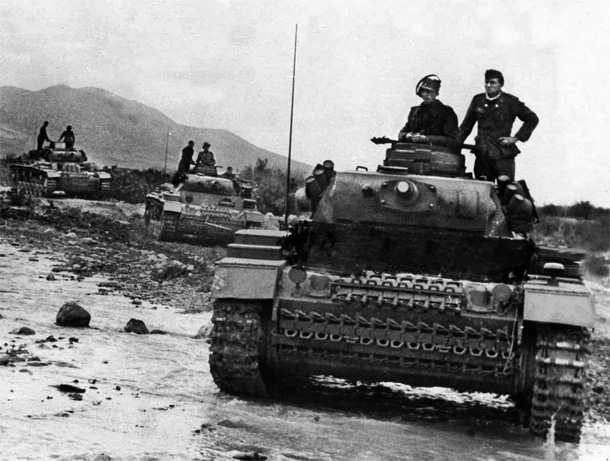
The character of the fighting in Tunisia was largely determined by the terrain — rocky ridges, passes, watercourses, source: flickr.com, Public Domain, edited
Both battle groups of the 10th Panzer Division first passed through Faid Pass together before splitting up. Kampfgruppe Reimann, which had also been assigned the Tiger tanks of sPzAbt 501, pushed southwest from the pass toward Sidi Bou Zid, while Kampfgruppe Gerhardt swung north to outflank Djebel Lessouda and silence the American artillery concealed there. On the hill the Americans had one battalion from the 168th Infantry Regiment of the 34th Infantry Division, and at the foot of the hill a tank company and a platoon of tank destroyers were patrolling, all under the command of Colonel Waters. The initial movement of the German units, however, went unobserved for a long time — it could be heard, but not seen, thanks to a sandstorm raging around the pass that morning.
The Germans exploited the complete surprise to easily scatter the patrolling American tanks, and in doing so destroyed the company commander's tank — the only one equipped with a radio for communication with the artillery. The American tankers thus had no way to call in artillery support, and the infantry on Djebel Lessouda could not see through the sandstorm well enough to call for fire on a specific target. The American guns therefore remained silent until Kampfgruppe Gerhardt swung around the northern side of the hill and knocked them out. The American infantry on Djebel Lessouda was now encircled. The Germans, however, had no intention of being delayed, so they simply ignored the encircled American battalion and pressed on according to plan. Around 7:30 a.m. Luftwaffe aircraft struck the town of Sidi Bou Zid itself. By now it was clear to the Americans that what was advancing under cover of the sandstorm was not merely an enemy reconnaissance unit — a full-scale attack on Sidi Bou Zid had begun. A battle group under Colonel Hightower immediately set out from the town to counterattack: 44 Sherman tanks (Companies H and I of the 3rd Battalion, 1st Armored Regiment, 1st Armored Division) and 12 tank destroyers (Company A, 701st Tank Destroyer Battalion).
Around 8:30 the sandstorm died down, and at roughly 9 a.m. Hightower made contact with the enemy south of Djebel Lessouda — immediately grasping that he could do little more than slow the German advance somewhat. Such was the message he sent back to Combat Command A headquarters in Sidi Bou Zid. Around 10 a.m. Kampfgruppe Gerhardt and Kampfgruppe Reimann linked up again south of Djebel Lessouda and looked toward Sidi Bou Zid, roughly 8 kilometres away.
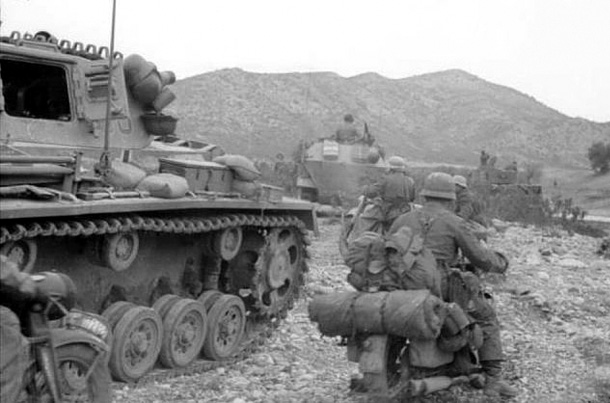
German tanks, half-tracks and other vehicles moving through the Tunisian countryside, source: Bundesarchiv Bild 101I-788-0017-06, Wikimedia, Creative Commons, edited
How was Operation Frühlingswind unfolding on the 21st Panzer Division's sector? As noted, this division had been split into Kampfgruppe Schütte and Kampfgruppe Stenkhoff. Kampfgruppe Schütte advanced directly north from the Maizila pass. Around noon it reached the point where the road to Sidi Bou Zid passes between the hills of Djebel Ksaira and Djebel Qarat al Hadid (roughly 9 kilometres southeast of the town). On these hills were deployed soldiers of the third battalion of the 168th Infantry Regiment of the 34th American Infantry Division, commanded by Colonel Thomas Drake. The Americans put up a fight and Kampfgruppe Schütte's march on Sidi Bou Zid was brought to a temporary halt.
Combat Command A commander Colonel McQuillin now knew that German units were advancing on Sidi Bou Zid from two directions (and Kampfgruppe Stenkhoff was still on its way). Around noon he received fresh reports from Colonel Hightower, who was leading the already-mentioned American counterattack south of Djebel Lessouda. Hightower reported that roughly half his tanks had already been destroyed and that he would not be able to hold the Germans back much longer. McQuillin therefore turned to his superiors and requested permission for all Combat Command A units to withdraw. The American units inside Sidi Bou Zid itself were permitted to fall back westward, but the units positioned on Djebel Lessouda, Djebel Ksaira and Djebel Qarat al Hadid were ordered to hold their positions until a counterattack could be organised. As would soon become clear, this decision by Major General Fredendall sealed the fate of more than two thousand American soldiers.
The second battle group of the 21st Panzer Division, Kampfgruppe Stenkhoff, advanced from the Maizila pass in a wide arc — first roughly 40 kilometres northwest to the town of Bir El Hafey, then turned northeast and covered another approximately 25 kilometres to attack Sidi Bou Zid from the opposite direction. Although Kampfgruppe Stenkhoff had set off earliest of all the German battle groups, it still only approached the town at around 2 p.m. During the afternoon the American infantry defending from the hills of Djebel Ksaira and Djebel Qarat al Hadid and blocking the advance of Kampfgruppe Schütte came under unsustainable pressure. Colonel Drake therefore withdrew his men from Djebel Ksaira and concentrated them on the more defensible Djebel Qarat al Hadid. Kampfgruppe Schütte was then free to bypass it and finally advance on Sidi Bou Zid.
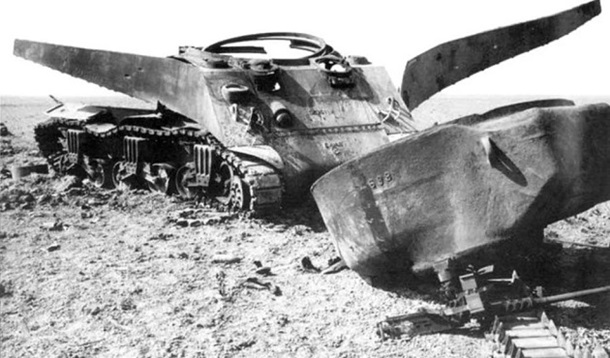
A Sherman tank blown apart by an ammunition explosion; the photograph was taken after the repulse of the American counterattack at Faid Pass on 31 January or 1 February 1943, source: flickr.com, edited
Around 5 p.m. Kampfgruppe Stenkhoff linked up west of Sidi Bou Zid with the soldiers of the 10th Panzer Division (Kampfgruppe Gerhardt and Kampfgruppe Reimann), sealing the town's fate. Colonel Hightower's battle group had been virtually destroyed in the delaying action. Of his 44 Sherman tanks, just 7 survived. Fifteen of the destroyed Shermans were credited to the Tiger tanks of sPzAbt 501. The Tiger of Feldwebel Theo Augustin recorded a tank kill that day near Sidi Bou Zid at an extraordinary range of 2,700 metres. Around the town, 44 destroyed or abandoned American tanks, 59 armoured half-tracks, 26 guns and 22 lorries were left on the battlefield. On the hills of Djebel Lessouda and Djebel Qarat al Hadid, two American infantry battalions remained encircled. Operation Frühlingswind had proceeded essentially according to plan and German losses were reported as "light only." With the coming of darkness, General Ziegler ordered his units to cease combat operations and prepare defensive positions in anticipation of an American counterattack. Soldiers of the 21st Panzer Division were also to prepare to move south, where they were to join Kampfgruppe DAK and execute Operation Morgenluft.
The American Counterattack
How did the Allies respond to Operation Frühlingswind? Their response was unfortunately heavily influenced by a faulty reading of the overall situation. The commander of the 1st Armored Division, Major General Ward, estimated that the Germans had committed only between 40 and 60 tanks at Sidi Bou Zid. The commander of the British First Army, General Anderson, likewise believed that the attack at Sidi Bou Zid was merely a feint and that the Germans were preparing a larger offensive in the northern sector against the British. As a result, a completely inadequate force was sent in for the counterattack.
The jumping-off point for the attack was the road junction of routes No. 3 and No. 13, roughly halfway between Sbeitla and Sidi Bou Zid. Combat Command C was pulled in from the town of Hadjeb El Aioun to this area, and its commander Colonel Robert Stack was given command of the operation. The 2nd Battalion of the 1st Armored Regiment (commander Lieutenant Colonel James Alger) was selected as the main striking force, supplemented by additional reinforcements. The Americans thus committed only one reinforced tank battalion from Combat Command C — somewhere between 44 and 54 tanks depending on which source you trust — accompanied by a company of M3 half-track tank destroyers, a battalion of motorised infantry and two batteries of self-propelled artillery. The attacking force's main task was to push the Germans back out of Sidi Bou Zid and relieve the two encircled American infantry battalions.
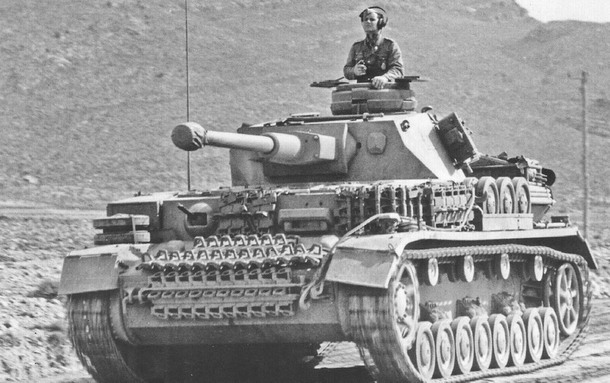
A Panzer IV Ausf. G of the 10th Panzer Division on the road from Kasserine Pass toward the town of Thala, source: flickr.com, edited
The American counterattack began approximately 40 minutes after noon on 15 February 1943. The Germans had thus had the entire night and the whole morning to prepare for it, and when it came, they received early warning from Luftwaffe observers. The Americans had not troubled themselves with devising any particularly sophisticated plan. The entire attacking force simply drove toward Sidi Bou Zid across a vast sandy plain in a V-formation, raising such an enormous cloud of dust that it was visible for kilometres in every direction. General Ziegler had 75 mm anti-tank guns and 88 mm Flak positioned and three tank companies of Kampfgruppe Stenkhoff were sent south while roughly the same number of tanks from Kampfgruppe Gerhardt swung north, ready to hit the Americans from both flanks simultaneously.
The outcome of the American counterattack hardly needs elaborating — it was a catastrophe. The American tanks drove straight into the sights of the anti-tank guns and were then hit from both flanks by the German armour. The Americans had driven straight into a trap, from which only the soldiers at the very tail of the column managed to escape. The result was the loss of 40 to 50 American tanks (again depending on which source you believe), 9 self-propelled guns and 130 other vehicles. German losses are recorded differently in at least two sources. One states that 13 Panzer III and Panzer IV tanks were damaged but every single one was subsequently repaired; another source gives a figure of 20 German tanks lost, with no mention of whether any were recovered.
Either way, the American counterattack was a complete failure and never came close to relieving the infantry encircled on Djebel Lessouda and Djebel Qarat al Hadid. Major General Fredendall therefore issued orders during the night of 15 to 16 February for the American soldiers on Djebel Lessouda to attempt to break out westward on their own. Their march toward the American lines did not end particularly gloriously — of roughly a thousand men, around eight hundred were taken prisoner. The second American battalion encircled on Djebel Qarat al Hadid received its withdrawal order the following night and fared much the same. Of these two battalions totalling more than 2,600 men, somewhere between 1,600 and 2,400 soldiers were taken prisoner by the Germans.
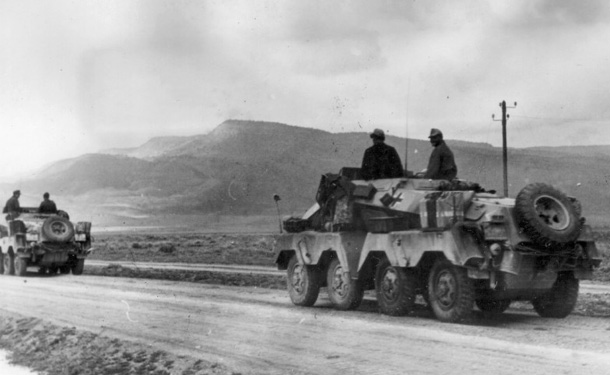
Sd.Kfz. 233 armoured cars passing through the captured Kasserine Pass; in the background the hill of Djebel Semmama is visible, source: flickr.com, edited
The "Capture" of Gafsa
What of the second planned German operation, Morgenluft? As a reminder, it was to be carried out by Kampfgruppe DAK reinforced by the 21st Panzer Division, with the objective of capturing the town of Gafsa. Still on 14 February, while the German attack on Sidi Bou Zid was in progress, the Americans had noticed reconnaissance activity by Kampfgruppe DAK in the south and worked out that something was likely being prepared there as well. II Corps commander Major General Fredendall therefore pre-emptively ordered the American-French forces in the Gafsa area to withdraw to more defensible positions. German reconnaissance established on the morning of 15 February that the town had been evacuated. There was therefore no need to wait for the 21st Panzer Division — the town was undefended, and Kampfgruppe DAK occupied it without a fight during the afternoon and evening.
This unexpectedly favourable turn of events prompted General von Arnim to issue new orders. Since Gafsa had been taken, there was no reason to send the 21st Panzer Division south to Kampfgruppe DAK. Instead, General Ziegler was to advance northwest from Sidi Bou Zid and capture the town of Sbeitla, an important Allied supply hub. Rommel in the southern sector was equally busy, ordering Kampfgruppe DAK commander Colonel Liebenstein to push north from Gafsa and capture the town of Feriana. This manoeuvre began drawing the advance routes of Rommel's (Liebenstein's) and von Arnim's (Ziegler's) units together in the direction of Kasserine Pass — although for von Arnim, this was not yet his next objective.
The Attack on Sbeitla
After the catastrophic failure of their counterattack, the Allies realised they had underestimated the Germans. It also became clear that the next target of the enemy advance would be the town of Sbeitla. The decimated Combat Command A and Combat Command C, which together had lost nearly a hundred tanks on 14 and 15 February, stood no chance of holding Sbeitla, and so the Americans pulled the entire Combat Command B back toward the town as well. A defensive line was established roughly 5 kilometres east of the town, making extensive use of the local olive groves for concealment.
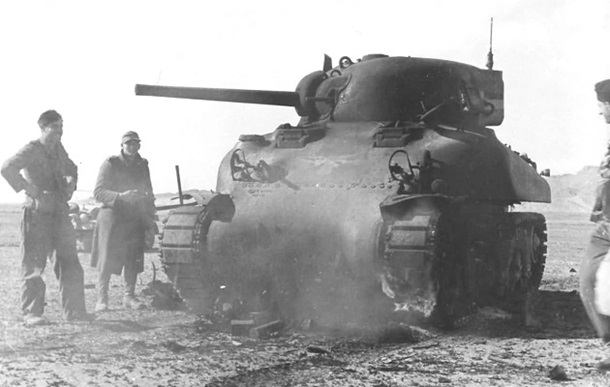
This Sherman was most likely destroyed during the American counterattack on the town of Sidi Bou Zid on 15 February 1943, source: flickr.com, edited
General Ziegler was unable to organise an attack on Sbeitla before the afternoon of 17 February, delayed by the business of rounding up encircled American infantrymen trying to escape westward. The defence of Sbeitla exposed a striking difference in morale between American soldiers from the different Combat Commands. The men of Combat Command B had a few engagements behind them and were not easily rattled — they managed to repel the first German thrust at Sbeitla, destroying somewhere between 5 and 15 enemy tanks in the process. The soldiers of Combat Command A and C, by contrast, had received their baptism of fire only three days earlier and had so far experienced nothing but defeat and retreat, seen plenty of dead and wounded comrades, and knew about their fellow soldiers who had been left encircled on the hills of Djebel Lessouda and Djebel Qarat al Hadid and fallen into captivity. It is therefore no surprise that outright panic set in among their ranks even before the German attack began, and a chaotic westward retreat got underway.
Under the circumstances it appeared impossible to hold Sbeitla, and so General Anderson authorised the defenders to withdraw westward all the way to Kasserine Pass. While Combat Command A and C fell back in a rather disorganised fashion, Combat Command B held the defensive line until nightfall before beginning a gradual and orderly withdrawal. The German 21st Panzer Division was therefore able to enter Sbeitla virtually without a fight during the night of 17 February 1943. The American order to withdraw to Kasserine Pass applied equally to units stationed in the town of Feriana. As a result, Kampfgruppe DAK was also able to occupy Feriana — and the neighbouring town of Thélepte — without a fight on 17 February. However, Kampfgruppe DAK commander Colonel Liebenstein was seriously wounded that day when his vehicle drove over a mine, and he had to be replaced by Major General Karl Bülowius.
Let us return to the units of General von Arnim, who now held Sbeitla. To Rommel's considerable frustration, the cautious von Arnim had no intention of pursuing the Americans retreating toward Kasserine Pass. His soldiers had been fighting continuously for four days and their fuel and ammunition were running low. Von Arnim therefore left the 21st Panzer Division in defensive positions around Sbeitla and sent the 10th Panzer Division not southwest toward Kasserine, but in exactly the opposite direction — northeast to Pichon (today's Haffouz) and Fondouk (today's Al-Hawarib). From there it was theoretically possible to continue northwest toward El Kef, which had been von Arnim's "dream objective" from the very beginning.
Operation Sturmflut
A furious Rommel therefore turned to Field Marshal Kesselring on 18 February, complained about von Arnim's lack of initiative, and requested that the 10th and 21st Panzer Divisions be transferred to his (Rommel's) command so he could attack through Kasserine Pass and seize the Allied supply hub at Tebessa in Algeria (70 kilometres deep in the American rear). In essence, each of the two commanders still wanted to pursue his own original plan.
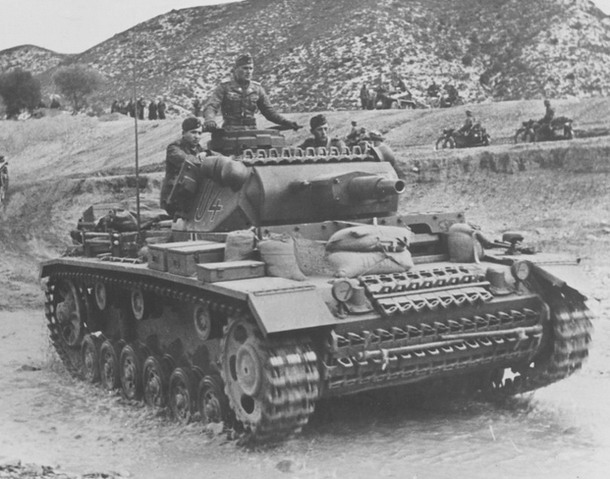
Panzer III Ausf. N tanks served as escorts for the heavy Tigers of sPzAbt 501, source: flickr.com, edited
Kesselring, as before, was more inclined toward Rommel's more ambitious proposal. After all, the preceding offensive operations in the central sector had gone better than expected, the Führer was pleased, and Rommel was essentially proposing to continue what was already working and capitalise on the gains achieved. Kesselring, however, needed formal approval from the Italian supreme command, Comando Supremo, for such a decision. While waiting for it, another precious day was unfortunately lost. The decision finally arrived in the night of 18 to 19 February 1943. The good news for Rommel was that he did indeed immediately receive both the 10th and 21st Panzer Divisions and was authorised to pick up where the previous operations had left off — advancing after the retreating Americans through Kasserine Pass and pressing on to the northwest. The purely bad news, as Rommel saw it, was that the operational objective was not his proposed Tebessa but the more northerly city of El Kef. Rommel's new operation received the codename Sturmflut — "storm surge" (a meteorological phenomenon). General von Arnim was of course not pleased at all, and quickly submitted his own proposal for an offensive operation against El Kef to Kesselring, but the decision had already been made. Von Arnim lost command of both the 10th and 21st Panzer Divisions and was instead tasked with supporting Rommel's operation with smaller diversionary attacks to the north, keeping the British First Army occupied.
To have a free hand for Operation Sturmflut, Rommel was relieved of command of the remnants of the Deutsch-Italienische Panzerarmee, which was still holding the Mareth Line in the far south of Tunisia against the British Eighth Army. Command of this force was formally transferred to the Italian General Giovanni Messe and redesignated as the 1st Italian Army. For Operation Sturmflut, Rommel had at his disposal almost all German armoured forces in Tunisia. Together with this striking force came the chance to step back into the spotlight. There was, however, one problem. As mentioned above, von Arnim had sent the 10th Panzer Division to Pichon and Fondouk on 18 February, meaning it was effectively unavailable to Rommel for the attack on Kasserine Pass at that moment. Rommel could of course have postponed the attack and waited for the 10th Division to return, but every additional day of inaction gave the Americans time to recover from their recent defeats, regroup and prepare their defences — and that was something Rommel was not prepared to allow. He therefore decided to attack immediately with what he had to hand, which meant the 21st Panzer Division and Kampfgruppe DAK.
Kasserine Pass
Rommel divided his forces as follows: the 21st Panzer Division was to advance north from Sbeitla along road No. 71 through the villages of Sbiba and El Ksour toward El Kef. Kampfgruppe DAK was to force its way through Kasserine Pass and then continue in the direction of Thala (and then on to El Kef). The 10th Panzer Division, once it returned, was to join whichever of the two axes needed reinforcement most. For some reason Rommel did not have the Tiger tanks of sPzAbt 501 available for Operation Sturmflut — either they were simply not allocated to him, or von Arnim refused to release them.
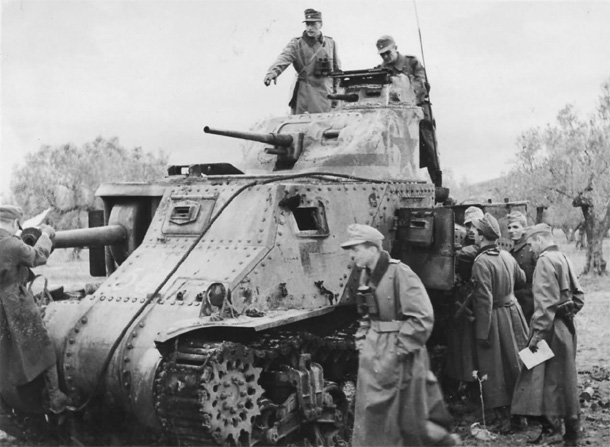
An American M3 Lee tank knocked out, apparently near the olive groves outside the town of Sbeitla, source: flickr.com, edited
The Allies naturally expected the Germans to keep pushing after their previous successes, but did not know which direction the next blow would come from. They therefore tried to build defences on all three possible routes of further German advance: from Thélepte toward Tebessa, from Kasserine toward Thala, and from Sbeitla toward Sbiba. For the remainder of this account, however, we will focus exclusively on the events at Kasserine Pass itself. On the eve of the German attack, the pass was defended by a mix of several American units. From the German (i.e. southeastern) side, only a single road led into the pass (road No. 17). At the narrowest point of the pass this road forked. The original road No. 17 continued to the right (essentially northward) toward the town of Thala. The left fork (road No. 13) ran in a more westerly direction. The Americans built their main defensive line a short distance past this junction.
On the left wing of the defensive line (from the American perspective) was the 1st Battalion of the 26th Infantry Regiment, 1st Infantry Division. On the right wing was the 19th Engineer Regiment. Also present were self-propelled half-track guns from the 805th Tank Destroyer Battalion, two batteries of 105 mm guns from the 33rd Field Artillery Battalion, and one battery of elderly French 75 mm guns. Command of the defence was entrusted to Colonel Stark, earning the formation the nickname "Stark Force" (though the colonel only formally assumed command on the morning of the German attack). During 17 and 18 February the Americans laid roughly three thousand mines in the area around the pass. Infantry was also deployed in the surrounding hills and rocks — Djebel Semmama on the northeastern side of the pass and Djebel Chambi on the southwestern side.
The Attack on the Pass
Operation Sturmflut began on Friday 19 February 1943. The assault on Kasserine Pass was opened by the 33rd Reconnaissance Battalion (Aufklärungs-Abteilung 33). The American defenders were on alert, however, and managed to repel the first push by the German scouts without too much difficulty. Two further grenadier battalions from Panzergrenadier-Regiment Afrika were therefore brought up. One battalion drove through the pass itself, while the soldiers of the second began climbing the slopes of Djebel Semmama on the northeastern side of the pass. Around noon the first German tanks finally joined the action. The fighting was very intense. The Germans advanced slowly but steadily. During the afternoon the Americans did reinforce the pass defence with fresh troops (including eight Sherman tanks from the 13th Armored Regiment of the 1st Armored Division), but at the same time, together with the British, they began preparing for the possibility that the Germans would break through. This meant building defences on both roads leading out of the pass. The northern road No. 17 toward the town of Thala was occupied during the afternoon by British infantry, artillery, anti-tank guns and also seven Valentine tanks and four Crusader tanks. The defence of road No. 13, by contrast, was covered by the Americans.
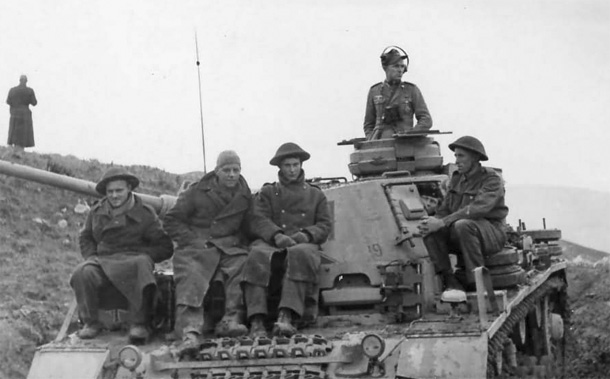
British soldiers captured beyond Kasserine Pass waiting to be transported to the German rear, source: flickr.com, edited
Seeing the fierce resistance of the defenders in the pass and on the surrounding slopes, Rommel decided that the returning 10th Panzer Division should be committed here to assist Kampfgruppe DAK. The first elements of the 10th Panzer Division, however, only reached the pass during the night of 19 to 20 February. The fighting in the mountains around the pass continued at varying intensity throughout the night, and the Germans did manage to outflank and cut off some American soldiers on the crests of Djebel Semmama, but there was no decisive breakthrough during the hours of darkness. At around 8:30 a.m. on 20 February 1943 the Germans renewed their assault. The main striking force remained the two grenadier battalions of Panzergrenadier-Regiment Afrika, but they were now joined by another battalion of Italian Bersaglieri (elite light infantry) and virtually all available artillery went into action as well, including a battery of the new Nebelwerfer rocket launchers making their African debut. Around noon the American defensive line in the pass began to collapse. Tanks, infantry, anti-tank guns and field artillery all started pulling back. Now it was the turn of the Allied forces positioned to defend the roads beyond the pass.
Thala or Tebessa?
Rommel, who had arrived at the pass in person that morning to assess the situation, ordered an afternoon attack by all available forces of both Kampfgruppe DAK and the 10th Panzer Division. Both units were to pass side by side through the now-open pass and then each continue along one of the two roads. Kampfgruppe DAK was to advance left along road No. 13 toward the town of Tebessa, while the 10th Panzer Division was to follow road No. 17 toward the town of Thala. Precisely as instructed, the German-Italian units passed through the pass during the afternoon and divided onto the two agreed routes. What was the reason behind Rommel's decision to send his forces in two different directions? The advance on Thala was entirely consistent with the official objective of Operation Sturmflut, as the road from Thala continued north to El Kef. The advance on Tebessa, however, was somehow "off the prescribed route." Do you remember what objective Rommel himself had originally proposed for his offensive before Comando Supremo designated El Kef instead? Yes — it was Tebessa. Is it possible that Rommel intended to pursue his personal ambitions in defiance of orders? Or did he merely want to ensure that no unexpected Allied counterattack came from that direction? The literature does not provide a fully clear answer. In any case, Kampfgruppe DAK and the 10th Panzer Division parted ways beyond Kasserine Pass and headed off in different directions.
Kampfgruppe DAK sent a battalion of the Italian armoured division Centauro and the German 33rd Reconnaissance Battalion (Aufklärungs-Abteilung 33) as its vanguard. These soldiers covered roughly eight kilometres along road No. 13 without any contact with the enemy before darkness fell. The 10th Panzer Division, advancing from the pass along road No. 17 with around 30 tanks, 20 self-propelled guns, 35 half-track transports and a number of cross-country vehicles, by contrast ran into Allied defences after just a few kilometres. This was the battle group under Lieutenant Colonel Adrian Gore, which included among others the seven British Valentine tanks and four Crusader tanks mentioned above. The Germans swept Gore's group aside, destroying all 11 British tanks in the process. Their rapid advance also cut off the 3rd Battalion of the 6th Motorised Infantry Regiment of the 1st Armored Division, which was still fighting in the Djebel Semmama range. At the foot of the hills, 30 American half-track armoured personnel carriers belonging to that very battalion were parked, fully fuelled and undamaged — a very welcome prize for the Germans.
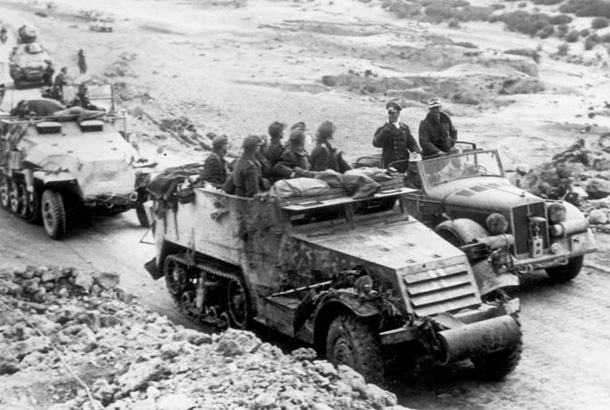
Rommel in a Horch Kfz 21 cross-country vehicle passing his soldiers riding in a captured American M3 half-track, source: flickr.com, edited
The Allies used the night of 20 to 21 February to strengthen their defensive positions. Road No. 13 was defended by an American tank battalion from Combat Command B of the 1st Armored Division and a battalion of motorised infantry, all backed by self-propelled guns and half-track tank destroyers. This fighting force held positions in the area of the hill of Djebel el Hamra. Road No. 17 was defended by tanks of the British 2nd Lothians Regiment, deployed roughly 15 kilometres short of the town of Thala. The forward elements of Kampfgruppe DAK made contact with the Americans only in the early morning of 21 February. Around noon the rest of Kampfgruppe DAK began moving up to the front, and sometime after 4 p.m. the Germans launched their attack — but were repulsed. The Germans attempted to regroup during the night to be able to strike at a different point in the morning. During the nocturnal movement, however, Panzergrenadier-Regiment Afrika became somewhat lost and separated from the rest of the group. It did succeed in pushing back some of the Americans it encountered, but soon found itself "isolated" on one of the hills and within range of American artillery. In daylight Panzergrenadier-Regiment Afrika was unable to return to the rest of the German forces, and so Kampfgruppe DAK could not mount a full concentrated attack. The Americans, however, did not hesitate — they seized the initiative and forced the scattered German-Italian units to fall back toward Kasserine Pass. The advance of Kampfgruppe DAK was over by 22 February 1943.
The 10th Panzer Division on the road to Thala was faring considerably better — at least on the first day, 21 February. During the morning its forward units tested the strength of the British defences, and only around 3 p.m. did the main attack get underway. British losses mounted rapidly until their commander Dunphie was forced to order a withdrawal to the next defensive line before the town late in the afternoon. The Germans, however, managed to use a captured Valentine tank to inconspicuously infiltrate the new British positions and trigger close-quarters fighting there. The British lost 38 Crusader and Valentine tanks, 28 guns, and six to seven hundred of their soldiers were taken prisoner. The German advance was slowed, however, which gave the Allies time to rush additional reinforcements to Thala, most notably powerful American artillery with 155 mm howitzers.
The 10th Panzer Division commander Colonel von Broich had originally planned to renew the attack on Thala first thing on the morning of 22 February, but the Allies threw him completely off balance with a deceptive morning counterattack. At 7 a.m. the British sent a literal handful of their remaining serviceable tanks against the German positions (essentially a suicidal action) while simultaneously opening artillery fire. Von Broich became convinced that this was the precursor to a much larger counterattack and ordered his soldiers to temporarily go on the defensive. Only at 4 p.m., when nothing further had happened, did von Broich order the attack on Thala to resume. By then, however, Allied air reinforcements had also finally arrived. Swarms of P-38 fighter-bombers pounced on the German positions, and in the end no German attack took place on 22 February.
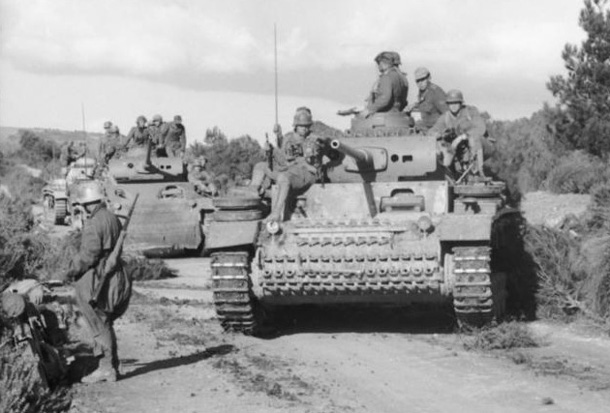
Panzer III tanks during the fighting in Tunisia, source: Bundesarchiv_Bild_101I-788-0006-16, edited
The End of the Offensive
On 22 February 1943 Rommel carried out an assessment of his forces' situation. Kampfgruppe DAK was retreating from Djebel el Hamra back toward Kasserine Pass. The 21st Panzer Division had been fighting the Allied defences near the village of Sbiba for the third day without success. And although the 10th Panzer Division stood at the gates of Thala, fresh aerial reconnaissance photographs made it perfectly clear to Rommel that powerful American artillery had arrived at the town, artillery that would in all likelihood drown any further German assault attempt in blood. At an afternoon briefing with Field Marshal Kesselring, Rommel therefore proposed ending Operation Sturmflut. Kesselring agreed and asked Comando Supremo for an official decision, though Rommel immediately issued an order for the 10th Panzer Division to begin withdrawing from Thala back toward Kasserine Pass. Kesselring reportedly noted in his diary that day that Rommel was utterly exhausted, both physically and mentally.
Comando Supremo officially approved the termination of the entire offensive just before midnight on 22 February 1943. All combat units involved in Operation Sturmflut were to immediately cease offensive actions and withdraw to their starting positions. By the morning of 23 February, German and Italian soldiers of the 10th Panzer Division and Kampfgruppe DAK were marching back through Kasserine Pass — the very pass they had fought to capture just three days earlier in the opposite direction. Engineers followed the withdrawing units, laying mines and booby traps intended to slow down any American pursuers — though this turned out to be essentially unnecessary. The Americans in the town of Thala had not noticed the German withdrawal at all and spent the entire day anticipating another attack. Only toward evening did they realise what was happening. Even then they did not pursue the retreating enemy, but merely advanced cautiously to assess the situation. The Americans did not actually enter Kasserine Pass until the morning of 25 February. As a result, the German withdrawal proceeded very quietly and without losses.
Assessment
While the Germans achieved several fine tactical victories during operations Frühlingswind, Morgenluft and (partially) Sturmflut, they gained nothing of strategic value. According to German records, the Allies lost at least 235 tanks, 95 armoured personnel carriers, and around 3,700 prisoners during these operations. American records speak of 183 of their own tanks lost, 194 half-track transports, 208 guns and 560 lorries. To this must be added approximately 100 destroyed British tanks. American personnel losses were 192 killed, 2,624 wounded and 2,459 missing; British personnel losses are not given in the sources. And the Germans? The February offensive cost them 20 tanks, 61 other motor vehicles, 201 killed, 536 wounded and 252 missing.
Just before midnight on 22 February 1943, the order came for all units engaged in Operation Sturmflut to immediately cease offensive actions and withdraw to their starting positions, source: Public Domain, edited
Although the Allies suffered materially far greater losses than their attacker, this represented no fatal blow to them. Most of the British tanks lost were of the Valentine and Crusader types, which were already obsolete at that point and were in any case about to be replaced by new American Shermans. The Allies were also — unlike the Germans — capable of replacing their losses relatively quickly. By far the greatest losses were suffered by the American 1st Armored Division. For the American tank forces, the first encounter with the battle-hardened tankmen of the Wehrmacht was genuinely a shock. Fortunately for them, however, it happened here, in Africa, on a battlefield of relatively peripheral importance — and in the final analysis this failure turned out to be genuinely useful for the Americans. They had experienced first-hand that self-confidence and material superiority are not everything, and that their training and tactics required a fundamental overhaul — which they subsequently carried out. Had this awakening not occurred in February 1943 in Tunisia but only in June 1944 in France, the consequences for the Americans would have been far, far more serious.
The German offensive had a chance to deal the Allies a strategically significant blow only if it had managed to advance very quickly through Thala to El Kef and then further north all the way to Tabarka on the coast. That would have cut off the massive British forces in northern Tunisia, and if these could subsequently have been destroyed, it would have been a genuinely severe blow to Allied plans. Something like this would, at least theoretically, only have been possible if Rommel had committed all his forces in one direction as a single enormous battering ram. Instead, as we have seen, Rommel inexplicably split his forces and sent them in three different directions. On none of these three routes were the Germans strong enough to break through, and so all three axes inevitably stalled and the entire offensive fizzled out. Rommel left Africa in ignominy on 9 March 1943; the last German and Italian forces on the continent surrendered to the Allies exactly two months later.

ARTICLE
CONTENTS:
Reproducing text from the Panzernet website without the written consent of the operator is prohibited.