SCHILDKRÖTE
a turtle with a steel shell
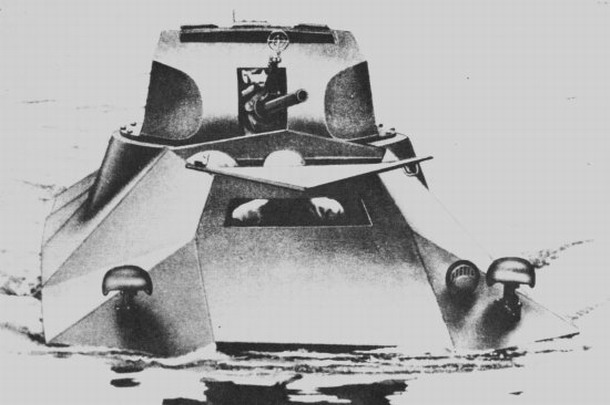
Schildkröte armoured car prototype during trials; source: Aviarmor.net, edited
The Schildkröte (turtle) amphibious armoured car was a project of Trippel Werke, who had been working on it since 1940. Schildkröte was, however, only an unofficial name for the vehicle; the official manufacturer's designation was E3. Three prototypes of this armoured vehicle were completed in 1944.
The vehicle had four conventional wheels fitted with standard pneumatic tyres. The hull was welded from steel plate between 7 and 10 mm thick. All walls, and especially the front plate, were sharply angled to increase their resistance to penetration. The crew was most likely just two men – a driver and a gunner. The driver sat in the front of the hull and looked out through a rectangular aperture directly ahead. A hatch above his position served for entry and exit.
The second crew member was stationed in a rotating turret mounted on top of the hull at roughly mid-length. The gunner entered and exited through his own hatch in the turret roof.
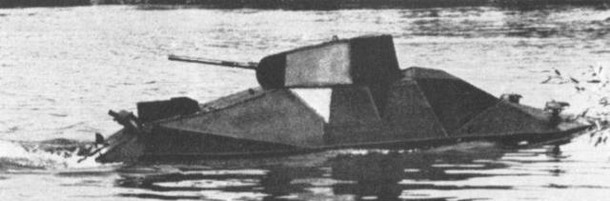
Schildkröte armoured car prototype during trials; source: Aviarmor.net, edited
The powerplant was a Tatra Typ 87 eight-cylinder engine producing a maximum of 70 horsepower, which drove both axles. For travel on water the vehicle used two propellers connected to the engine through a transmission. The vehicle carried a single integral weapon, mounted in the turret: an MG 34 machine gun of 7.92 mm calibre on the first prototype, and a 20 mm MG 151/20 automatic cannon on the other two.
The three prototypes built were both the first and the last completed examples, as series production was not approved. The primary reason for its rejection was Germany's steadily deteriorating military and economic situation in 1944, which left little room for introducing new types of armoured vehicle.
Reproducing text from the Panzernet website without the written consent of the operator is prohibited.