PANHARD P178
a French machine in German service
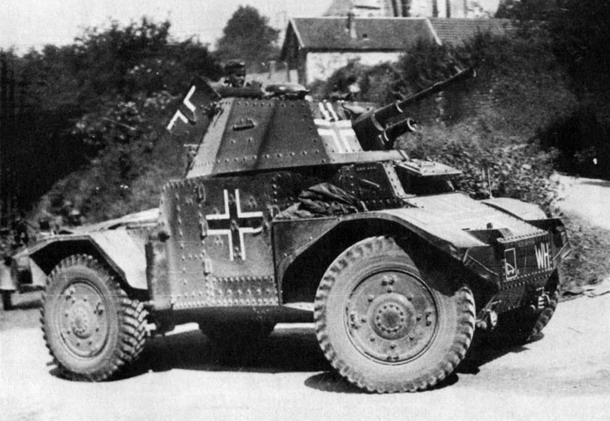
Panzerspähwagen P204(f); source: Flickr.com with permission of the publishing user, edited
Made in France
Among the materiel captured from the French was a large number of Panhard P178 armoured cars. The French army had only begun equipping itself with these vehicles shortly before the outbreak of war. They were therefore far from obsolete – on the contrary, they were very modern and reliable machines, considered by some experts to be the finest armoured cars of their day.
The Panhard P178, sometimes nicknamed "pan-pan" by its crews, rode on a four-wheel chassis fitted with conventional pneumatic tyres. The hull design was very simple yet at the same time elegant. Behind a low vertical radiator mask rose a sharply sloped front plate, flanked on either side by the front wheel mudguards. This front plate merged into a less steeply angled wall with vision ports for the driver, which formed the beginning of the raised central hull section. This section ended just ahead of the rear wheels in a sharp step, behind which the flat engine deck began, fitted with louvres to allow air to reach the powerplant.
The front section of the hull was relatively narrow, but it widened behind the front axle before narrowing again at the rear between the rear wheels. However, when viewed from above, the mudguards compensated for the narrowed nose and tail, giving the vehicle an essentially rectangular footprint. The hull was welded and riveted from 13 mm steel plate.
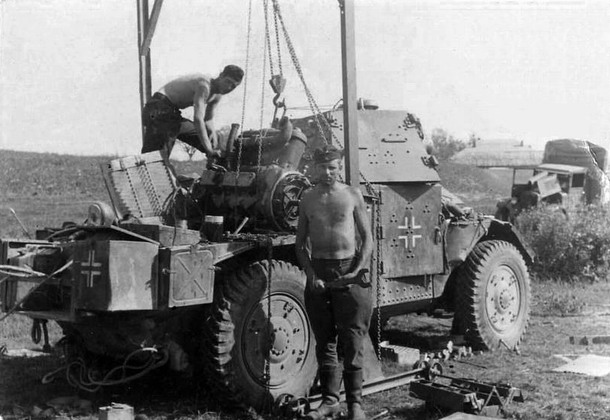
Panzerspähwagen P204(f) during engine maintenance; source: Flickr.com with permission of the publishing user, edited
The Panhard P178 had two complete driving positions and two drivers. The front driver sat centrally, immediately behind the front axle, and looked out through three closeable vision ports: one large one in the front plate directly ahead of him, and one smaller one on each side. The second driver sat facing rearward in the left half of the hull, with visibility provided by a hinged vision port in the rear wall of the raised section above the engine compartment, plus one additional port in the door to his right.
The rear driver took over control of the vehicle when reversing. Reversing an armoured car with virtually no rearward visibility was no easy task, and performing a full turn in combat conditions was far too dangerous.
The remaining two crew members occupied the fully rotating turret mounted in the centre of the hull – a loader and the commander, who also served as gunner. Each driver had his own hatch for entry and exit. In the case of the rear driver this was the already-mentioned door on his right side (left side from the perspective of the other crew members). The door was pentagonal in shape, fitted with a closeable vision port, hinged at three points, and opened towards the front of the vehicle.
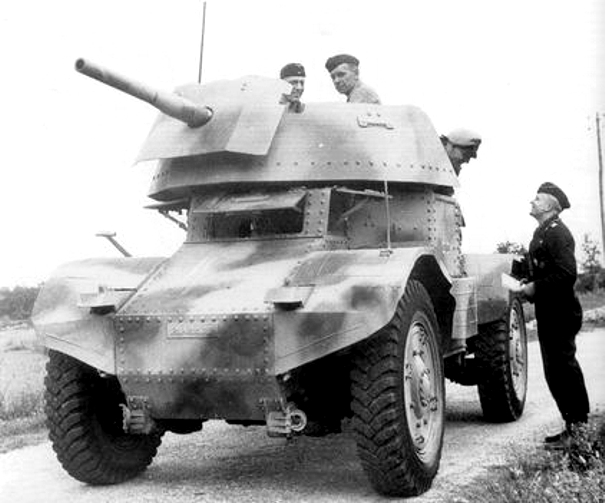
Panzerspähwagen P204(f) in the variant armed with a 50 mm gun; source: Flickr.com with permission of the publishing user, edited
The front driver's entry door was on the opposite side of the hull, to the right. It was rectangular and opened towards the rear. On the inside of this door were mounted the drum magazines for the machine gun. The commander and loader entered the vehicle either through a round hatch in the turret roof, closed by a single-piece lid, or through a larger rectangular opening in the rear wall of the turret, closed by two-part doors fitted with slit vision ports. Further similar ports were in the turret side walls, and one more was in the front wall to the right of the gun.
All of the vehicle's organic armament was installed in the manually rotated turret, though it varied depending on the specific variant. The standard and most common version of the Panhard P178 was armed with a 25 mm SA35 gun and a supplementary 7.5 mm MAC 1931 machine gun. The gun was mounted in the centre of the front turret wall, with the machine gun to its left. The machine gun barrel was enclosed in a wide sleeve that made it look optically like a second gun. Ammunition stowage totalled 150 rounds for the gun and 3,750 for the machine gun.
Vehicles assigned to junior commanders were fitted with additional whip antennas to extend their transmission range. There were two, one on the front mudguard and one on the rear mudguard on the left side of the vehicle. The antennas extended considerably above the height of the vehicle itself. To prevent them from snapping when passing under a low obstacle, they were mounted on hinged joints that allowed them to flex.
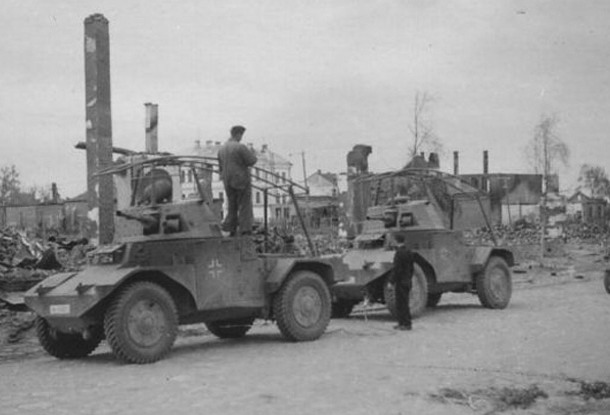
two Panzerspähwagen P204(f) converted into radio vehicles with expanded communications equipment and large frame antennas; source: Flickr.com with permission of the publishing user, edited
For senior commanders a further variant was produced with a substantially more comprehensive radio fit. Installing the more powerful – and therefore heavier and bulkier – ER27 radio set (which weighed approximately 200 kg) required significant changes. Instead of a rotating turret, a fixed box was fitted with no armament of any kind: the gun and machine gun had to give way to the radio. The vehicle was therefore not intended for direct combat but solely for directing it from behind the front line, acting as a radio bridge between field units and the rear. Vehicles of this variant also carried two whip antennas, these mounted on the right-hand mudguards.
The Panhard P178 was 4.79 m long, 2.31 m tall, and 2.01 m wide, with a total weight of 8.2 tonnes. It was powered by an eight-cylinder engine with a displacement of 6.3 litres and a maximum output of 110 horsepower, capable of propelling the vehicle to a top road speed of 72 km/h. Fuel capacity was 145 litres, giving a range of up to 300 km.
In 1940 a small number of Panhard vehicles were produced armed with a 47 mm gun. These are generally referred to as the Panhard P178B. The hull remained unchanged, but a new and larger turret was required to accommodate the new weapon. Given the German conquest of France in June 1940, however, only a very small number of vehicles with this armament were ever completed.
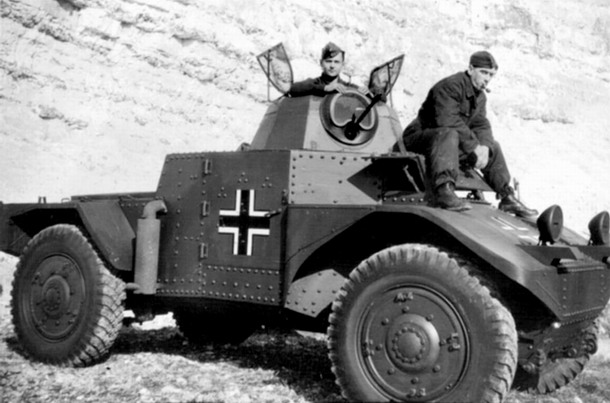
one of the many special conversions of the original Panhard; source: Flickr.com with permission of the publishing user, edited
German War Booty
Following the French capitulation, the Germans took approximately 190 Panhard P178 vehicles into service with their units, mostly in the version armed with the 25 mm gun. The Wehrmacht accepted these vehicles under the designation Panzerspähwagen P204(f). The Panhards served with police and anti-partisan units as well as with combat formations as reconnaissance vehicles. The new masters of France did not resume production, as their needs for this type of vehicle were already adequately covered by captured stocks and their own output.
Some vehicles were rearmed by the Germans with their own KwK 30 L/55 or KwK 38 L/55 guns in 20 mm calibre. During 1943 an unknown number of vehicles were then rearmed with the 50 mm KwK 38 L/42 gun. Installing this larger weapon required a complete redesign of the turret. The original turret disappeared and what replaced it was more of a rotating gun shield than a proper turret, protecting the gun crew from the front and sides but open at the top and rear (the Panhard with this armament can be seen in the first photograph).
A total of 43 Panhard vehicles were converted into armoured railway reconnaissance cars. These were fitted with steel wheels for running on rails and operated ahead of freight trains, both to scout the ground in front of them and to provide fire protection in the event of an ambush. Since these vehicles were intended for long-distance travel, they were equipped with powerful frame antennas for better radio communication. Frame antennas were also fitted to some of the standard wheeled Panhards in German service.
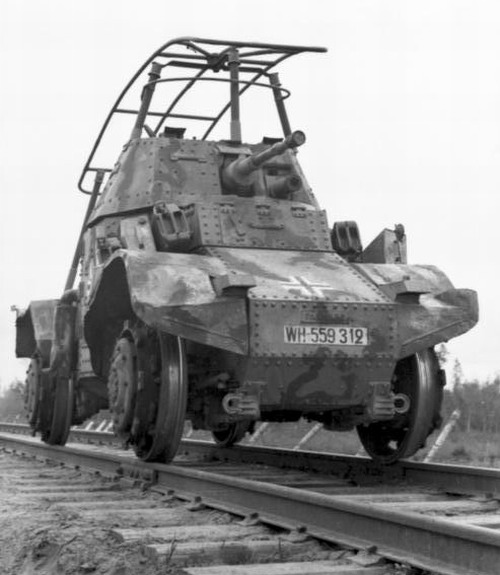
Panzerspähwagen P204(f) as a railway reconnaissance vehicle; source: Bundesarchiv_Bild_101I-639-4252-20A, Wikimedia, Creative Commons, edited
In addition to the versions already described, the Germans created at least one further modification of the Panhard P178. This was armed with only two machine guns, both installed in the turret, and served the needs of non-combat units such as war correspondents.
After the War
After the war ended, Panhard production in France was resumed. However, only the pre-war P178B variant was built – that is, the version armed with a 47 mm gun. These vehicles went on to serve in the French army until the 1960s.
ARTICLE
CONTENTS:
Reproducing text from the Panzernet website without the written consent of the operator is prohibited.