DAF M39
captured goods "made in Holland"
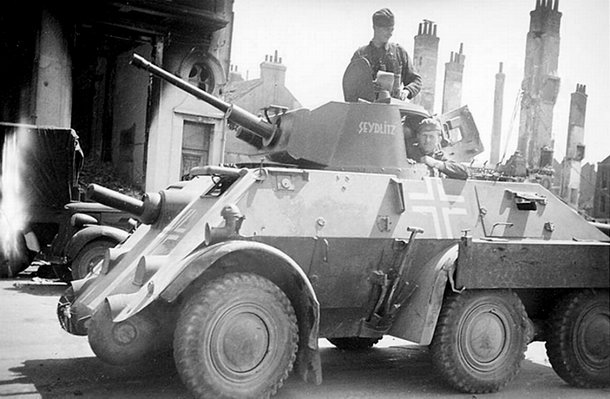
DAF M39 (also known as Panzerspähwagen DAF 201 (h)) in German service in occupied France, source: forum.worldoftanks.eu
A Vehicle for the Dutch Army
When the Dutch army was looking for an armoured vehicle for its units in the second half of the 1930s, it initially considered purchasing and adapting one of the available British designs. The Dutch trailer manufacturer DAF of Eindhoven was approached at the time about the possibility of licensed production. The company's representatives, however, sensed a business opportunity and proposed a different solution to the army: developing and manufacturing an armoured car of their own design. The army agreed, and DAF was able to present its prototype a mere eight months after receiving the government order.
Vehicle Description
The vehicle had three single wheels on each side, fitted with standard pneumatic tyres. The two rear wheels on each side were suspended and mounted together. The two rear pairs of wheels were driven, while the front pair handled steering. The chassis carried a sizeable hull of straightforward shape, with sharply sloped front and rear walls — the sloping increasing the walls' resistance to penetration. Maximum armour thickness was 12 mm.
The otherwise flat front plate was broken only by the headlights, a machine gun and the driver's vision port. The headlights were recessed into closable housings that protected them from damage. A 7.92 mm machine gun was installed on the right side of the plate, its barrel enclosed in a wide steel sleeve. To the upper left of the machine gun was the driver's rectangular vision port, which could be closed by a cover when operating in dangerous areas, leaving only a narrow slit for observation. Two further hinged vision ports were located on each side wall — the right-hand one for the hull machine gunner, the left-hand one for the driver.
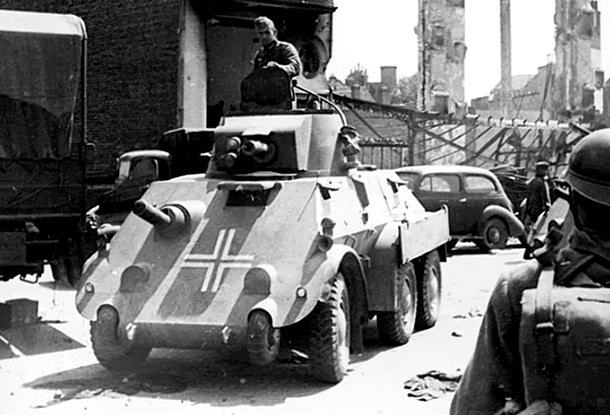
DAF M39 passing columns of French prisoners of war, source: weapons-of-war.ucoz.ru
In addition to the front driver and machine gunner already mentioned, the crew included four further men: the commander, loader and gunner — all three stationed in the rotating turret — and a rear driver. The rear driver sat facing the back of the vehicle, in the left half of the rear section of the hull. The engine occupied the right half of this section, meaning the rear driver was permanently exposed to its noise. The rear driver took over control of the vehicle when reversing — manoeuvring a reversing armoured car from the front cab, with virtually no rearward visibility, was no easy matter, and turning the entire vehicle around in combat conditions was far too dangerous. Hence the two-driver arrangement.
Crew entry and exit were provided by a large rectangular door on each side of the hull between the front and rear mudguards, as well as a hatch in the turret roof and small doors on both sides of the turret.
In the centre of the hull sat a fully rotating turret housing the vehicle's main armament — a 37 mm Bofors gun. The gun was not positioned at the centre of the turret's front wall but slightly to the right of centre, with a second 7.92 mm machine gun mounted to its left. A shared mounting allowed both weapons to be elevated vertically between -9.5° and +23°.
The vehicle weighed 5.8 tonnes. Its length was 4.75 metres, width 2.08 metres and height 2.16 metres. The powerplant was a Ford Mercury V8 engine producing a maximum output of 95 horsepower at 3,600 rpm, giving the DAF M39 a top road speed of up to 75 km/h. A fuel capacity of 100 litres allowed a range of up to 300 km.
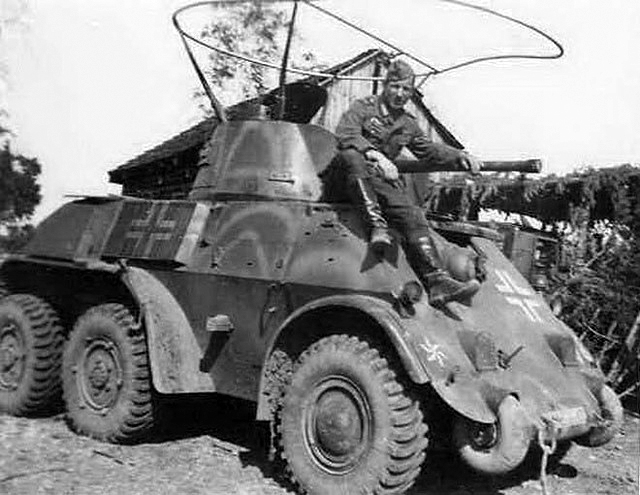
DAF M39 fitted with a frame antenna, source: Flickr.com with the permission of the publishing user, modified
An interesting design feature was two small rollers mounted on the lower edge of the front wall, which prevented the nose from digging into the ground when crossing rough terrain.
Combat Deployment
Only 12 of these armoured cars had been produced by the time the Second World War broke out. When the German army invaded in May 1940, however, the Dutch command did not commit a single one of them to battle — presumably judging that resistance would be entirely futile and the loss pointless. After the capitulation all 12 vehicles therefore fell into German hands completely undamaged.
The Germans incorporated them into their inventory under the designation Panzerspähwagen DAF 201 (h). They were deployed in action in France and in the early stages of fighting in the East. Photographs confirm that at least three of these cars were fitted with frame antennas, suggesting they may well have served as command vehicles. How long these vehicles remained in German service and what ultimately became of them is not known; what is certain is that at least three were destroyed on the Eastern Front. The surviving examples most likely ended their days in the role of vehicles for police and security units in the rear areas.
ARTICLE
CONTENTS:
Reproducing text from the Panzernet website without the written consent of the operator is prohibited.