ADGZ
Austrian heavy armoured car
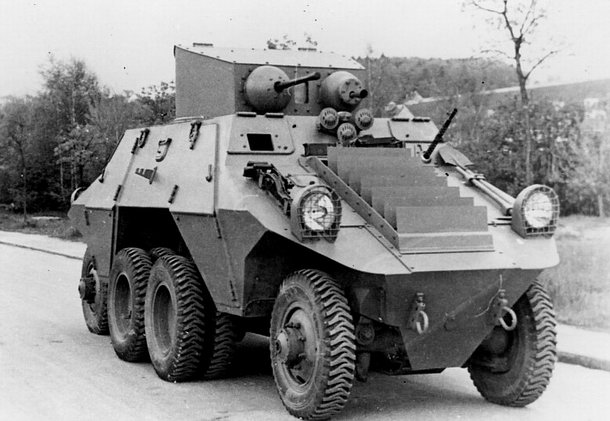
armoured car ADGZ, source: warwheels.net with the permission of the site operator, edited
Origins of the Vehicle
Development of the heavy armoured car ADGZ was initiated by the Austrian manufacturer Austro Daimler Puch Werke as early as 1928. The project did not take on a definite form until 1931, however, and the first prototype appeared two years after that.
Vehicle Description
The armoured car rested on a cleverly designed chassis with four axles. The two middle axles were placed close together at the centre of the vehicle and fitted with doubled wheels. The two outer axles had single wheels and were steerable. The chassis carried an equally interesting armoured hull, constructed from flat armour plates joined by a combination of welding and riveting. Armour thickness was 11 mm on all walls.
The front and rear halves of the vehicle were almost mirror images of each other. Where the front wall of the forward half was sharply raked, the rear half featured a raised engine compartment cover in the equivalent position. At the front this wall was fitted with louvres to regulate the flow of air to the cooling unit and into the cab itself. On either side of these louvres were two headlights protected by wire grilles. The louvred section was followed by a more vertical plate incorporating two closable vision ports and a 7.92 mm machine gun — an arrangement repeated identically at the rear of the vehicle. Hinged vision ports were also fitted on both sides of the hull, at mid-length.
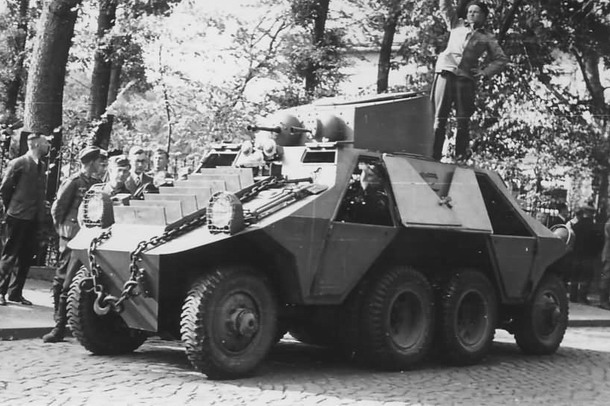
armoured car ADGZ, source: worldwarphotos.info with the permission of the site operator, edited
On each side of the hull there were two hexagonal doors for crew entry and exit. The upper half of each door could be folded down to allow ventilation of the interior. The vehicle's total weight was 12 tonnes. The crew comprised six men.
A rotating turret sat on top of the hull, housing the vehicle's main armament: a KwK 35 rapid-fire cannon in 20 mm calibre. A 7.92 mm machine gun was mounted to the left of the cannon. The vehicle thus carried three machine guns in total.
The powerplant was an Austro Daimler M 612 six-cylinder engine with a displacement of 11.9 litres and a maximum output of 150 horsepower. The gearbox offered three ratios for travel in both directions. The vehicle was capable of reaching an impressive top speed of 70 km/h on roads — a figure that naturally fell considerably in cross-country conditions. Although the car was designed primarily for movement and combat on hard-surfaced roads, it proved surprisingly capable in more broken terrain as well.
Following the completion of prototype trials, series production began in 1933 and continued until 1937. Over this period, however, only 27 vehicles were produced in total. After the Anschluss of Austria, all of the vehicles were taken into German service.
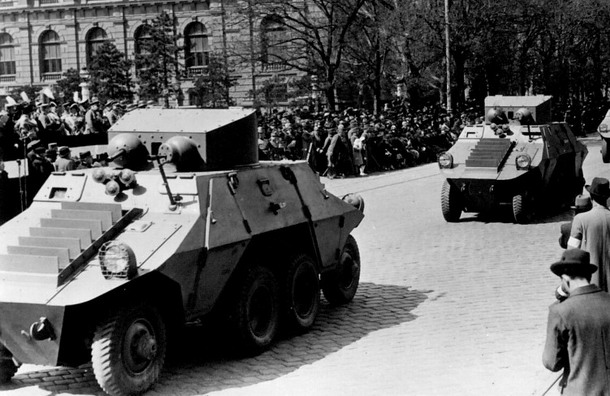
ADGZ armoured cars during a military parade, source: warwheels.net with the permission of the site operator, edited
German Use
The Germans showed no particular enthusiasm for these vehicles. Production was not resumed and the requisitioned cars were assigned only to police units. In practice, however, the vehicles proved themselves sufficiently that the Wehrmacht eventually placed an order in 1942 for a further series of 25 vehicles. In German hands they saw combat deployment in the Balkans, in the Soviet Union, and eventually on the Western Front as well — though the majority continued to serve with police or anti-partisan units. By 1944, the vehicles were beginning to be withdrawn from service as obsolete.
ARTICLE
CONTENTS:
Reproducing text from the Panzernet website without the written consent of the operator is prohibited.