PANZERKOMPANIE-Z
or: how to disguise illegal tank development
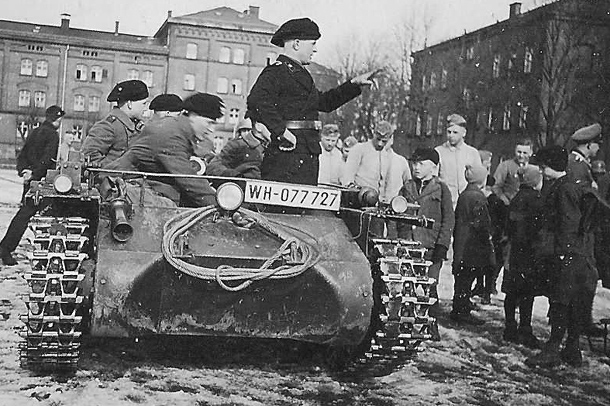
this is where it all started... to disguise the development of banned weapons, the Germans passed off their first tanks as a fairground attraction for children — specifically, the La.S. type (launiger Schlepper, or "jolly tractor") giving children rides at a funfair in Zossen, source: Flickr.com with permission of the publishing user, edited
The Treaty of Versailles, signed in 1919, imposed on defeated Germany not only the payment of enormous reparations, but also a prohibition on the development and manufacture of many types of weapons — particularly modern and effective ones. Tanks included. The German army's high command, however, had no intention of missing the train of progress, and very soon began thinking about how the terms of the Versailles Treaty might be quietly circumvented. And so it came about that barely ten years after the end of the Great War, Germany was cheerfully working on the development of its own tanks once again.
Everything had to be kept under strict secrecy, however, because compliance with the imposed restrictions was carefully monitored by the French. The development, manufacture, and testing of a new tank type is an undertaking that involves a great many contracts, orders, minutes, protocols, and other official paperwork. Everything therefore had to be arranged so that none of these documents contained anything that might hint to the supervising authorities — even remotely — that a new tank was being developed. A cover name and a sufficiently convincing cover story had to be devised for the planned vehicle. For the first two types, whose development began in the 1920s, the Germans chose the cover designations Grosstraktor and Leichttraktor — large tractor and light tractor — and according to all official documentation these were agricultural, not military, machines.
The Germans intended to proceed similarly with the next type, whose development got under way in the early 1930s — now under the direction of Lieutenant Colonel Heinz Guderian. This was the light tank that would later become known as the Panzer I. In the specification issued to Krupp in September 1931, however, the vehicle was designated Kleintraktor — small tractor. The German Ordnance Office was beginning to worry, though, that the French might find it suspicious that the German army kept gravitating towards the development of yet another type of agricultural tractor — the third already. The officials therefore asked Lieutenant Colonel Guderian to come up with some new cover story, preferably from a completely different field than agriculture.
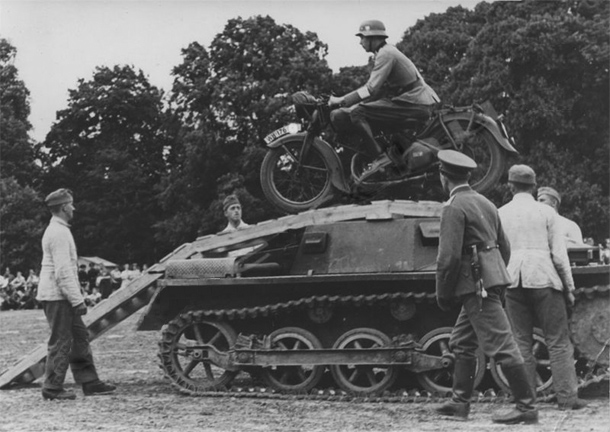
to make the cover story watertight and prevent the French inspectors from seeing through it, the Germans formed a special tank company composed of former circus performers who knew how to put on a proper show — for children and adults alike, source: Flickr.com with permission of the publishing user, edited
Guderian had by that point already conducted several large military exercises in which his tank crews had used simple tank mock-ups made of canvas and plywood. The standard reaction of the other soldiers to these "tanks" was volleys of laughter and an abundance of gleeful jokes.
This experience gave Guderian a simple but inspired idea. If canvas tank mock-ups were such a source of amusement for everyone, why not use that as the formal cover for the development of real tanks? And so Guderian proposed changing the cover name of the new Panzer I from "Kleintraktor" to "launiger Schlepper" — literally "jolly hauler" or "fun tractor" — abbreviated to La.S.
The new designation naturally required a new cover story to go with it. The German population, battered by the economic crisis, needed every possible form of entertainment to take its mind off the hardships of daily life. And since the German army — cut to a minimum by the Treaty of Versailles — could not provide its nation with proper military protection, it would instead provide at least amusement and merriment. The official stated purpose of the newly developed La.S. was therefore: a vehicle for fun and thrilling rides for children and ordinary citizens at fairs, festivals, and public celebrations — something along the lines of a fairground ride, essentially. The Ordnance Office approved, and the designation La.S. duly appeared in all documents connected with the development of the Panzer I from that point on.
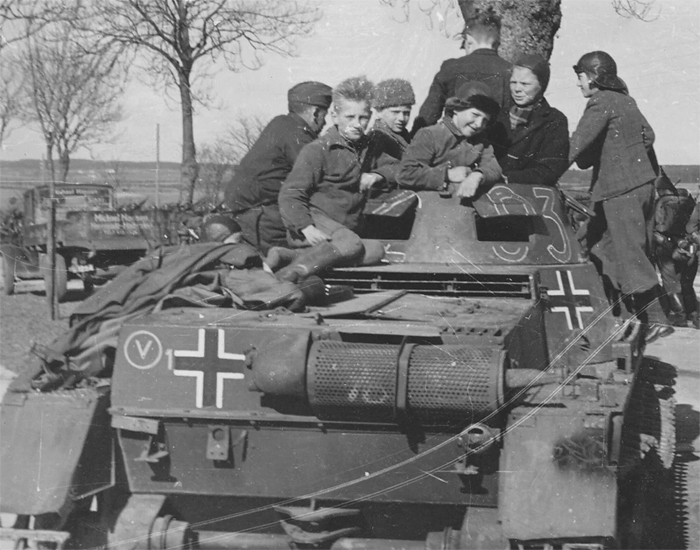
another public celebration somewhere in Germany, and the members of Panzerkompanie-Z have gone into action again, entertaining the local civilians — children especially, source: Flickr.com with permission of the publishing user, edited
But the work on the cover story did not end there. Preparations also had to be made for the eventuality that French inspection commissioners would want to see such an entertaining hauler demonstrated in action. The Germans, renowned for their thoroughness, thought everything through to the last detail. The French inspectors were not stupid, and a cheap charade would not fool them. The army therefore needed someone in its ranks with experience in organising public celebrations and entertaining children — someone who knew how to put on a show.
In December 1933, a special company was therefore established within the tank training battalion at Zossen, and the relevant Wehrkreis (military district) was tasked with recruiting personnel for it from among circus workers — specifically men who in civilian life had performed as clowns, acrobats, and entertainers. It was this that earned the special tank company its name: Panzerkompanie-Z, where the letter Z stood for Zirkus — German for circus.
In January 1934 the unit received its first La.S. vehicles. These were not, of course, fully equipped tanks with armament — nobody could have explained that to the French even after three bottles of wine — but merely chassis with open cargo beds, no roof, no turret, and no weapons. On these machines the members of the special "circus" company were to undergo driver training and then take part in children's days, carnivals, and funfairs all across Germany, where — in full view of the French commissioners — they would give children rides up and down hills, through mud, puddles, and streams, and perform various other acrobatic stunts.
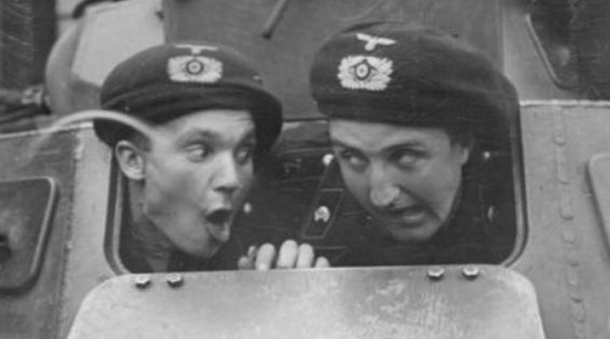
a rare photograph from a performance by the comedy duo Karl and Otto; their sketch "Wer hat hier gefurzt?" was based on the search for the source of a mysterious smell inside the tank — children were in absolute stitches, source: Flickr.com with permission of the publishing user, edited
The Ordnance Office took a liking to the idea of passing the tanks under development off as fairground vehicles, and decided to use the same cover story for the next types in the pipeline as well. For the Panzer II, the Waffenamt even shamelessly recycled the cover name, simply adding a number: launiger Schlepper 100, or La.S. 100.
At the beginning of 1934, development began on two further tank types: the Panzer III and the Panzer IV. Here the Germans were a little wary of using the La.S. designation again in case it raised suspicions, and so new cover names were devised. The Panzer III project was designated "magic coach" — in German, Zauberwagen, most commonly abbreviated to Z.W. — while the Panzer IV project received the cover name "entertainment coach" — in German, Belustigendwagen, abbreviated to B.W. The new tank types naturally also began appearing at public events, at which the special circus company from Zossen performed all manner of conjuring acts, acrobatic numbers, and mischievous comic sketches for the public — and for the French inspectors.
As time went on, German inhibitions faded and they began sending fully armed complete tanks to the celebrations. At one such event — the Frankfurt harvest festival — the French commissioner Michel Martin reportedly asked one of the organisers why the entertainment coaches had cannons. The quick-thinking German army representative shot back without a moment's hesitation: "What sort of a celebration would it be without a bit of banging and crashing, eh?" — and offered the commissioner another Bratwurst, on the house.
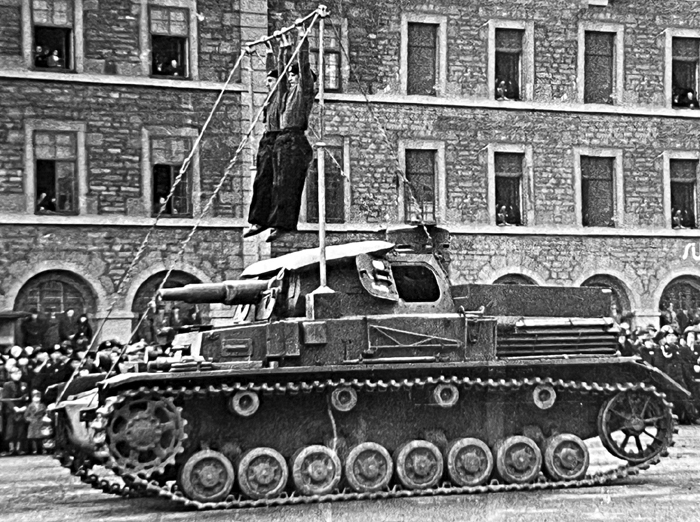
the same cover story continued to serve for further German tank types; here specifically the B.W. type — Belustigendwagen or "entertainment coach" — during an acrobatic display at a Berlin carnival, source: Flickr.com with permission of the publishing user, edited
Some of the "soldiers" in the circus company became famous across all of Germany thanks to their frequent public appearances — and not only among children. This was true, for example, of the comedy duo Karl and Otto, whose comic sketch "Wer hat hier gefurzt?" became so well known that it was soon being imitated by other comedians performing at variety shows around the country.
When Adolf Hitler came to power in Germany and decided to tear up the Treaty of Versailles along with all its prohibitions, the special "entertainment" company lost its purpose. The armoured branch stopped hiding and its rapid expansion began in earnest. The circus performers in their black uniforms were somehow forgotten by everyone in the process. These soldiers remained at Zossen and, with nothing worthwhile to do, whiled away their spare time performing at pubs in the surrounding area. The army only remembered them again at the turn of 1942 to 1943.
By that time, German forces in North Africa were in serious crisis, and plugging the gap required every available pair of hands. Most of the available units were committed on the Eastern Front — where the stakes were equally high — and so the Germans were forced to start dipping into their reserves. It was at this point that someone remembered there was a circus company sitting idle, and that even if it was full of tattooed and poorly disciplined bohemians, they were men who had tanker training and might prove useful in Africa.
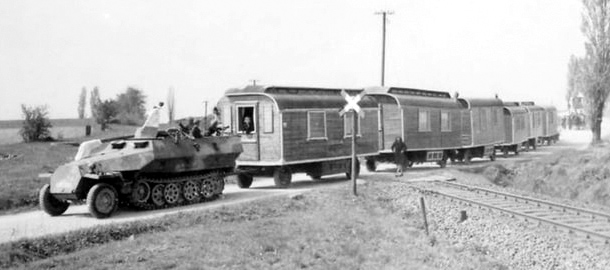
Panzerkompanie-Z making its own way south through Italy, from where it was to continue by ship to Tunisia, source: Flickr.com with permission of the publishing user, edited
In January 1943, Panzerkompanie-Z duly received orders to prepare immediately for transfer to Italy, from where it was to proceed by ship to Tunisia. The soldiers packed up their costumes, wigs, make-up, and comedy noses, their trapeze bars, hoops, and drums, and set off southward rather cheerfully after months of boredom. The move to Italy was as unconventional as Panzerkompanie-Z itself. The unit did not travel by train as was customary, but under its own steam, just as circus people had travelled their whole lives. There is little need to elaborate further — one need only look at the rare photograph above, which has miraculously survived in German archives from this journey.
In Tunisia, Panzerkompanie-Z was attached to the 10th Panzer Division and sent to a quieter section of the front to hold a defensive line against any Allied advance from the west. The attempt to use the company in combat, however, ended in fiasco. Suspicions that something was not quite right surfaced after barely a week of the unit's time at the front. Without having made contact with the enemy at all, the company had already reported the permanent loss of a considerable number of fighting vehicles. The commanding officer of the 10th Panzer Division ordered an investigation and could not believe what he found.
In an Africa teeming with exotic animals, the old circus hands had very quickly been reminded of their days performing in the ring under the big top, and had felt an irresistible longing to touch again that dazzling world from which the army had torn them. As it emerged, the soldiers of Panzerkompanie-Z had needed only one week at the front to trade with local Bedouins — six tanks and approximately twenty other wheeled vehicles, in exchange for an unspecified quantity of camels, dromedaries, monkeys, parrots, and snakes.
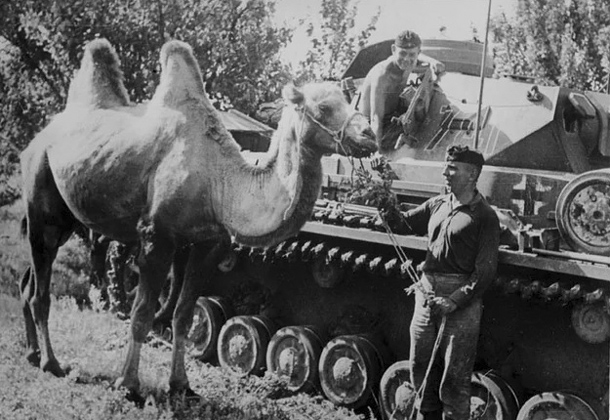
fiasco in Tunisia! The members of the circus tank company managed, in a single week in Africa, to trade six tanks and twenty other vehicles for exotic animals! This photograph captures the moment a deal is struck: one Panzer IV for 10 camels — the joy on the soldiers' faces speaks for itself, source: Flickr.com with permission of the publishing user, edited
It looked for a moment as though the entire circus company was going to rot in a Tunisian prison, but the Minister of Propaganda, Josef Goebbels, stepped in personally. And why him, of all people? The beginning of 1943 was not a happy time for the German armed forces. The Sixth Army encircled at Stalingrad was fighting its last battles, and virtually the entire southern wing of the Eastern Front was beginning to crumble. German families were gripped with terror for the fate of the hundreds of thousands of husbands, sons, grandsons, and brothers who were caught up in the disaster.
Goebbels was beginning to notice a certain despondency spreading among the population, and the once boundless trust in the German army was shaking. He was therefore thinking about how to reverse this unwelcome trend. He was looking for something that would entertain the masses while coming from the army — which would help people develop a positive attitude towards it once more. And when news reached him of the fiasco of Panzerkompanie-Z's combat deployment in Africa, he took it as a sign. He immediately ordered the entire company transported back to Germany to serve out its punishment — and then went to meet its members with an offer they could not refuse.
Goebbels, as always, had thought everything through. He was well aware that one company of circus performers was not enough to entertain an entire nation. But he saw it as a seed — the foundation for something far greater... though we shall have to save that story for another time.
1st April 2026, HAPPY APRIL FOOLS' DAY!

Reproducing text from the Panzernet website without the written consent of the operator is prohibited.