BA-22
a rejected armoured personnel carrier
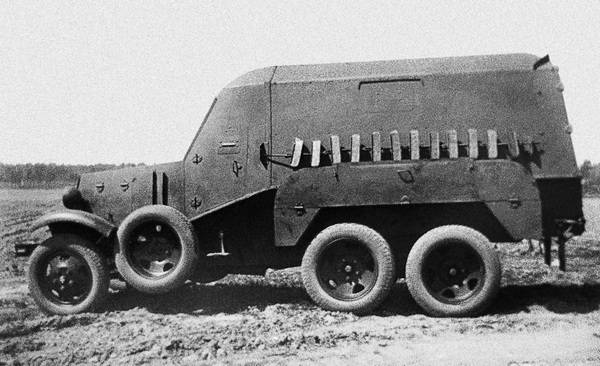
BA-22 prototype, source: Wikimedia, Public domain, edited
Origins and Description of the Vehicle
The BA-22 prototype was built in 1939 at the Izhora Factory as the first Soviet attempt at an armoured personnel carrier. Like many other Soviet armoured vehicles of the period, the BA-22 was built on the three-axle chassis of the GAZ-AAA truck. The front steerable wheels were single, while the two rear pairs were doubled, giving the vehicle a total of ten wheels.
The chassis carried a hull welded from flat 6 mm steel plates. The front section, with its nose plate and engine bonnet, was closely similar in design to other BA-series armoured cars. The nose of the engine compartment was narrow, with the front wheel mudguards flanking it on either side. These, along with the front bumper, were carried over directly from the GAZ truck. The engine compartment widened towards the rear before opening into the raised crew cabin.
The front wall of the cabin carried a pair of vision ports fitted with openable covers, each cover incorporating a slit for observation when closed in a combat area. Large entry doors in the cabin side walls were similarly fitted with vision ports. The only two permanent crew members — the commander and the driver — were seated in this cabin. The rear portion of the hull provided space for an infantry section of up to ten men, who embarked and disembarked through doors in the rear wall of the hull.

BA-22 prototype, source: Wikimedia, Public domain, edited
The BA-22 had a combat weight of 5,240 kg. The powerplant was a GAZ-AA four-cylinder engine with a maximum output of 40 hp, giving a top road speed of 40 km/h. With 110 litres of fuel on board the vehicle had a road range of around 250 km. The vehicle carried no integral armament. It was, however, equipped with a type 71-TK-1 radio set for communication with headquarters and other vehicles.
One of the wheeled vehicle's greatest disadvantages was its limited cross-country capability. The designers attempted to mitigate this at least partly by fitting the vehicle with simple bolt-on tracks. Similar tracks were also used on other Soviet armoured vehicles of the period. They were slipped over the wheels of the two rear axles and stowed on the mudguards above those wheels when removed. The tracks probably improved off-road performance to some degree, but a wheeled vehicle was simply never going to cope with seriously difficult terrain. A further drawback was the vehicle's considerable height of 288 cm, which compromised stability and — more critically — made the BA-22 a relatively easy target to spot.
It was not these shortcomings, however, that led to the BA-22's rejection. The primary reason was the concept of the vehicle itself, for which Soviet army officials saw little practical application. Protecting soldiers was simply not a priority in the Red Army, and spending considerable resources to deliver troops safely to a battlefield where they would in all likelihood be killed shortly afterwards was not something the Soviets considered worthwhile. The BA-22 was therefore not approved for series production, and the prototype built remained the only example of the type ever constructed.
Technical Specifications
Weight |
5.24 t |
Length |
6.10 m |
Width |
1.98 m |
Height |
2.88 m |
Engine |
GAZ-AA |
Maximum power |
40 hp |
Maximum speed |
40 km/h |
Fuel capacity |
110 l |
Range – road |
250 km |
Armour |
6 mm |
Crew |
2 + 10 men |

ARTICLE
CONTENTS:
Reproducing text from the Tankist website without the written consent of the operator is prohibited.