TANK GROTE
when a German designs a Soviet tank
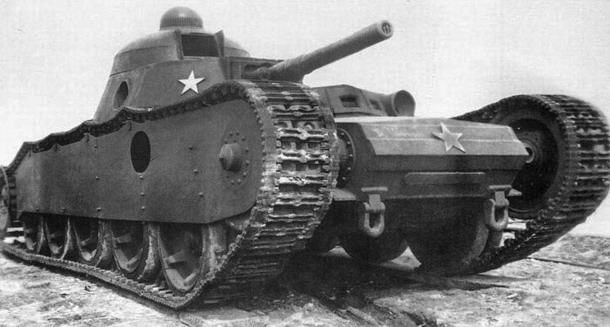
TG prototype, source: topwar.ru with permission, edited
Origins of the Tank
Behind the abbreviation TG (Tank Grote) lies a very interesting — though also very little known — medium tank project developed in the Soviet Union between 1930 and 1931. The reason this vehicle never entered wider public awareness is that it emerged from collaboration between Soviet and German designers, which was a rather unwelcome piece of information after the Second World War. The fact remains, however, that Germany and the Soviet Union cooperated quite actively on the development of land armoured vehicles during the interwar period — up until Hitler's rise to power. Germany was prohibited from developing tanks by the Treaty of Versailles, while the Soviets gained new technologies and ideas through the collaboration.
As part of this collaboration, a sizeable group of German engineers led by Eduard Grote arrived in the Soviet Union in March 1930. This group worked alongside their Russian counterparts on a total of five projects, of which only one ever reached physical realisation — the others remained at the drawing stage. The purpose of the vehicle that was actually built was to be the breaking of defended enemy lines. The tank was therefore to have heavy armour, powerful armament, and as high a speed as possible.
Technical Description
Development took place at the Bolshevik plant in Leningrad under the supervision of Soviet engineer Ujuk. Grote approached the vehicle with a very modern outlook and championed the use of new technologies — welding, for example, was used extensively in joining the steel plates instead of the more common riveting. The hull was extremely low, barely exceeding the height of the track assembly at all. The wheels and tracks were effectively attached to the sides of the hull, with only the double turret rising above them. The fact that the tracks were not covered by any mudguards from above only underscored the unusual nature of this design.
The track assembly itself consisted of five large-diameter road wheels with rubber tyres on each side, with an idler wheel at the front and a toothed drive sprocket at the rear. The upper run of the track rested on six return rollers — two small ones at the front and four larger ones with rubber rims behind them. The upper half of the track assembly was covered on the outer side by steel plates. Suspension of the road wheels was pneumatic, which proved to be one of the tank's weaknesses. Frontal armour thickness ranged from 38 to 50 mm, the side walls were 16 mm, and the rear wall, floor, and roof were 10 mm.
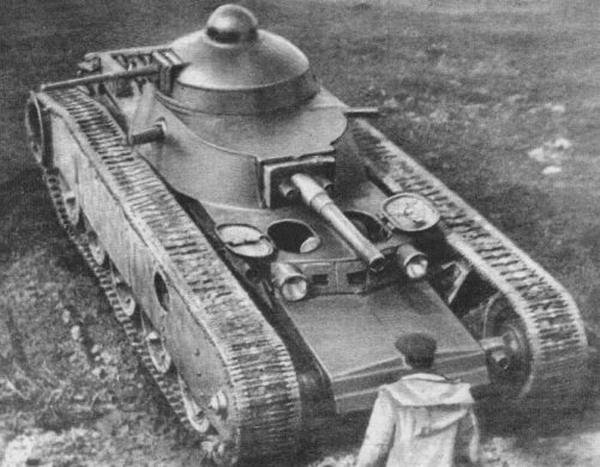
TG prototype, source: Wikimedia, Public domain, edited
In the centre of the hull sat the large main turret, which was relatively flat and oval in plan. On top of this turret — specifically in its rear half — was mounted a smaller secondary turret of circular plan with a conical roof, topped by a cupola with vision ports around its circumference. By stacking both turrets on top of each other, Grote kept the dimensions of the running gear within reasonable limits while still achieving multiple armament. The tank's primary weapon was the 76.2 mm A-19 cannon, mounted in the front face of the main turret. Three heavy water-cooled Maxim M1919 machine guns of 7.62 mm calibre were also installed in the main turret — one in the rear wall and one in each side wall, giving the main turret all-round coverage. A 37 mm PS-2 cannon was mounted in the front face of the secondary turret.
The armament did not end there. Two additional DT machine guns of the same calibre as the Maxims were installed in the hull sides — one pointing to each side — operated by the driver and the hull machine gunner. Circular apertures were cut in the side armour of the running gear through which these machine guns could be fired. On board the tank carried 50 rounds for the main gun, 300 rounds for the 37 mm cannon, and 5,000 rounds of 7.62 mm ammunition for all five machine guns. According to sources, both turrets were intended to be fully traversable, but in the event the lower one could not be rotated due to a manufacturing error. I would venture the observation that given how low the main turret sits above the tracks, it is quite possible it was never intended to traverse at all — a view supported by the positioning of the three Maxim machine guns to provide complete all-round coverage without any need to turn the turret. In any case the upper secondary turret was definitely traversable, as photographs confirm.
The crew of five consisted of the driver and the hull machine gunner, seated side by side in the forward hull section, observing through vision ports at their respective stations, each with their own oval entry and exit hatch closed by a single-piece cover. The remaining three men were stationed in the turrets. The commander sat in the upper turret, doubling as loader and gunner for the 37 mm cannon. The other gunner and loader occupied the main turret and were responsible for operating the heavier cannon and all three turret machine guns. How these three turret crew members entered and exited the vehicle is not something I have been able to determine — no hatches are visible in the turret walls in any photograph or drawing. Either they used the same hatches as the driver and hull machine gunner, or there was a hatch at the very apex of the smaller turret with the cupola hinged to open.
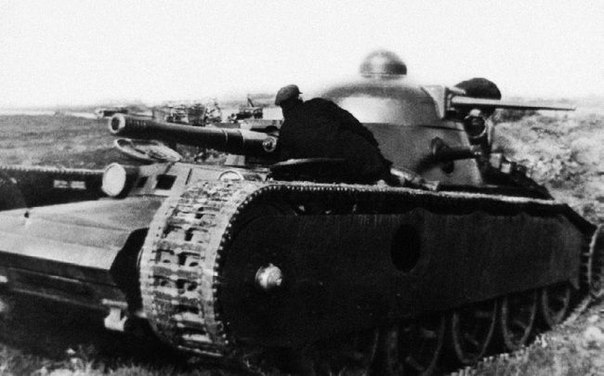
TG prototype, source: Flickr.com, Public domain, edited
The engine and gearbox were housed in the rear of the hull. The originally planned engine was not available at the time the prototype was completed, so a substitute was used — a petrol-powered eight-cylinder M6 producing 300 horsepower. The gearbox offered six speed ratios in both directions, meaning the tank could travel at the same speed forward and in reverse. Maximum speed is generally quoted as 34 km/h. The vehicle's total weight was 28.5 tonnes.
The prototype was completed in April 1931 and trials began in July. The tests demonstrated that the prototype was a success — the tank achieved its design speed and manoeuvred well. Despite all this, it was not accepted for series production. It was technically very complex, demanding to maintain, and above all prohibitively expensive to build: its price was around 1.5 million roubles, compared to just 60,000 roubles for a BT-2. The first prototype was therefore also the last.
It would certainly be fascinating to consider how this tank might have performed had it entered production and been forced to face German opponents. Given the strength of its armour and armament, it seems reasonable to assume it would have been a serious threat to the Wehrmacht — and how ironic it would have been that it was a German engineer who built it for Russia.
Technical Specifications
Weight |
28.5 t |
Length |
5.88 m |
Width |
2.20 m |
Height |
2.21 m |
Engine |
M6 |
Maximum output |
300 hp |
Maximum speed |
34 km/h |
Range – road |
150 km |
Armour |
16–50 mm |
Armament |
1 x 76.2 mm cannon 1 x 37 mm cannon 5 x 7.62 mm machine gun |
Crew |
5 men |

ARTICLE
CONTENTS:
Reproducing text from the Tankist website without the written consent of the operator is prohibited.