TANK T-12
medium tank prototype
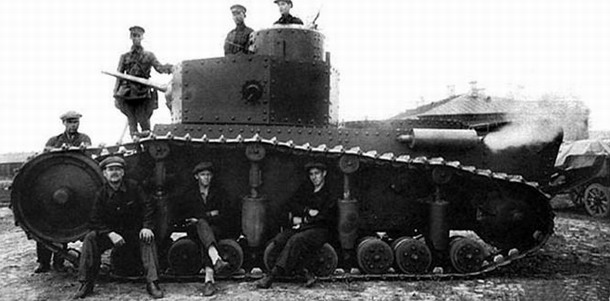
T-12 tank prototype, source: topwar.ru with permission of the operator, edited
Origins
On 17 November 1927 the Red Army command tasked the production plants in Kharkov and Chelyabinsk with developing a new medium-weight tank that would surpass the older T-18 and all other vehicles then being developed or considered. Development was led by chief designer S. Shukalov. On 15 October 1929 the first prototype of the new tank, designated T-12, was formally handed over.
Design Description
The prototype's design clearly reflected its inspiration from the T-18 light tank. The T-12's running gear arrangement was essentially an enlarged version of the T-18's. On each side it consisted of eight small-diameter paired road wheels, grouped into four bogie pairs and suspended and sprung in those pairs. At the front was a large solid idler wheel; at the rear the toothed drive sprocket. Four return rollers supported the track from above. The road wheels and rollers all had rubber tyres around their rims. Like the tank as a whole, the running gear sat quite tall — the upper run of the track reached as high as the roof of the hull.
The hull itself was constructed from flat steel plates joined by riveting. Behind the sharply pointed nose the driver's front plate rose, and from there the hull continued at the same height rearward to a vertical rear wall. Above the forward section of the hull sat a large, manually traversed turret. The turret had vertical walls, riveted from flat steel plates in the same manner as the hull. In the turret's front wall was the tank's main armament: a 45 mm Sokolov gun. To the right of the gun were two coaxially mounted 7.62 mm machine guns. A further pair of machine guns of the same type was installed in the left side wall.
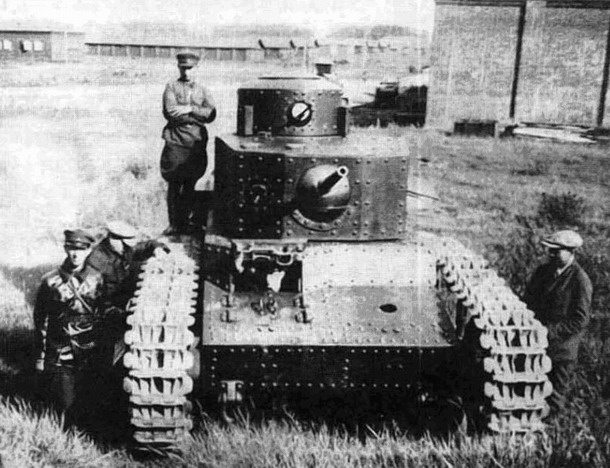
T-12 tank prototype, source: Flickr.com, Public domain, edited
Rising from the rear section of the main turret roof was a small secondary turret, housing yet another pair of machine guns. The prototype was initially armed with machine guns only, as the gun's development had not yet been completed at the time. Armour thickness ranged from 11 to 22 mm. The tank measured just under six and a half metres in length, 2.81 metres in width and 2.95 metres in height. Total weight was just under sixteen tonnes.
The crew of four consisted of the driver — the only crew member stationed inside the hull proper, in its front right section — the gun loader, the machine gunner in the secondary turret, and the commander, who also served as main gun operator. In front of the driver's position was a large rectangular vision port that could be closed by a cover. On the sharply sloped upper nose plate was a further opening connected to this port, and together these two openings formed the hatch through which the driver entered and exited the vehicle. Ammunition stowage comprised 100 rounds for the gun and 4,000 rounds for the machine guns.
The tank had no radio. Crew members communicated directly with each other, and signalling flags had to be used for communication with other tanks. The turret crew entered and exited through a large rectangular hatch in the turret roof, closed by a single-piece cover. A further circular hatch was in the roof of the secondary turret.
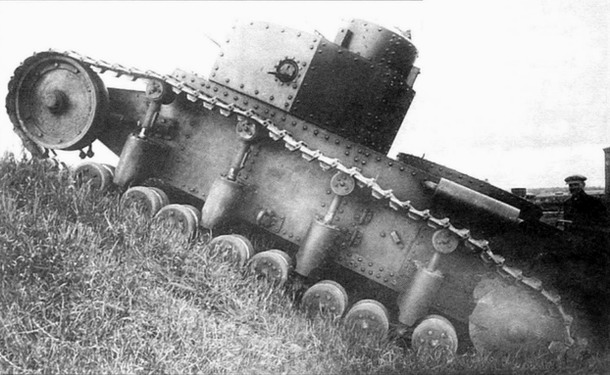
T-12 tank prototype, source: Flickr.com, Public domain, edited
At the rear of the hull was the engine compartment, housing an eight-cylinder petrol Hispano M6 engine with a maximum output of 180 hp. Also at the rear were fuel tanks of 240 litres total capacity and the gearbox, which provided four speeds for both forward and reverse travel. Exhaust pipes ran along both sides of the engine compartment. The powerplant gave the tank a top speed of around 26 km/h. The relatively modest fuel supply restricted the tank's range to just 80 km.
Early in 1930 trials of the prototype were conducted in the presence of senior army officials. The vehicle handled cross-country movement reasonably well, but its shortcomings also became apparent: the engine overheated, the tracks threw themselves, and the gearbox was unreliable. After the trials concluded, a decision was made to put the vehicle into series production — but only on condition that all identified deficiencies were first corrected. The process of correcting them led to such fundamental changes to the design that the vehicle which eventually entered production came to be regarded as an entirely new tank: the T-24. The T-12 prototype thus remained the first and only example of its kind.
Technical Specifications
Weight |
15.99 t |
Length |
6.28 m |
Width |
2.81 m |
Height |
2.95 m |
Engine |
M6 |
Maximum power |
180 hp |
Maximum speed |
26 km/h |
Fuel capacity |
240 l |
Range – road |
80 km |
Range – cross-country |
140 km |
Turret armour |
11–22 mm |
Hull armour |
12–22 mm |
Armament |
1 × gun, 45 mm 6 × machine gun, 7.62 mm |
Crew |
4 men |

ARTICLE
CONTENTS:
Reproducing text from the Tankist website without the written consent of the operator is prohibited.