TANK KV-85
the answer to the question "what to do with the KV tanks?"
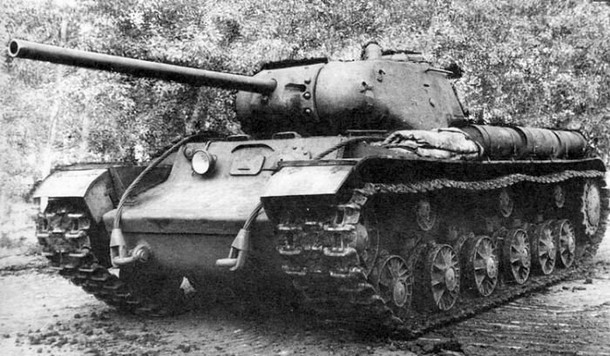
rejected prototype KV-1S-85, source: Topwar.ru with permission of the operator, edited
Origins
At the turn of 1942–43, Soviet officials were increasingly confronted with the question of what the Red Army actually needed heavy KV-1 tanks for, given that they carried the same armament as the medium T-34 tanks, which were far cheaper to produce and operate. The issue came to a head at the Battle of Kursk in the summer of 1943, which made it abundantly clear that the 76.2 mm guns of the KV-1 were inadequate for effective combat against the modern German Panther and Tiger tanks. Soviet designers therefore set to work urgently on rearming their heavy tanks. The first attempt consisted of simply fitting a more powerful gun into the turret of a production KV-1S. However, the new 85 mm gun severely restricted the interior space and made normal crew operation impossible. The prototype, designated KV-1S-85, was consequently rejected, and work on rearming the tank continued in a different direction.
Prototypes
If the KV-1 was to carry an 85 mm gun, it would also need a new, larger turret. And what could be more straightforward than using the turret developed for another new tank — the IS-1? Two test prototypes were therefore built on the KV-1S chassis. Both received the new larger turret, but each was fitted with a different gun type. The first prototype, designated Objekt 238, had the S-31 gun; the second, Objekt 239, had the D-5T. Both weapons were of 85 mm calibre and both had originally been developed for the IS-1 as well. Trials of both prototypes were conducted in July 1943, from which Objekt 239 with the D-5T gun emerged the winner. On 8 August 1943, Order No. 3891ss was issued approving series production of the new tank under the designation KV-85. Production itself began the following month in September.
Design Description
The tank's chassis was taken from the production KV-1S. On each side it consisted of six paired road wheels — all-steel, with pressed reinforcing ribs and small circular lightening holes. The wheels were evenly spaced, each independently suspended by a swing arm connected to a torsion bar. At the front of the running gear was a spoked idler wheel; at the rear a large toothed drive sprocket. Three evenly spaced return rollers supported the track from above.
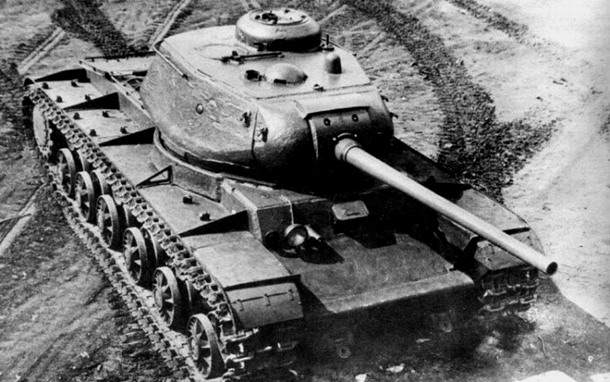
KV-85 — note the hull widening around the turret ring, source: Topwar.ru with permission of the operator, edited
The hull nose was formed by two plates meeting at a sharp angle. The lower plate was 60 mm thick; the upper was 50 mm thick and angled at 70°. Two heavy towing brackets were mounted on the lower plate. The front wall of the fighting compartment rose from the upper nose plate, angled at 30° and 75 mm thick. In the centre of the front wall was the driver's rectangular vision port, which in an emergency could be closed by a cover, leaving only a narrow slit for observation. The hull floor was 30 mm throughout, and the hull sides were 60 mm. In the left section of the fighting compartment roof was the circular driver's hatch, closed by a single-piece cover. The roof of the fighting compartment was 40 mm thick ahead of and just behind the turret, dropping to 30 mm over the engine compartment.
At the rear of the tank was the engine compartment. Immediately behind the turret was a service hatch, flanked by two smaller longitudinal air intake openings for the powerplant, protected by grilles. Behind these, two exhausts exited through the roof plate. Further towards the rear were two circular access hatches for the gearbox. The powerplant was a twelve-cylinder V-2 diesel engine delivering a maximum of 600 hp at 2,000 rpm. The gearbox provided five forward speeds and one reverse. The 46-tonne vehicle could reach a maximum road speed of 34 km/h.
The new fighting turret was larger than the original, requiring a partial modification to the hull to accommodate it — a clearly visible widening of the hull around the turret ring. As already noted, the KV-85's turret was taken from the then-in-development IS-1 heavy tank. It was cast, with all walls — except the roof — 100 mm thick. The turret roof was 30 mm (though some sources give 40 mm). In the front wall were the D-5T gun already mentioned and a coaxially mounted 7.62 mm DT machine gun. A further machine gun of the same type was installed in the right side of the turret's rear wall. Ammunition stowage comprised 70 rounds for the gun and 3,276 rounds in 52 drum magazines for the machine guns, plus 25 hand grenades and 30 signal flares. In the left front section of the turret roof was an MK-4 periscope; to its right was the fighting compartment ventilator outlet. To the left at the rear was the commander's cupola with a series of vision slots around its circumference, and a crew entry/exit hatch in its top. A further circular hatch was immediately to the right of the cupola. The side walls of the turret featured closeable pistol ports for personal weapons. External handrails for tank-riding infantry were welded onto the rear half of the turret.
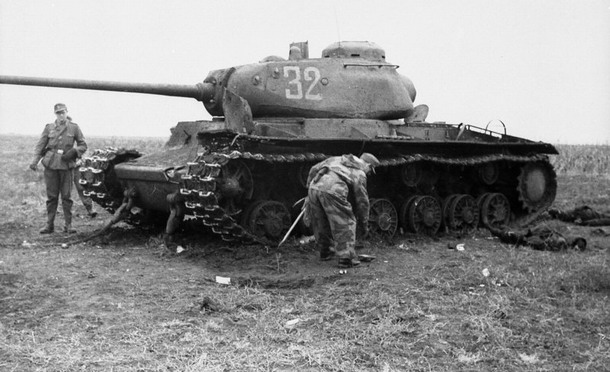
KV-85 destroyed by the Germans, source: Topwar.ru with permission of the operator, edited
The original hull machine gun — previously located to the left of the driver's vision port — was removed on the KV-85 and replaced by a fixed machine gun positioned on precisely the opposite side, immediately to the right of the driver's port. Operation of this gun became the driver's own responsibility. This allowed the KV-85 to operate with a crew of just four — unlike the KV-1S — consisting of the driver, commander, gunner and loader. The driver was the only crew member with a position inside the hull proper, at its forward end; the rest of the crew sat in the turret. When necessary, the tank commander also served as operator of the rear turret machine gun.
The 85 mm gun delivered the long-sought improvement in the KV's combat value. Unlike the original 76.2 mm weapon, the KV-85 could now engage German Panther and Tiger tanks effectively. It cannot be said, however, that it outclassed them entirely — the outcome of an engagement depended more on the overall situation, the element of surprise and, of course, the skill of the crews on both sides.
Only a very small number of KV-85s were produced — around 140 vehicles. The reason was the successful production of the new T-34-85 tanks, which carried the same gun while being faster and cheaper to manufacture and operate. In an attempt to justify continued production of the KV, Soviet designers began experimenting with fitting an even more powerful weapon. None of the further experimental tanks based on the KV-1 chassis reached series production, however. The prototypes that were built will be described in a separate section.
Only a single example of this tank has survived to the present day, and it can be seen in St. Petersburg. The tank museum at Kubinka displays the rejected KV-1S-85 prototype — a production KV-1S experimentally fitted with the 85 mm S-31 gun.
Technical Specifications
Weight |
46 t |
Length |
8.49 m |
Width |
3.25 m |
Height |
2.53 m |
Engine |
V-2 |
Maximum power |
600 hp |
Maximum speed |
34 km/h |
Hull armour |
front 50 – 75 mm sides 60 mm rear ?? mm |
Turret armour |
walls 100 mm roof 30 mm |
Armament |
1 × D-5T gun, 85 mm 3 × DT machine gun, 7.62 mm |
Crew |
4 men |

ARTICLE
CONTENTS:
Reproducing text from the Tankist website without the written consent of the operator is prohibited.