SU-12
self-propelled gun on a Ford chassis
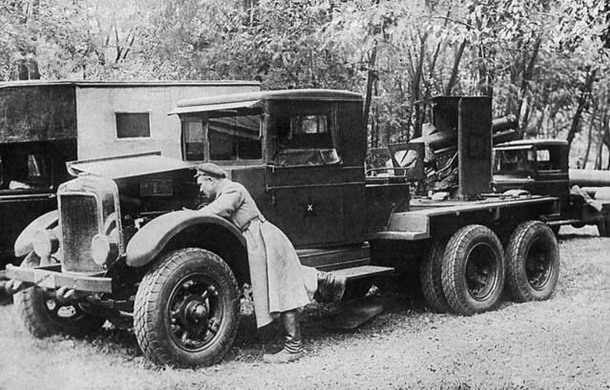
SU-12, source: Wikimedia, Public domain, edited
Origins
In the 1930s the Soviets made extensive use of Ford truck chassis manufactured in the Soviet Union under American licence. Several armoured cars were built on the Ford Timken and Ford AA chassis during this period, and it was only a matter of time before designers would attempt to use the same platform for other types of combat vehicle — including a self-propelled gun.
Design Description
This idea took shape in 1932 and was realised as a prototype within the same year. The new vehicle, built on the three-axle Ford Timken chassis, received the designation SU-12. The chassis was adopted with minimal modifications, retaining the civilian driver's cab. Immediately behind the cab was a box for artillery ammunition, though the number of rounds carried is unfortunately not recorded. At the rear of the vehicle a platform was constructed, on which a 76.2 mm Model 1927 gun was mounted on a rotating pedestal.
The gun was protected by a large shield covering its front and partially its sides, but this was the only armour on the entire vehicle. It is therefore clear that crew members — whether in the cab or at the gun — were afforded very little protection. Although the gun could traverse through a full circle, the driver's cab blocked direct forward fire in the direction of travel. The SU-12 carried no anti-infantry weapon, though this was not a particularly critical shortcoming given that the vehicle's intended role was to support advancing infantry from behind the front line, with no expectation of direct engagement with the enemy.
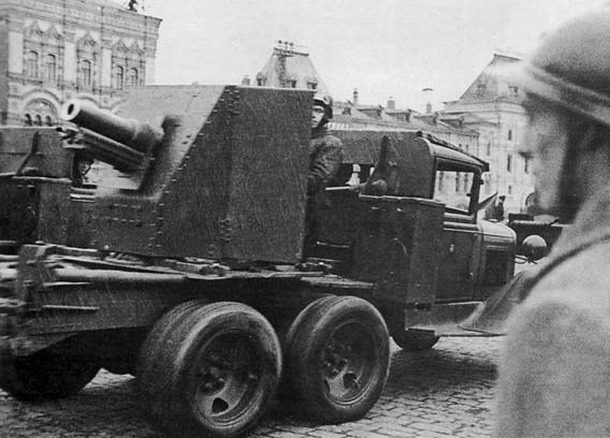
SU-12 during a military parade, source: Aviarmor.net with permission of the operator, edited
Trials showed that the self-propelled gun had some combat value but also numerous shortcomings. The wheeled chassis made it dependent on roads or only the lightest terrain, and its negligible armour protection ruled out any direct combat use. The chassis also suffered considerably from the stress and vibration of firing. Overall the vehicle had the unmistakable character of a stopgap solution. Despite this, a small production run of SU-12s was completed — partly on the Ford Timken chassis and partly on the GAZ-AA — and these vehicles served in the Red Army throughout the 1930s. It is unlikely that any of them saw action in the Second World War.
Technical Specifications
Weight |
6.4 t |
Engine |
GAZ-AA |
Maximum power |
40 hp |
Maximum speed |
40 km/h |
Armament |
1 × Model 1927 gun, 76.2 mm |
Crew |
3 men |

ARTICLE
CONTENTS:
Reproducing text from the Tankist website without the written consent of the operator is prohibited.