KSP-76
self-propelled gun on a wheeled chassis
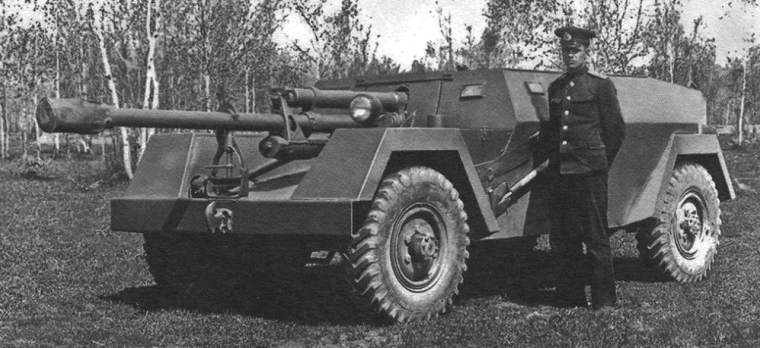
KSP-76, source: Flickr.com with permission of the publishing user, edited
Origins
After the Battle of Kursk in the summer of 1943, the tide on the Eastern Front turned decisively and Soviet forces began their relentless push westward. It was around this time that a shortage of fast self-propelled weapons capable of effectively pursuing a retreating enemy became apparent. The GAZ factory in Gorky (known both before and after as Nizhny Novgorod) therefore began development of a self-propelled gun on a fast wheeled chassis.
The project was led by a design team under Grachev, starting on 19 October 1943. A wooden mock-up was completed by the end of that year, and the first prototype was finished on 4 May 1944. The project was initially designated 63-SU, later GAZ-68, before receiving its final factory designation of KSP-76.
Design Description
The vehicle was based on a two-axle all-wheel-drive chassis derived from the GAZ-63 truck. All wheels were single (i.e. not doubled), fitted with standard pneumatic tyres, with steering on the front axle. On this chassis sat a straightforward but functional hull welded from flat steel plates of varying thickness. Between the angular front wheel mudguards was an open gap through which the gun barrel protruded, with the cab's front wall rising behind the mudguards.
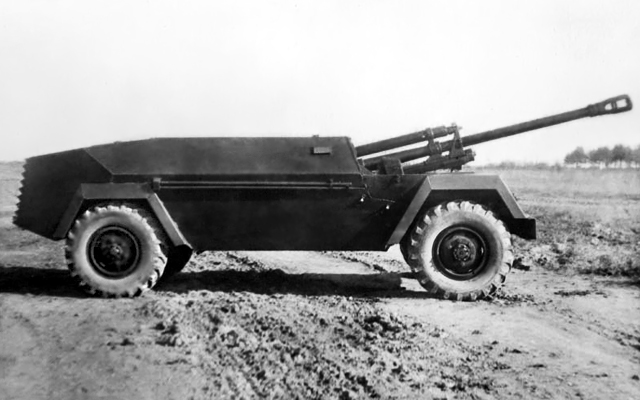
KSP-76, source: Flickr.com with permission of the publishing user, edited
The 76.2 mm ZIS-3 gun was mounted through the centre of the front wall. To its right was a rectangular vision port for the driver, and to the left a slightly smaller one for the gunner. Both crew members sat directly behind the front wall, one on each side of the gun. The driver operated the vehicle using a conventional steering wheel. The gunner also served as vehicle commander. Both men could observe to the sides through vision ports in the side walls. The third and final crew member was the loader, who sat at the rear behind the gun, offset slightly to the right of centre.
The fighting compartment was open-topped, which helped keep the vehicle's weight and the load on the wheeled chassis within acceptable limits. In poor weather the crew could shelter inside by pulling a waterproof canvas over the roof opening. Behind the fighting compartment was the engine bay, which was fully enclosed with armour including overhead cover. The engine bay roof sloped gently downward towards the rear and featured several access hatches for servicing the powerplant — a GAZ-11 engine developing a maximum of 85 hp. The engine bay also housed the gearbox and a 140-litre fuel tank. In the right half of the rear wall was an armoured louvred air intake for the engine.
The side walls of the cab were angled to improve ballistic protection, though even so the armour offered protection only against small arms fire and light shell splinters. The front wall was 16.5 mm thick, the side walls 7 mm, the engine bay roof 5 mm, the rear wall 7 mm and the hull floor just 4 mm. The KSP-76 had a combat weight of 5.34 tonnes and was capable of road speeds up to 77 km/h. A major advantage was its very low overall height of just 155 cm, making it a difficult target to spot and giving it a practical advantage of firing first in an engagement.
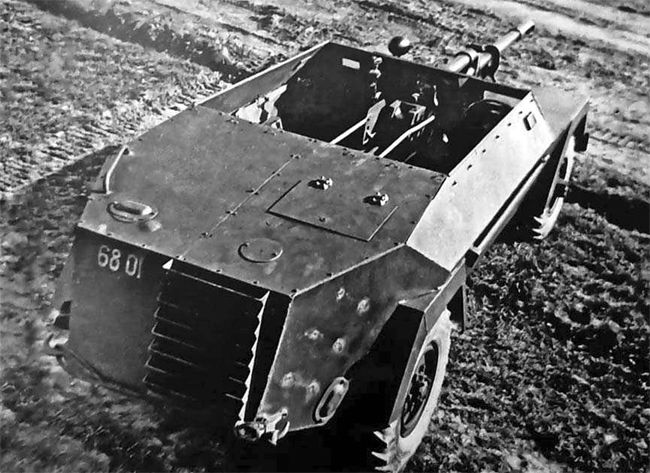
view into the KSP-76 fighting compartment, source: Aviarmor.net with permission of the operator, edited
The prototype was tested in November 1944, with trials including a self-propelled journey from Gorky to Moscow. Although the tests returned satisfactory results, it was ultimately decided not to proceed with series production. A considerable amount of time had passed since the original concept was conceived, and the situation on the front had changed fundamentally — a victorious end to the war was now almost within sight, and the need for such a vehicle was no longer pressing. The history of the KSP-76 thus closed with the completion of its one and only prototype.
Technical Specifications
Weight |
5.34 t |
Length |
6.35 m |
Width |
2.05 m |
Height |
1.55 m |
Engine |
GAZ-11 |
Maximum power |
85 hp |
Maximum speed |
77 km/h |
Range – road |
580 km |
Range – cross-country |
350 km |
Superstructure armour |
4 – 16 mm |
Armament |
1 × ZIS-3 gun, 76.2 mm |
Crew |
3 men |

ARTICLE
CONTENTS:
Reproducing text from the Tankist website without the written consent of the operator is prohibited.